Dualities and apparent contradictions in Carlos Drummond de Andrade’s poetry
DOI:
https://doi.org/10.5007/1984-784X.2017v17n28p106Abstract
From the analysis of the poems “Os ombros suportam o mundo” and “Mas viveremos”, both written by Carlos Drummond de Andrade and published in the books Sentimento do Mundo (1940) and A Rosa do Povo (1945), respectively, we can contemplate the apparent contradiction and duality in Drummond’s work as a problematic issue in many of his writings, and not only in one of his books. They also demonstrate the evolution of the poet’s voice. Furthermore, these poems may relate not only because of this apparent contradiction, but also because of the use of specific images that reveal a poetic procedure, which mobilizes a thematic pillar and suggests the possibility of a “yes” coexisting with a “no” in poetry. Besides, it is possible to draw a timeline between them, considering that both poems convey images from the past, present, and future, in a constant transition.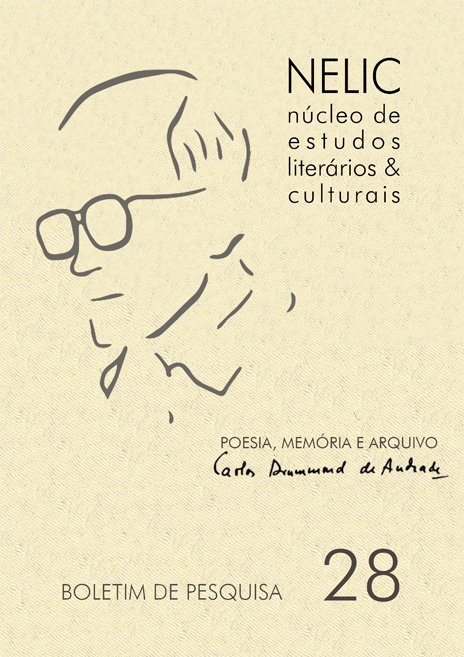
Downloads
Published
Issue
Section
License
Authors that publish in the Boletim de Pesquisa NELIC agree with the following terms:
a) Authors maintain copyrights and allow the journal to publish their work under the Creative Commons License BY-NC 4.0, which allows the sharing of the work, authorship recognition, and the initial publication in this journal.
b) Authors may sign additional separate contracts for non-exclusive distribution of the version of the work publish in this journal (e.g. publishing in an institutional repository or as book chapter).
c) Authors are authorized and encouraged to publish and share their work online (e.g. in institutional repositories, social media, personal pages, etc.) after the editorial process, once such actions may raise impact and citation of the published work.
d) Authors of approved works authorize the journal to reproduce their content in indexers, virtual libraries and the like.
e) The authors ensure that the submitted work for publishing is original, and are fully responsible for their content in case of any dispute by third-parties.


