
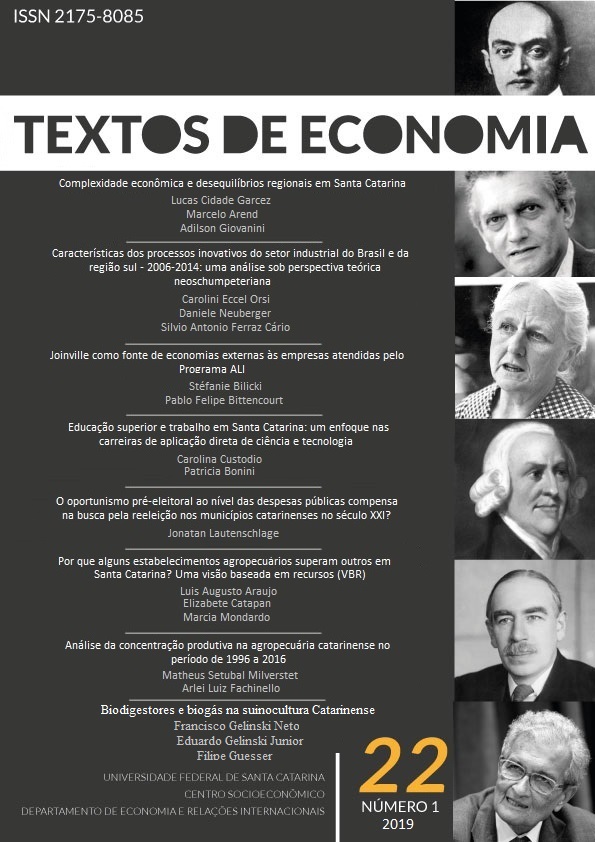
Educação superior e trabalho em Santa Catarina: um enfoque nas carreiras de aplicação direta de ciência e tecnologia
DOI:
https://doi.org/10.5007/2175-8085.2019v22n1p82Resumo
Este artigo apresenta resultados sobre a distribuição espacial e de gênero dos cursos de graduação ligados à ciência e tecnologia em Santa Catarina. Especificamente, enfoca-se na no perfil de gênero dos cursos de formação de aplicação direta de ciência e tecnologia agrupados acrônimo STEM (Science, Technology, Engeneering and Mathematics), tanto em termos de qualificação em nível superior quanto em termos de força de trabalho. A metodologia consiste em análise descritiva de dados primários e secundários sobre ensino universitário e mercado de trabalho. Utilizam-se dados primários de universidades catarinenses e dados secundários do censo universitário do Instituto Nacional de Estudos e Pesquisas Educacionais Anísio Teixeira (INEP), para o ano de 2015, quantificando os cursos de graduação em termos de pessoal entrante e pessoal formado em 2015.
Referências
ACOLA, Australian Council of Learned Academy. STEM: Countries Comparison. International Comparisons of Science Technology Engeneering and Mathematics (STEM) Education, 2013.
BARRO, R. J.; LEE, J. “International Data on Educational Attainment: Updates and Implications”. Oxford Economic Papers, v. 53, n. 3, jul, 2000.
BECKER, G. “Human capital”. 2nd ed. New York: Columbia University Press, 1975.
BEEDE, D.; JULIAN, T.; LANGDON, D.; MCKITTRICK, G., KHAN, K.; DOMS, M. “Women in STEM: a gender gap to innovation. Executive Summary”. US Department of Commerce, Economics and Statistics Administration (ESA), Issue Brief, 2011. CBO, Classificação Brasileira de Ocupações. Disponível em http://www.ocupacoes.com.br/tabela-completa-da-cbo. Acessado em/08/2018.
EUROMONITOR: International Report. Students of Tomorrow Global Trends Driving Demand for Education, 2018.
FEDGAZZET REGIONAL BUSINESS & ECONOMICS NEWSPAPER: “Getting to the Root of STEM”. The Federal Reserve Bank of Mineapolis, 2014.
GIUBERTI, A.C.; MENEZES-FILHO. N. “Discriminação de Rendimentos por Gênero: uma comparação entre o Brasil e os Estados Unidos”. Economia Aplicada, v. 8, n 3, p. 369-383, 2005.
GOLDBERG, J.D.; HILL,C. “Behind the Paying Gap”. AAUW Educational Foundation. Washington: DC, 2007.
GOLDIN, C. “The quiet revolution that transformed women´s employment, education and Family”. NBER, working paper, n. 11953, Cambridge, MA, 2006.
HALVORSEN, R.; PALMQUIST, R. “The interpretation of dummy variables in semilogarithmic equations”. The American Economic Review, v. 70, n.3, p. 474-475, 1980.
INEP, Instituto Nacional de Estudos e Pesquisas Educacionais Anisio Teixeira. Censo da Educação Superior, 2015. Disponível em http://portal.inep.gov.br/microdados. Acessada em 1/08/2018.
JANN, B. “The Blinder-Oaxaca decomposition for linear regression models”. The Stata Journal, v. 8, n. 4, pp. 453-479, 2008.
LANGDON, D.; MCKITTRICK, G.; BEEDE, D., KHAN, B.; DOMS, M. Good Jobs now and for the future. Economic & Statistic Administration – US Department of Commerce, 2011. (Disponível em http://www.esa.doc.gov/Reports/stem-good-jobs-now-and-future. Acesso em 1/08/2018.
OAXACA, R.; RANSOM, M. “On discrimination and the decomposition of wage differentials”. Journal of Econometrics, v. 61, n. 1, mar, p.5-21, 1994.
OAXACA, R. “Male-female wage differentials in urban labor markets”. International Economic Review, v. 62, n. 1, p. 693-709, 1973.
RAIS, Relação Anual de Informação Social. Disponível em http://ftp.mtps.gov.br/pdet/microdados/RAIS/2015. Acessado em 1/08/2018.
RESTUCCIA, D.; VANDENBROUCKE, G. “The Evolution of Education: A Macroeconomic Analysis”. University of Toronto, Department of Economics - working paper 388, 2010.
ROMER, P. M. “Endogenous Technological Change”. Journal of Political Economy, v. 98, n. 5, pp. S71-S102, 1990.
ROTHWELL, J. “The Hidden STEM Economy”. The Metropolitan Policy Program at Brookings, 2013.
Downloads
Publicado
Edição
Seção
Licença
Os Direitos Autorais para artigos publicados neste periódico são do autor. Em virtude de aparecerem nesta revista de acesso público, os artigos são de uso gratuito, com atribuições próprias, em aplicações educacionais, de exercício profissional e para gestão pública. A Revista adotou a licença Creative Commons - Atribuição-NãoComercial-SemDerivações 4.0 Internacional. Esta licença permite acessar, baixar (download), compartilhar o conteúdo dos artigos desde que citada a fonte, atribuindo os devidos créditos de autoria.

Esta obra está licenciada sob uma Licença Creative Commons - Atribuição-NãoComercial-SemDerivações 4.0 Internacional.

