
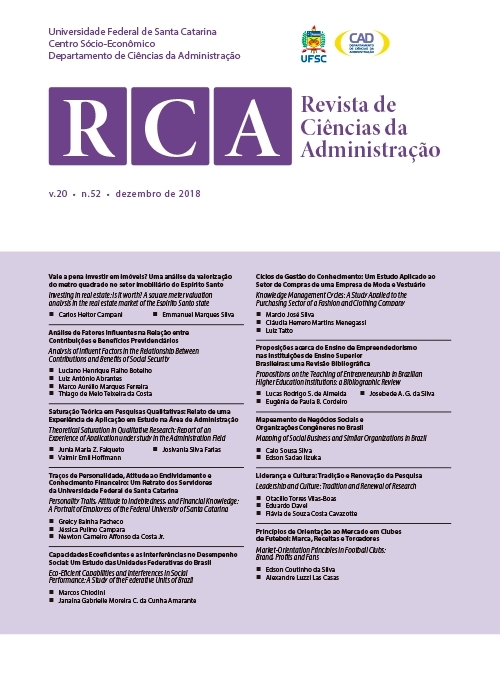
Personality traits, attitude to indebtedness, and finacial knowledge: a portrait of employess of the Federal University of Santa Catarina
DOI:
https://doi.org/10.5007/2175-8077.2018V20n52p54Abstract
The constant evidence of financial illiteracy, as well as the raising level of indebtedness of our society, means that these issues need to be better explored, so that alternatives to these problems can emerge. Thus, the objective of this work is to identify which aspects influence the attitude to indebtedness and the financial knowledge of employees of the Federal University of Santa Catarina (UFSC) considering variables of profile and personality traits. The main results, revealed through the application of a questionnaire, showed the predominance of personality traits "conscientiousness" and "openness to experience", in addition to indicating a high financial knowledge and low attitudes to indebtedness, which indicates a profile less susceptible to problems among employees. However, there are still those with a greater tendency to present low financial education and high attitude to indebtedness, and the other results are directed to the identification of these, which should be prioritized in training courses.References
ATKINSON, Adele; MESSY, Flore-Anne. Measuring financial literacy: results of the OECD infe pilot study. Papers on Finance, Insurance and Private Pensions - OECD Publishing, v. 15, p. 01-73, 2012.
BAEK, Eunyoung; HONG, Gong-Soog. Effects of family life-cycle stages on consumer debts. Journal of Family and Economic Issues, v. 25, n. 3, p. 359-385, 2004.
BANCO CENTRAL DO BRASIL - BACEN. Caderno de Educação Financeira – Gestão de Finanças Pessoais (Conteúdo Básico). Brasília: BCB, 2013. 72 p. Disponível em: <http://www.bcb.gov.br/pre/pef/port/caderno_cidadania_financeira.pdf>. Acesso em: 19 jun. 2016.
BERG, Carla ; SANEM, Julia; LUST, Katherine; AHLUWALIA, Jasjit; KIRC, Matthias; LAWRENCE, An; Health-related characteristics and incurring credit card debt as problem behaviors among college students. The Internet Journal of Mental Health, 2010.
BORGHANS, Lex; DUCKWORTH, Angela Lee; HECKMAN, James; WEEL, Bas Ter. The economics and psychology of personality traits. Journal of human Resources, v. 43, n. 4, p. 972-1059, 2008.
BORTOLI, Daiane de. Traços da personalidade, avaliação do perfil do investidor e teoria do prospecto: um estudo em finanças comportamentais para identificar o comportamento dos indivíduos em decisões mediante risco. 2016. 129 f. Dissertação (Mestrado) - Programa de Pós-graduação em Economia, Centro Socioeconômico, Universidade Federal de Santa Catarina, Florianópolis, 2016. Disponível em: <https://repositorio.ufsc.br/xmlui/bitstream/handle/123456789/167803/340643.pdf?sequence=1&isAllowed=y>. Acesso em: 09 jan. 2017.
BORTOLI, Daiane de; COSTA JR, Newton Carneiro Affonso da; GOULART, Marco Antônio De Oliveira Vieira. Teoria do prospecto, traços da personalidade, teste de reflexão cognitiva e avaliação do perfil do investidor: um estudo em finanças comportamentais. 2015.
BROWN, Sarah; TAYLOR, Karl. Household finances and the ‟Big Five‟ personality traits. Discussion Paper Series, Institute for the Study of Labor (IZA). n. 6191. 2011.
CAMPARA, Jéssica Pulino; VIEIRA, Kelmara Mendes; CERETTA, Paulo Sergio. Entendendo a atitude ao endividamento: fatores comportamentais e variáveis socioeconômicas o determinam?[doi: 10.21529/RECADM. 2016002]. Revista Eletrônica de Ciência Administrativa-RECADM, v. 15, n. 1, p. 5-24, 2016.
CLAUDINO, Lucas Paravizo; NUNES, Murilo Barbosa; SILVA, Fernanda Cristina da. Finanças Pessoais: um estudo de caso com servidores públicos. XII SEMEAD – Seminários em Administração, São Paulo, ago. 2009.
CONFEDERAÇÃO NACIONAL DO COMÉRCIO DE BENS, SERVIÇOS E TURISMO - CNC. Pesquisa de Endividamento e Inadimplência do Consumidor: maio de 2017. 2017. Disponível em: < http://cnc.org.br/central-do-conhecimento/pesquisas/economia/pesquisa-nacional-de-endividamento-e-inadimplencia-do--30?utm_source=akna&utm_medium=email&utm_campaign=Release+Peic+-+maio+2017>. Acesso em: 02 maio. 2017.
DAVIES, Emma; LEA, Stephen EG. Student attitudes to student debt. Journal of economic psychology, v. 16, n. 4, p. 663-679, 1995.
DELAVANDE, Adeline; ROHWEDDER, Susann.; WILLIS, Robert. Retirement Planning and the Role of Financial Literacy and Cognition. In: Michigan Retirement Research Center, Working Paper 2008-190. 2008.
DISNEY, Richard; GATHERGOOD, John. Financial Literacy ad Indebtedness: New Evidence for UK Consumers. 2011.
EYSENCK, Hans Jürgen; EYSENCK, Michael William.Personalidad y diferencias individuales. Madrid: Pirámides, 1987.
FECOMERCIOSC. Pesquisa de Endividamento e Inadimplência do Consumidor. Núcleo de Estudos Estratégicos Fecomércio-SC, dez. 2016. 2016. Disponível em: <http://www.fecomercio-sc.com.br/fmanager/fecomercio/pesquisas/arquivo538_1.pdf>. Acesso em: 24 jan. 2017.
FLORES, Silva Amélia Mendonça. Modelagem de equações estruturais aplicada à propensão ao endividamento: uma análise de fatores comportamentais. 2012. 192 f. Dissertação (Mestrado em Administração) – Universidade Federal de Santa Maria, 2012.
FLORES, Silvia Amélia Mendonça; VIEIRA, Kelmara Mendes, CORONEL, Daniel Arruda. Influência de fatores comportamentais na propensão ao endividamento. Revista Adm. FACES, v. 12, n. 2, p. 13-35, abr./jun., 2013.
GOSLING, Samuel; RENTFROW, Peter; SWANN JR., William. A very brief measure of the Big-Five personality domains. Journal of Research in Personality, 37, 504–528, 2003.
HAIR, Joseph; BLACK, William; BABIN, Barry; ANDERSON, Rolph. Multivariate Data Analyses. 7 ed. New Jersey: Pearson, 2010.
HOFMANN, Ruth Margareth; MORO Maria Lucia Faria. Educação matemática e educação financeira: perspectivas para a ENEF. Rev. Zetetiké – FE/Unicamp – v. 20, n. 38 – jul/dez, 2012.
HUANG, Jiekun; KISGEN, Darren J. Gender and corporate finance: Are male executives overconfident relative to female executives?. Journal of Financial Economics, v. 108, n. 3, p. 822-839, 2013.
KATONA, George. Psychological economics. New York: Elsevier, 1975.
KEESE, Matthias. Who Feels Constrained by High Debt Burdens? Subjective vs. Objective Measures of Household Indebtedness. RUHR Economic Papers, Germany, 2010.
KEESE, Matthias. Who feels constrained by high debt burdens? Subjective vs. objective measures of household debt. Journal of Economic Psychology, v. 33, n. 1, p. 125-141, 2012.
KLAPPER, Leora; LUSARDI, Annamaria; OUDHEUSDEN, Peter Van. Financial Literacy Around the World. Insights From The Standard & Poor’s Ratings Services Global Financial Literacy Survey, 2015.
LEA, Stephen Edmund Gillam; WEBLEY, Paul; LEVINE, Mark. The economic psychology of consumer debt. Journal of Economic Psychology, 14, p. 85–119, 1993.
LIRA, Caetano Correia. Crédito consignado: cenários no Brasil e diagnóstico na UFPE (2010 a 2012). Dissertação de Mestrado em Gestão Pública. 2014.
LIVINGSTONE, Sonia; LUNT Peter. Predicting personal debt and debt repayment: Psychological, social and economic determinants. Journal of Economic Psychology 13, 111-134, 1992.
LUCKE, Viviane Aparecida Caneppele; FILIPIN, Roselaine; VIEIRA, Euselia Paveglio; BRIZOLLA, Maria Margarete Baccin. Comportamento financeiro pessoal: um comparativo entre jovens e adultos de uma cidade da região noroeste do estado do RS. Anais dos Seminários em Administração, São Paulo, SP, Brasil, v. 17, 2014.
LUSARDI, Annamaria. The Importance of Financial Literacy and the Effectiveness of Financial Education. Financial Education and Investor Behavior Conference – Rio, dez, 2015. Disponível em: <http://pensologoinvisto.cvm.gov.br/wp-content/uploads/2015/12/AnnamariaLusardi-presentation-IEC2015.pdf>. Acesso em: 15 mai. 2016.
LUSARDI, Annamaria; MITCHELL,Olivia S. Financial literacy and retirement planning in the United States. Journal of Pension Economics and Finance, Cambridge University Press, v. 10, n. 04, p. 509-525, 2011.
LUSARDI, Annamaria; WALLACE, Dorothy. Financial literacy and quantitative reasoning in the high school and college classroom. Numeracy, v. 6, n. 2, 2013.
MILANEZ, Daniel Yabe. Finanças comportamentais no Brasil. Tese (Doutorado em Economia) - Universidade de São Paulo, 2003.
MOTTOLA, Gary. In our best interest: Women, financial literacy, and credit card behavior. Numeracy, v. 6, n. 2, art. 4, 2013.
MOURA, Ana Grisanti de. Impacto dos Diferentes Níveis de Materialismo na Atitude ao Endividamento e no Nível de Dívida para Financiamento do Consumo nas Famílias de Baixa Renda do Município de São Paulo. Dissertação (Mestrado em Administração de Empresas) - Escola de Administração de Empresas de São Paulo da Fundação Getulio Vargas, São Paulo, 2005.
NOGUEIRA, Roberto Carneiro Gurgel. Finanças comportamentais: diferenças na tolerância de risco entre cônjuges –
replicando uma pesquisa e propondo alternativas complementares. 2009. 80 p. Dissertação de Mestrado - Departamento de Administração, Pontifícia Universidade Católica do Rio de Janeiro, 2009.
OBSERVATÓRIO DE ENDIVIDAMENTO DOS CONSUMIDORES. Endividamento e sobreendividamento das famílias: Conceitos e estatísticas para sua avaliação. Centro de Estudos Sociais da Faculdade de Economia da Universidade de Coimbra, Fev, 2002.
OLIVATO, Herica; SOUZA, Patricia Keli. Botari. Endividamento: um estudo preliminar dos fatores contribuintes. Anais do Simpósio de Educação e do Encontro Científica de Educação da Unisalesiano, Lins/São Paulo, 2007.
ORGANIZAÇÃO PARA A COOPERAÇÃO E DESENVOLVIMENTO ECONÔMICO - OCDE. Recommendation on Principles and Good Practices for Financial Education and Awareness. Recommendation of the Council. Jul, 2005.
PONCHIO, Mateus Canniatti. The Influence of Materialism on Consumption Indebtedness in the Context of Low Income Consumers From the City of Sao Paulo. [Tese de Doutorado]. Escola de Administração de Empresas de São Paulo da Fundação Getúlio Vargas. São Paulo, p. 175. 2006.
POTRICH, Ani Caroline Grigion. Alfabetização Financeira: Integrando conhecimento, Atitude e comportamento financeiros. 2014. 178 f. Dissertação (Mestrado) – Curso de Curso de Mestrado do Programa de Pós-Graduação em Administração, Universidade Federal de Santa Maria.
POTRICH, Ani Caroline Grigion; VIEIRA, Kelmara Mendes; CAMPARA, Jéssica Pulino; FRAGA, Luana dos Santos; SANTOS, Luis Felipe de Oliveira. Educação Financeira dos Gaúchos: Proposição de uma Medida e Relação com as Variáveis Socioeconômicas e Demográficas. Sociedade, Contabilidade e Gestão, v. 9, n. 3, 2014.
RAMMSTEDT, Beatrice; JOHN, Oliver. Measuring personality in one minute or less: A 10-item short version of the Big Five Inventory in English and German. Journal of research in Personality, v. 41, n. 1, p. 203-212, 2007.
SAVOIA, José Roberto Ferreira; SAITO, André Taue; SANTANA, Flavia de Angelis. Paradigmas da educação financeira no Brasil. Revista de Administração pública, v. 41, n. 6, p. 1121-1141, 2007.
SILVA, Luiz Fernando; VIEIRA, Valter Afonso; DA SILVA FAIA, Valter. Fatores determinantes do endividamento e da inadimplência associados à propensão de falência da pessoa física. Análise–Revista de Administração da PUCRS, v. 23, n. 3, p. 207-221, 2015.
TOKUNAGA, Howard. The use and abuse of consumer credit: Application of psychological theory and research. Journal of Economic Psychology 14, 285-316, 1993
Downloads
Published
How to Cite
Issue
Section
License
The author must ensure:
- that there is complete consensus among all co-authors to approve the final version of the paper and its submission for publication.
- that their work is original, and if the work and/or words of others have been used, these have been duly acknowledged.
Plagiarism in all its forms constitutes unethical publishing behavior and is unacceptable. RCA reserves the right to use software or any other methods of plagiarism detection.
All submissions received for evaluation in the RCA journal are screened for plagiarism and self-plagiarism. Plagiarism identified in manuscripts during the evaluation process will result in the submission being archived. In the event of plagiarism being identified in a manuscript published in the journal, the Editor-in-Chief will conduct a preliminary investigation and, if necessary, retract it.
Authors grant RCA exclusive rights of first publication, with the work simultaneously licensed under the Creative Commons (CC BY) 4.0 International License.

Authors are authorized to enter into separate, additional contractual arrangements for the non-exclusive distribution of the version of the work published in this journal (e.g., publishing in an institutional repository, on a personal website, publishing a translation, or as a chapter in a book), with an acknowledgement of its authorship and initial publication in this journal.
This license grants any user the right to:
Share – copy, download, print, or redistribute the material in any medium or format.
Adapt – remix, transform, and build upon the material for any purpose, even commercially.
According to the following terms:
Attribution – You must give appropriate credit (cite and reference), provide a link to the license, and indicate if changes were made. You may do so in any reasonable manner, but not in any way that suggests the licensor endorses you or your use.
No additional restrictions – You may not apply legal terms or technological measures that legally restrict others from doing anything the license permits.
