
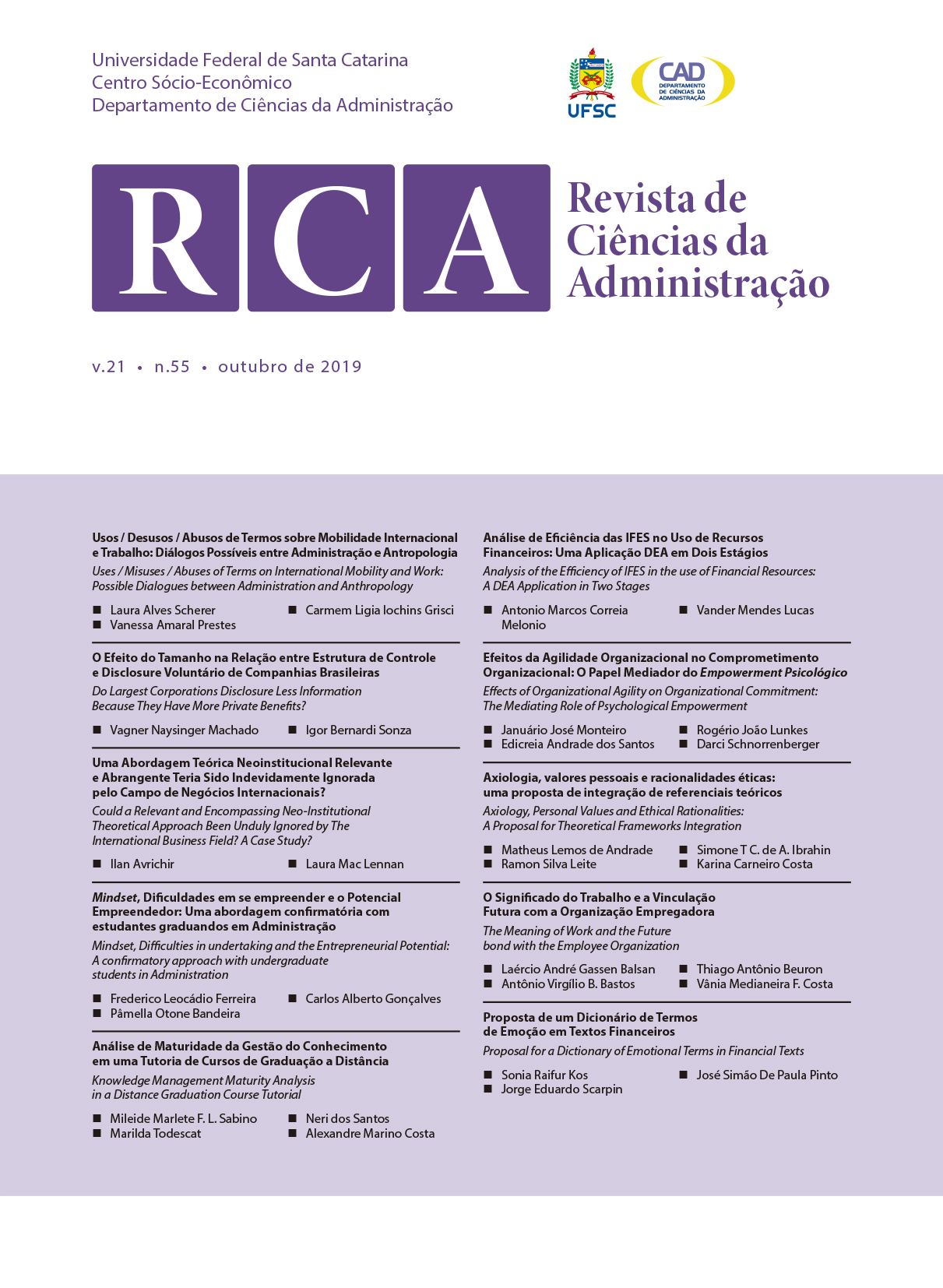
Efeitos da agilidade organizacional no comprometimento organizacional: o papel mediador do empowerment psicológico
DOI:
https://doi.org/10.5007/2175-8077.2019v21n55p101Resumo
Este estudo tem como objetivo examinar o efeito da agilidade organizacional no comprometimento organizacional mediado pelo empowerment psicológico. A pesquisa foi desenvolvida a partir de um questionário que levantou a percepção de 87 funcionários de um Hospital com atendimento de excelência a emergências cardiológicas de Florianópolis/SC. Foram testadas três hipóteses e os dados foram analisados a partir da técnica Equações Estruturais. Dentre os achados confirmou-se que há relação positiva significante entre a agilidade e o comprometimento organizacional, além de que o empowerment psicológico está diretamente relacionado com o comprometimento organizacional, e também medeia positivamente a relação entre a agilidade organizacional e o comprometimento. Infere-se que os funcionários percebem que sua organização é ágil, quando essa adota políticas que a permitem adaptar-se às mudanças no ambiente organizacional. Essa percepção aumenta o empowerment psicológico dos funcionários e consequentemente afeta o sentimento de apego com a organização.
Referências
ALAVI, Somaieh et al. Organic structure and organisational learning as the main antecedents of workforce agility. International Journal of Production Research, v. 52, n. 21, p. 6273-6295, 2014.
ALLEN, Natalie J.; MEYER, John P. The measurement and antecedents of affective, continuance and normative commitment to the organization. Journal of occupational psychology, v. 63, n. 1, p. 1-18, 1990.
ALMAHAMID, Soud; AWWAD, Abdulkareem; MCADAMS, Arthur C. Effects of organizational agility and knowledge sharing on competitive advantage: an empirical study in Jordan. International Journal of Management, v. 27, n. 3, p. 387, 2010.
AVOLIO, Bruce J. et al. Transformational leadership and organizational commitment: Mediating role of psychological empowerment and moderating role of structural distance. Journal of Organizational Behavior: The International Journal of Industrial, Occupational and Organizational Psychology and Behavior, v. 25, n. 8, p. 951-968, 2004.
BAHRAMI, Mohammad Amin et al. The mediating role of organizational learning in the relationship of organizational intelligence and organizational agility. Osong public health and research perspectives, v. 7, n. 3, p. 190-196, 2016.
BAIRD, Kevin M.; TUNG, Amy; YU, Yanjie. Employee organizational commitment and hospital performance. Health care management review, v. 44, n. 3, p. 206-215, 2019.
BIDO, Souza Diógenes; SILVA, Dirceu. SmartPLS 3: especificação, estimação, avaliação e relato. Administração: Ensino e Pesquisa, v. 20, n. 2, p. 1-31, 2019.
BIN JOMAH, Nouf. Psychological empowerment on organizational commitment as perceived by Saudi academics. World Journal of Education, v. 7, n. 1, p. 83-92, 2017.
Brislin, R. W. Back-translation for cross-cultural research. Journal of Cross-Cultural Psychology, 1(3), 185-216, 1970.
BROWN, Steve; BESSANT, John. The manufacturing strategy-capabilities links in mass customization and agile manufacturing-an exploratory study. International Journal of Operations & Production Management, v. 23, n. 7, p. 707-730, 2003.
CHARBONNIER-VOIRIN, Audrey. The development and partial testing of the psychometric properties of a measurement scale of organizational agility. Management, v. 14, n. 2, p. 120, 2011.
CONGER, Jay A.; KANUNGO, Rabindra N. The empowerment process: Integrating theory and practice. Academy of Management Review, v. 13, n. 3, p. 471-482, 1988.
CONWAY, Edel; MONKS, Kathy. Unravelling the complexities of high commitment: an employee‐level analysis. Human Resource Management Journal, v. 19, n. 2, p. 140-158, 2009.
FARAHANI, Alireza H.; SALIMI, Freidoon. The Study of the Relationship between Employees’ Empowerment and Organizational Agility: A Case Study in Azarab Industrial Company. European Online Journal of Natural and Social Sciences: Proceedings, v. 4, n. 1 (s), p. 067-1075, 2015.
FAUL, Franz et al. Statistical power analyses using G* Power 3.1: Tests for correlation and regression analyses. Behavior Research Methods, v. 41, n. 4, p. 1149-1160, 2009.
FORNELL, Claes; LARCKER, David F. Structural equation models with unobservable variables and measurement error: Algebra and statistics. 1981.
HAIR JR, Joseph F. et al. A primer on partial least squares structural equation modeling (PLS-SEM). Sage publications, 2016.
KIM, Beom Cheol et al. Motivational effects of empowerment on employees’ organizational commitment: a mediating role of management trustworthiness. Cornell Hospitality Quarterly, v. 53, n. 1, p. 10-19, 2012.
MATHIEU, John E.; ZAJAC, Dennis M. A review and meta-analysis of the antecedents, correlates, and consequences of organizational commitment. Psychological bulletin, v. 108, n. 2, p. 171, 1990.
MEHDIBEIGI, Najme; DEHGHANI, Masoud; MOHAMMAD YAGHOUBI, Nour. Customer knowledge management and organization's effectiveness: explaining the mediator role of organizational agility. Procedia-Social and Behavioral Sciences, v. 230, p. 94-103, 2016.
MOWDAY, Richard T.; PORTER, Lyman W.; STEERS, Richard M. Employee-organization linkages: The psychology of commitment, absenteeism, and turnover. Academic press, 2013.
NAFEI, Wageeh A. Organizational agility: The key to organizational success. International Journal of Business and Management, v. 11, n. 5, p. 296-309, 2016.
PORKIANI, Masood; HEJINIPOOR, Mohsen. Studying the relationship between organizational intelligence and organizational agility in supreme audit court. European Online Journal of Natural and Social Sciences: Proceedings, v. 2, n. 3 (s), p. 1052-1060, 2013.
SAMBAMURTHY, Vallabh; BHARADWAJ, Anandhi; GROVER, Varun. Shaping agility through digital options: Reconceptualizing the role of information technology in contemporary firms. MIS quarterly, p. 237-263, 2003.
SHAPIRA-LISHCHINSKY, Orly; TSEMACH, Sigalit. Psychological empowerment as a mediator between teachers’ perceptions of authentic leadership and their withdrawal and citizenship behaviors. Educational Administration Quarterly, v. 50, n. 4, p. 675-712, 2014.
SHARIFI, Hossein; ZHANG, Zhengwen. A methodology for achieving agility in manufacturing organisations: An introduction. International Journal of Production Economics, v. 62, n. 1-2, p. 7-22, 1999.
SPREITZER, Gretchen M. Psychological empowerment in the workplace: Dimensions, measurement, and validation. Academy of Management Journal, v. 38, n. 5, p. 1442-1465, 1995.
STEERS, Richard M. Antecedents and outcomes of organizational commitment. Administrative Science Quarterly, p. 46-56, 1977.
THANACOODY, P. R.; NEWMAN, A.; FUCHS, Sebastian. Affective commitment and turnover intentions among healthcare professionals: The role of emotional exhaustion and disengagement. The International Journal of Human Resource Management, v. 25, n. 13, p. 1841-1857, 2014.
THOMAS, Kenneth W.; VELTHOUSE, Betty A. Cognitive elements of empowerment: An “interpretive” model of intrinsic task motivation. Academy of Management Review, v. 15, n. 4, p. 666-681, 1990.
VANDENBERGHE, Christian; TREMBLAY, Michel. The role of pay satisfaction and organizational commitment in turnover intentions: A two-sample study. Journal of Business and Psychology, v. 22, n. 3, p. 275-286, 2008.
WANG, Yingyan. Examining organizational citizenship behavior of Japanese employees: A multidimensional analysis of the relationship to organizational commitment. The International Journal of Human Resource Management, v. 26, n. 4, p. 425-444, 2015.
YUSUF, Yahaya Y.; SARHADI, Mansoor; GUNASEKARAN, Angappa. Agile manufacturing: The drivers, concepts and attributes. International Journal of Production Economics, v. 62, n. 1-2, p. 33-43, 1999.
ZHANG, Z.; SHARIFI, H. Uma metodologia para alcançar agilidade nas organizações de manufatura. Revista Internacional de Operações e Gestão de Produção, v.20, n.4, p. 496-513, 2000.
Downloads
Publicado
Como Citar
Edição
Seção
Licença
O autor deve garantir:
- que haja um consenso completo de todos os coautores em aprovar a versão final do documento e sua submissão para publicação.
- que seu trabalho é original, e se o trabalho e/ou palavras de outras pessoas foram utilizados, estas foram devidamente reconhecidas.
Plágio em todas as suas formas constituem um comportamento antiético de publicação e é inaceitável. RCA reserva-se o direito de usar software ou quaisquer outros métodos de detecção de plágio.
Todas as submissões recebidas para avaliação na revista RCA passam por identificação de plágio e autoplágio. Plágios identificados em manuscritos durante o processo de avaliação acarretarão no arquivamento da submissão. No caso de identificação de plágio em um manuscrito publicado na revista, o Editor Chefe conduzirá uma investigação preliminar e, caso necessário, fará a retratação.
Os autores cedem à RCA os direitos exclusivos de primeira publicação, com o trabalho simultaneamente licenciado sob a Licença Creative Commons (CC BY) 4.0 Internacional.

Os autores têm autorização para assumir contratos adicionais separadamente, para distribuição não exclusiva da versão do trabalho publicada neste periódico (ex.: publicar em repositório institucional, em site pessoal, publicar uma tradução, ou como capítulo de livro), com reconhecimento de autoria e publicação inicial neste periódico.
Esta licença permite que qualquer usuário tenha direito de:
Compartilhar – copiar, baixar, imprimir ou redistribuir o material em qualquer suporte ou formato.
Adaptar – remixar, transformar e criar a partir do material para qualquer fim, mesmo que comercial.
De acordo com os seguintes termos:
Atribuição – Você deve dar o crédito apropriado (citar e referenciar), prover um link para a licença e indicar se mudanças foram feitas. Você deve fazê-lo em qualquer circunstância razoável, mas de maneira alguma que sugira ao licenciante apoiar você ou o seu uso.
Sem restrições adicionais – Você não pode aplicar termos jurídicos ou medidas de caráter tecnológico que restrinjam legalmente outros de fazerem algo que a licença permita.
