
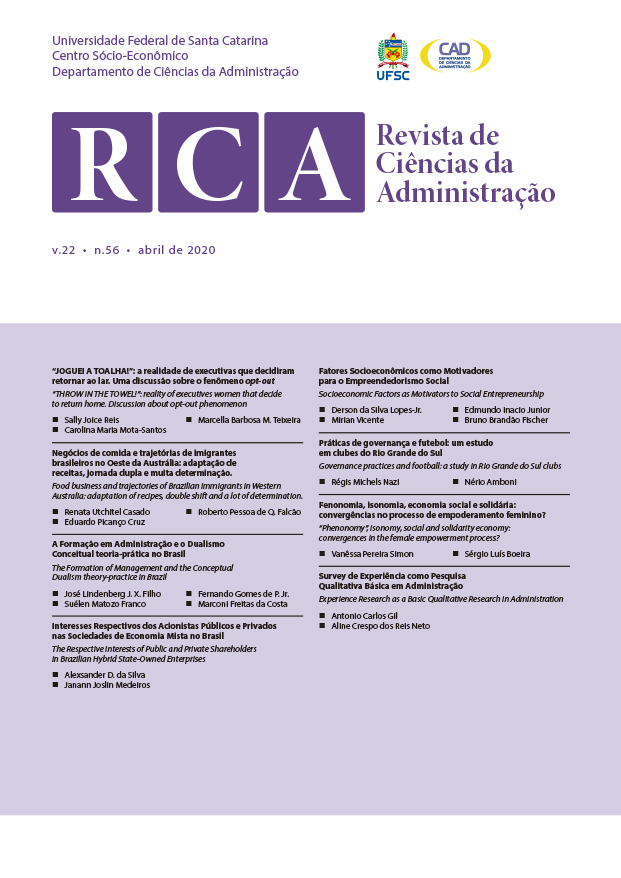
“Phenonomy”, isonomy, social and solidarity economy: convergences in the female empowerment process?
DOI:
https://doi.org/10.5007/2175-8077.2020.e67041Abstract
The purpose of this article is to show, from the theory of the delimitation of social systems and the paraeconomic paradigm, an articulation between the notions of isonomy and phenonomy with the possibilities presented by the social and solidarity economy, highlighting in this articulation the empowerment of women. The idea is maintained that women, in the construction of their history of empowerment, have a phenonomic trajectory, that consolidates in the isonomic spaces. The phenonomic trajectory can be understood as emancipation of the individual in the sense of breaking with the behavioral syndrome, in a movement that approaches the phenonomic enclave. In addition, social movements, specifically in this case social and solidarity economy, can be perceived as spaces that privilege the collective, without losing individuality, that is, with isonomic characteristics in conjunction with the phenonomic trajectories, spaces that catalyze the process of female empowerment.
References
ACOSTA, Alberto. O bem viver: uma oportunidade para imaginar outros mundos. São Paulo: Autonomia Literária, Elefante, 2016. 264 p.
ANDION, Carolina; SERVA, Maurício; LÉVESQUE, Benoît. O debate sobre a economia plural e sua contribuição para o estudo das dinâmicas de desenvolvimento territorial sustentável. Eisforia, Florianópolis, v. 1, n. 1, p. 199-221, jan./jul. 2003.
ARAÚJO, Geyson E. F. Caracterização da economia solidária à luz do ambiente isonômico de Guerreiro Ramos: um estudo no grupo mulheres decididas a vencer. 2010. Dissertação (Mestrado em Administração) – UFRG, Natal, 2010.
AZEVÊDO, Ariston. A sociologia antropocêntrica de Alberto Guerreiro Ramos. Tese (Doutorado em Sociologia Política). UFSC; Florianópolis, 2006. 311p.
AZEVÊDO, Ariston; ALBERNAZ, Renata O. A Paraeconomia como modelo e paradigma para a análise e a formulação de políticas públicas: o resgate de uma possibilidade. EmTese, Vol. 2, n. 1 (2), p. 20-32, jan./jun., 2004.
BESEN, Fernanda. As fenonomias e a economia plural: o olhar da gestão na dimensão territorial. 2010. Dissertação (Mestrado em Administração) – UFSC, Florianópolis, 2010.
BULGACOV, Yara L. M.; CASTIGLIA, Felipe Z. Dialogando com os princípios de uma abordagem substantiva das organizações. Revista Psicologia, Organizações e Trabalho, v. 3, n. 2, p. 1-34, jul./dez 2003.
CATTANI, Antonio; LAVILLE, Jean-Louis; GAIGER, Luiz; HESPANHA, Pedro (Coord.). Dicionário internacional da outra economia. Almedina; CES; Coimbra; São Paulo, 2009. 344p.
COSTA, Pedro D. A.; CARRION, Rosinha. D. S. M. Situando a Economia Solidária no campo dos estudos organizacionais. Otra Economia, v. III, n. 4, p. 66–81, 2009.
DOWBOR, Ladislau. A era do capital improdutivo: a nova arquitetura do poder, sob dominação financeira, sequestro da democracia e destruição do planeta. Outras Palavras/Autonomia Literária: São Paulo, 2017.
FRANÇA FILHO, Genauto. Esclarecendo terminologias: as noções de terceiro setor, economia social, economia solidária e economia popular em perspectiva. Revista de Desenvolvimento Econômico, ano II, n. 5, p. 52-60, dez. 2001.
FRANÇA FILHO, Genauto. Terceiro Setor, economia social, economia solidária e economia popular. Bahia Análise & Dados, v. 12, n. 1, p. 9-19, jun. 2002.
FRANÇA FILHO, Genauto. A temática da economia solidária e suas implicações originais para o campo dos estudos organizacionais. RAP, Rio de Janeiro, v. 37, n. 1, p. 11-31, jan./fev. 2003.
FRANÇA FILHO, Genauto. Decifrando a noção de paraeconomia em Guerreiro Ramos: a atualidade de sua proposição. O&S, v. 17, n. 52, p. 175–197, jan-mar, 2010.
FRIEDMANN, John. Empowerment: the politics of alternative development. Massachusetts, USA: Blackwell, 1992.
GAIGER, Luiz I. Empreendimentos econômicos solidários. In: CATTANI, Antônio David (Org.). A outra economia. Porto Alegre: Veraz, 2003.
GAIGER, Luiz I. Antecedentes e expressões atuais da economia solidária. Revista Crítica de Ciências Sociais, n. 84, p. 81-99, mar. 2009.
GUERREIRO RAMOS, Alberto. The new science of organizations: a reconceptualization of the wealth of nations. University of Toronto Press: Toronto, Buffalo, London, 1981.
GUERREIRO RAMOS, Alberto. A modernização em nova perspectiva: em busca do modelo de possibilidades. In: HEIDEMANN; F. G.; SALM, J. F. (Orgs.) Políticas públicas e desenvolvimento: bases epistemológicas e modelos de análise. Brasília: Ed. UnB, 2009.
HOROCHOVSKI, Rodrigo R.; MEIRELLES, Gisele. Problematizando o conceito de empoderamento. In: SEMINÁRIO NACIONAL MOVIMENTOS SOCIAIS, PARTICIPAÇÃO E DEMOCRACIA, 2007. Anais..., Florianópolis, 2007. p. 485 - 506.
JACOMETTI, Marcio et al. Fenonomia e isonomia no contexto da modernidade: possibilidades de um novo modelo social para as organizações. Revista Economia & Gestão. v. 13, n. 32, p. 87-106, maio/ago/2013.
LAGARDE, Marcela. Identidad de género y derechos humanos. In: STEIN, G.; PACHECO, L.; PACHECO, S. (Comps.). Estudios básicos de derechos humanos. San José: Instituto Interamericano de Derechos Humanos, 1996
LAVILLE, Jean L.; GAIGER, Luiz I. Economia solidária. In: HESPANHA et al. (Coord.). Dicionário internacional da outra economia. Coimbra: Almedina, 2009.
LEÓN, Magdalena de. Empoderamento: relaciones de las mujeres con el poder. Estudos Feministas, v. 8, n. 2, 2009.
LISBOA, Armando de M. Economia solidária e autogestão: imprecisão e limites, RAE, p. 109-115, jul./set. 2009.
LISBOA, Teresa K. Empoderamento de mulheres e participação na gestão de políticas públicas. In: SEMINÁRIO NACIONAL MOVIMENTOS SOCIAIS, PARTICIPAÇÃO E DEMOCRACIA, 2007. Anais... Florianópolis, 2007. p. 640-652.
LISBOA, Teresa K. Empoderamento como estratégia de inclusão das mulheres nas políticas sociais. In: FAZENDO GÊNERO, 2008, Florianópolis. Anais...., 2008. p. 1 -6.
MATURANA, Humberto; VENDEN-ZOLLER, Gerda. Amar e brincar: fundamentos esquecidos do humano do patriarcado à democracia. São Paulo: Palas Athena, 2004.
MAZZEI, Bianca B.; CRUBELLATE, João Marcelo. Autogestão em empreendimentos econômicos solidários: um estudo comparativo de casos em cooperativas de reciclagem de lixo de Maringá/PR. Revista Inteligência Organizacional, v. 1, n. 1, jul./dez. 2011.
MORIN, Edgar. O método 6. Ética. Porto Alegre: Sulina, 2005.
MORIN, Edgar. A via para o futuro da humanidade. Bertrand Brasil: Rio de Janeiro, 2013.
OLIVEIRA, Adriana. L. de. A trajetória de empoderamento de mulheres na economia solidária. Revista Gênero, v. 05, n. 2, p. 1–14, 2013
PAULA, Ana Paula. P. de. Guerreiro Ramos: resgatando o pensamento de um sociólogo crítico das organizações. O&S, v. 14, n. 40, p. 169-188, jan./mar. 2007.
POLANYI, Karl. A grande transformação: as origens de nossa época. Rio de Janeiro: Campus, 2000.
QUIJANO, Aníbal. “Bien vivir”: entre el “desarrollo” y la des/colonialidad del poder. Viento Sur, n. 122, mayo, año XXI, p. 46-56, 2012.
SALGADO, Francisco. Sumaq Kawsay: the birth of a notion? Cadernos EBAPE, v. 8, n. 2, paper 1, jun, p. 199-208, Rio de Janeiro, 2010.
SARDENBERG, Cecília. M. B. Conceituando “empoderamento” na perspectiva feminista. NEIM/UFBA, p. 1–12, 2009
SAUVAGE, Patrice. Synthèse. In: OCDE: réconcilier l’économique et le social – vers une économie plurielle. Paris: OCDE, 1996.
SCOTT, Joan. W. O enigma da igualdade. Estudos Feministas, Florianópolis, v. 1, n. 13, p. 216, jan./abr. 2005
SEN, Amartya. K. Desenvolvimento como liberdade. São Paulo: Companhia das Letras, 2000.
TONET, Rogério. S. Fenonomias, economia plural e desenvolvimento local: um estudo na feira de artesanato do Largo da Ordem em Curitiba – PR. 2004. Dissertação (Mestrado em Administração) – UFPR, Curitiba, 2004.
Downloads
Published
How to Cite
Issue
Section
License
The author must ensure:
- that there is complete consensus among all co-authors to approve the final version of the paper and its submission for publication.
- that their work is original, and if the work and/or words of others have been used, these have been duly acknowledged.
Plagiarism in all its forms constitutes unethical publishing behavior and is unacceptable. RCA reserves the right to use software or any other methods of plagiarism detection.
All submissions received for evaluation in the RCA journal are screened for plagiarism and self-plagiarism. Plagiarism identified in manuscripts during the evaluation process will result in the submission being archived. In the event of plagiarism being identified in a manuscript published in the journal, the Editor-in-Chief will conduct a preliminary investigation and, if necessary, retract it.
Authors grant RCA exclusive rights of first publication, with the work simultaneously licensed under the Creative Commons (CC BY) 4.0 International License.

Authors are authorized to enter into separate, additional contractual arrangements for the non-exclusive distribution of the version of the work published in this journal (e.g., publishing in an institutional repository, on a personal website, publishing a translation, or as a chapter in a book), with an acknowledgement of its authorship and initial publication in this journal.
This license grants any user the right to:
Share – copy, download, print, or redistribute the material in any medium or format.
Adapt – remix, transform, and build upon the material for any purpose, even commercially.
According to the following terms:
Attribution – You must give appropriate credit (cite and reference), provide a link to the license, and indicate if changes were made. You may do so in any reasonable manner, but not in any way that suggests the licensor endorses you or your use.
No additional restrictions – You may not apply legal terms or technological measures that legally restrict others from doing anything the license permits.
