
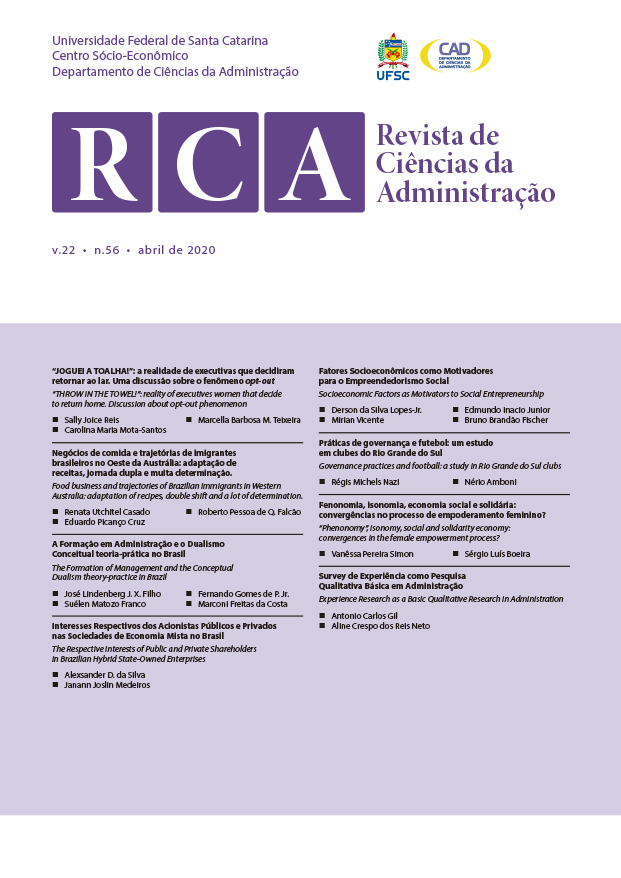
Survey de Experiência como Pesquisa Qualitativa Básica em Administração.
DOI:
https://doi.org/10.5007/2175-8077.2020.e74026Resumo
O survey de experiência tem sido utilizado no campo da Administração – provavelmente mais do que nas demais áreas do conhecimento - com propósitos profissionais e acadêmicos. Constitui um dos procedimentos mais recomendados na realização de estudos exploratórios, já que sua utilidade é amplamente reconhecida para proporcionar uma nova visão do problema proposto, para sugerir hipóteses de pesquisa e para aprimorar os procedimentos a serem adotados em pesquisas futuras. Constata-se, no entanto, que os manuais de pesquisa em Administração, embora recomendando sua utilização em estudos exploratórios, não enfatizam suas bases epistemológica, teóricas e metodológicas. Assim, elaborou-se o presente ensaio que tem como objetivo apresentar o survey de experiência como modalidade de pesquisa qualitativa básica e esclarecer acerca dos procedimentos adotados em seu planejamento e execução.
Referências
ACKOFF, Russell L. The design of social research. Chicago: University of Chicago Press, 1953.
BABBIE, Earl R. The basics of social research. Cengage learning, 2017
BRYMAN, Alan. Social research strategies. Social research methods, p. 3-24, 2008.
BULMER, Martin et al. (Ed.). The social survey in historical perspective, 1880-1940. Cambridge University Press, 1991.
CAELLI, Kate; RAY, Lynne; MILL, Judy. ‘Clear as mud’: toward greater clarity in generic qualitative research. International journal of qualitative methods, v. 2, n. 2, p. 1-13, 2003.
COOPER, Donald R.; SCHINDLER, Pamela S. Business research methods. 12 ed. New York: McGraw-Hill/Irvin, 2014.
CRESWELL, John W. Investigação Qualitativa e Projeto de Pesquisa-: Escolhendo entre Cinco Abordagens. Penso Editora, 2014.
CRESWELL, John W.; POTH, Cheryl N. Qualitative inquiry and research design: Choosing among five approaches. Sage publications, 2016.
CROTTY, Michael. The foundations of social research: Meaning and perspective in the research process. Sage, 1998.
DENZIN, Norman K.; LINCOLN, Yvonna S. Introduction: The discipline and practice of qualitative research. 2008.
DENZIN, Norman K. The SAGE Handbook of qualitative research. Thousand Oaks, 2017.
GIL, Antonio Carlos. Métodos e técnicas de pesquisa social. São Paulo: Atlas, 2020.
GLASER, Barney G.; STRAUSS, Anselm L. Discovery of grounded theory. Mill Valley. CA: Sociology, 1967.
GOODE, William J.; HATT, Paul K. Methods in social research. 1932.
GUEST, Greg; MACQUEEN, Kathleen M.; NAMEY, Emily E. Applied thematic analysis. Sage Publications, 2011.
JAHODA, Marie; DEUTSCH, Morton; COOK, Stuart W. Research methods in social relations with special reference to prejudice. Vol. 1, Basic processes. Vol. 2, Selected techniques. 1951.
JUDD, Charles M., KIDDER, Louise H., SMITH, Eliot R. Research methods in social relations. New York: Holt, Rinehart, Winston, 1991.
KIDDER, Louise H.; JUDD, Charles M. Research methods in social relations. New York: Holt, Rinehart, Winston, 1986.
KUHN, Thomas S. The Structure of Scientific Revolutions. 3rd edn (1962, 1970, 1996). University of Chicago Press, 1996.
LANCY, David F. Qualitative research in education: An introduction to the major traditions. 1993.
LAVELA, Sherri L.; GALLAN, Andrew. Evaluation and measurement of patient experience. Patient Experience Journal, v. 1, n. 1, p. 28-36, 2014.
LAVRAKAS, Paul J. et al. (Ed.). Experimental Methods in Survey Research: Techniques that Combine Random Sampling with Random Assignment. John Wiley & Sons, 2019.
LE PLAY, Frédéric. Les ouvriers européens [European workers]. Tours, France: Alfred Mame, 1855.
LINCOLN, Yvonna S.; LYNHAM, Susan A.; GUBA, Egon G. Paradigmatic controversies, contradictions, and emerging confluences, revisited. The Sage handbook of qualitative research, v. 5, p. 108-150, 2018.
MARUYAMA, Geoffrey; RYAN, Carey S. Research Methods in Social Relations. Hoboken: John Wiley & Sons, 2014.
MERRIAM, Sharan B.; TISDELL, Elizabeth J. Qualitative research: A guide to design and implementation. John Wiley & Sons, 2015.
MORSE, Janice M. Designing funded qualitative research. 1994.
MOUSTAKAS, Clark. Phenomenological research methods. Sage publications, 1994.
PATTON, Michael Q. Qualitative research & evaluation methods: Integrating theory and practice (4th ed.). Thousand Oaks, CA: Sage, 2014.
PUNCH, Keith F.; OANCEA, Alis. Introduction to research methods in education. Sage, 2014.
ROSSITER, John R. Measurement for the social sciences: The C-OAR-SE method and why it must replace psychometrics. Springer Science & Business Media, 2010.
RUSSEL, Sarah. (2013). Patients’ Experiences: Top heavy with research, Research matters. Disponível em: http://www.research-matters.com.au/publications/PatientsExperiencesReview.pdf. Acesso em: 5 jan. 2020.
SALDAÑA, Johnny. Fundamentals of qualitative research. OUP USA, 2011.
SELLTIZ, Claire; JAHODA, Marie; DEUTSCH, Morton; COOK, Stuart W. Research methods in social relations. New York: Henry Holt, 1959.
STEBBINS, Robert A. Exploratory research in the social sciences. Sage, 2001.
STRAUSS, Anselm; CORBIN, Juliet. Basics of qualitative research. Sage publications, 1990.
TESCH, R. Qualitative Research: Analysis Types and Software Tools. Bedford. 1990.
ZIKMUND, William G.; GRIFFIN, Mitch. BABIN, Barry J.; CARR, Jon C. Business research methods, 9 ed. Mason: Cengage Learning, 2013.
Downloads
Publicado
Como Citar
Edição
Seção
Licença
O autor deve garantir:
- que haja um consenso completo de todos os coautores em aprovar a versão final do documento e sua submissão para publicação.
- que seu trabalho é original, e se o trabalho e/ou palavras de outras pessoas foram utilizados, estas foram devidamente reconhecidas.
Plágio em todas as suas formas constituem um comportamento antiético de publicação e é inaceitável. RCA reserva-se o direito de usar software ou quaisquer outros métodos de detecção de plágio.
Todas as submissões recebidas para avaliação na revista RCA passam por identificação de plágio e autoplágio. Plágios identificados em manuscritos durante o processo de avaliação acarretarão no arquivamento da submissão. No caso de identificação de plágio em um manuscrito publicado na revista, o Editor Chefe conduzirá uma investigação preliminar e, caso necessário, fará a retratação.
Os autores cedem à RCA os direitos exclusivos de primeira publicação, com o trabalho simultaneamente licenciado sob a Licença Creative Commons (CC BY) 4.0 Internacional.

Os autores têm autorização para assumir contratos adicionais separadamente, para distribuição não exclusiva da versão do trabalho publicada neste periódico (ex.: publicar em repositório institucional, em site pessoal, publicar uma tradução, ou como capítulo de livro), com reconhecimento de autoria e publicação inicial neste periódico.
Esta licença permite que qualquer usuário tenha direito de:
Compartilhar – copiar, baixar, imprimir ou redistribuir o material em qualquer suporte ou formato.
Adaptar – remixar, transformar e criar a partir do material para qualquer fim, mesmo que comercial.
De acordo com os seguintes termos:
Atribuição – Você deve dar o crédito apropriado (citar e referenciar), prover um link para a licença e indicar se mudanças foram feitas. Você deve fazê-lo em qualquer circunstância razoável, mas de maneira alguma que sugira ao licenciante apoiar você ou o seu uso.
Sem restrições adicionais – Você não pode aplicar termos jurídicos ou medidas de caráter tecnológico que restrinjam legalmente outros de fazerem algo que a licença permita.
