
Perceptions of professional women in the productive restructuring scenario: persistence of a limited emancipation?
DOI:
https://doi.org/10.5007/2175-8069.2008v10n20p139Abstract
This research aims to evaluate how social gender representations have influenced the professional lives of women within the current context denoted by productive restructuring. With that in mind, a descriptive study was carried out in an organization of the telecommunication equipment sector. The data gathering technique adopted included semi structural interviews. The interviewees had to work double shifts. Gender based professional activities division could be verified in this organization and was, in part, a consequence of aspects that are inherent to its organizational culture. A phenomenon known as “glass ceiling”; a subtle barrier which hinders women’s professional growth ; could also be observed. As for autonomy and influence power, the advent of productive restructuring has brought no significant modifications to most of the women who were interviewd.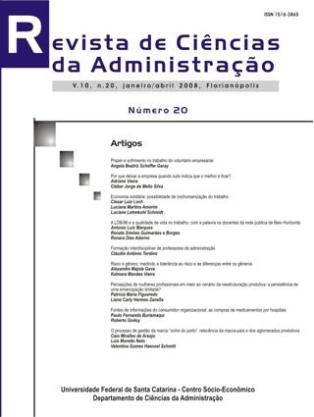
Downloads
Published
How to Cite
Issue
Section
License
The author must ensure:
- that there is complete consensus among all co-authors to approve the final version of the paper and its submission for publication.
- that their work is original, and if the work and/or words of others have been used, these have been duly acknowledged.
Plagiarism in all its forms constitutes unethical publishing behavior and is unacceptable. RCA reserves the right to use software or any other methods of plagiarism detection.
All submissions received for evaluation in the RCA journal are screened for plagiarism and self-plagiarism. Plagiarism identified in manuscripts during the evaluation process will result in the submission being archived. In the event of plagiarism being identified in a manuscript published in the journal, the Editor-in-Chief will conduct a preliminary investigation and, if necessary, retract it.
Authors grant RCA exclusive rights of first publication, with the work simultaneously licensed under the Creative Commons (CC BY) 4.0 International License.

Authors are authorized to enter into separate, additional contractual arrangements for the non-exclusive distribution of the version of the work published in this journal (e.g., publishing in an institutional repository, on a personal website, publishing a translation, or as a chapter in a book), with an acknowledgement of its authorship and initial publication in this journal.
This license grants any user the right to:
Share – copy, download, print, or redistribute the material in any medium or format.
Adapt – remix, transform, and build upon the material for any purpose, even commercially.
According to the following terms:
Attribution – You must give appropriate credit (cite and reference), provide a link to the license, and indicate if changes were made. You may do so in any reasonable manner, but not in any way that suggests the licensor endorses you or your use.
No additional restrictions – You may not apply legal terms or technological measures that legally restrict others from doing anything the license permits.
