
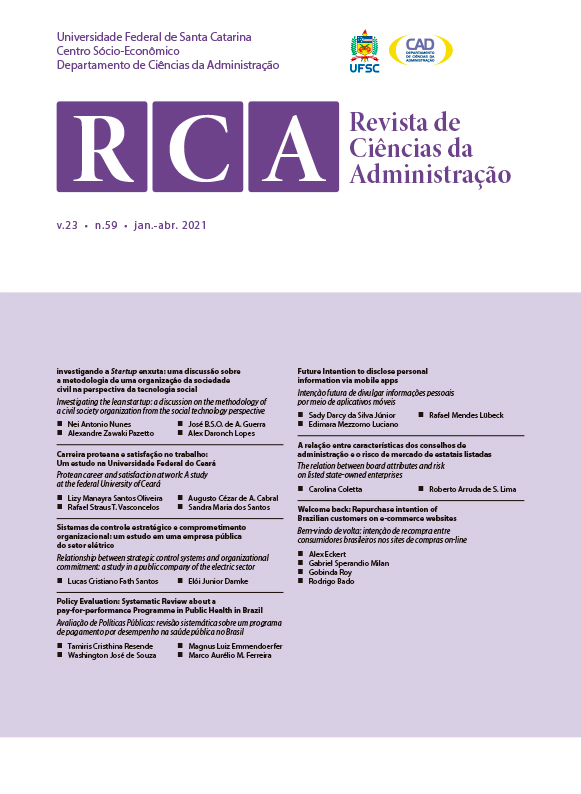
The relation between board attributes and risk on listed state-owned enterprises
DOI:
https://doi.org/10.5007/2175-8077.2021.e61106Abstract
Board of directors are considered the main mechanism of corporate governance. Such boards must overlook risk management and create controls to prevent corruption in state-owned enterprises. Considering that board of directors deliberate about strategic decisions that inherently present risks, its performance and attributes can impact the firm’s stability. The main purpose of this study is to investigate the relation between listed state-owned enterprises board attributes and its risk, measured by stock volatility. The firms with higher market liquidity were considered from 2015 to 2017. Board size presents a positive relation with risk, while the presence of women and independent directors present a negative relation with risk. However, these relations are not statistically significant, which points out to possible interference and flaws in the corporate governance of these firms.
References
ALLINI, A.; ROSSI, F. M.; HUSSAINEY, K. The board's role in risk disclosure: an exploratory study of Italian listed state-owned enterprises. Public Money & Management, v. 36, n. 2, p. 113-120, 2016.
ARAÚJO, D. L et al. O risco de mercado do agronegócio brasileiro: uma análise comparativa entre os modelos CAPM e GARCH-M. Revista Eletrônica de Gestão Organizacional, v. 2, n. 3, p. 207-220, 2004.
ASSAF NETO, A. Finanças corporativas e valor. 5a ed. São Paulo: Atlas, 2010.
B3. Regimento do Programa Destaque em Governança de Estatais. 2017. Disponível em: http://www.bmfbovespa.com.br/pt_br/listagem/acoes/governanca-de-estatais/. Acesso em: 14 dez. 2017.
BERLE, A.; MEANS, G. The modern corporation and private property. New Brunswick: Transaction Publishers, 1932.
BERNILE, G.; BHAGWAT, V.; YONKER, S. Board diversity, firm risk, and corporate policies. Journal of Financial Economics, v. 127, n. 3, p. 588-612, 2018.
BRASIL. Lei n° 13.303, de 30 de junho de 2016. Dispõe sobre o estatuto jurídico da empresa pública, da sociedade de economia mista e de suas subsidiárias, no âmbito da União, dos Estados, do Distrito Federal e dos Municípios. Diário Oficial da União. Brasília, DF, 01 jul. 2016. Seção 1. Disponível em: http://www2.camara.leg.br/. Acesso em: 10 mai. 2018.
CHARNESS, G.; GNEEZY, U. Strong Evidence for Gender Differences in Risk Taking. Journal of Economic Behavior & Organization, v. 83, n. 1, p. 50-58, 2012.
CHENG, S. Board size and the variability of corporate performance. Journal of Financial Economics, v. 87, n. 1, p. 157-176, 2008.
CHRISTIE, A. A. The stochastic behavior of common stock variances. Journal of Financial Economics, v. 10, n. 4, p. 407-432, 1982.
COSTA, H. U.; MAZZEU, J. H. G.; COSTA JR., N. C. A. O comportamento dos componentes da volatilidade das ações no Brasil. Revista Brasileira de Finanças, v. 14, n. 2, p. 225-268, 2016.
IBGC. Boas práticas de governança corporativa para sociedades de economia mista. Série Cadernos de Governança Corporativa. São Paulo: IBGC, 2015a.
IBGC. Código das melhores práticas de governança corporativa. 5a. ed. São Paulo: IBGC, 2015b.
FAMA, E. F.; JENSEN, M. C. Separation of ownership and control. Journal of Law and Economics, v. 26, n. 2, p. 301-325, 1983.
HUANG, Y. S. WANG, C. J. Corporate governance and risk-taking of Chinese firms: the role of board size. International Review of Economics and Finance, v. 37, p. 96-113, 2015.
JENSEN, M. C. The modern industrial revolution, exit, and the failure of internal control systems. Journal of Finance, v. 48, n. 3, p. 831-880, 1993.
JENSEN, M. C.; MECKLING, W. H. Theory of the firm: managerial behaviour, agency costs and ownership structure. Journal of Financial Economics, v. 3, p. 305-360, 1976.
KHONGMALAI, O.; DISTANONT, A. Corporate governance model in Thai state-owned enterprises: structural equation modelling approach. Corporate Governance: The International Journal of Business in Society, v. 17, n. 4, p.613-628, 2017.
LAMEIRA, V. J. As relações entre governança e risco nas companhias abertas brasileiras. Revista Brasileira de Gestão de Negócios, v. 14, n. 42, p. 7-25, 2012.
MATHEW, S.; IBRAHIM, S.; ARCHBOLD, S. Boards attributes that increase firm risk – evidence from the UK. Corporate Governance: The International Journal of Business in Society, v. 16, n. 2, p. 233-258, 2016.
MATHEW, S. Corporate governance and firm risk. Corporate Governance: The International Journal of Business in Society, v. 18, n. 1, p. 52-67, 2018.
MATIAS, A. B. Finanças corporativas de longo prazo: criação de valor com sustentabilidade financeira. São Paulo: Atlas, 2010, 2 v.
MENOZZI, A.; URTIAGA, M. G.; VANNONI, D. Board composition, political connections, and performance in state-owned enterprises. Industrial and Corporate Change, v. 21, n. 3, p. 671-698, 2012
MIRANDA, R. A.; AMARAL, H. F. Governança corporativa e gestão socialmente responsável em empresas estatais. Revista de Administração Pública, v. 45, n. 4, p. 1069-1094, 2011.
MUSSACHIO, A.; LAZZARINI, S. G.; AGUILERA, R. V. New varieties of state capitalism: strategic and governance implications. The Academy of Management Perspectives, v. 29, n. 1, p. 115-131, 2015.
NAKANO, M.; NGUYEN, P. Board size and corporate risk taking: further evidence from Japan. Corporate Governance: An International Review, v. 20, n. 4, p. 369-387, 2012.
OECD. OECD Guidelines on corporate-governance of state-owned enterprises. 2nd ed. Paris: OECD Publishing, 2015.
PAIVA, J. F. M.; OLIVEIRA, N. A.; PEIXOTO, F. M. A relação entre conselho de administração, desempenho, valor e risco no mercado brasileiro de ações. Revista de Educação e Pesquisa em Contabilidade, v. 9, n. 1, p. 25-44, 2015.
POWELL, M.; ANSIC, D. Gender differences in risk behaviour in financial decision-making: an experimental analysis. Journal of Economic Psychology, v. 18, n. 6, p. 605-628, 1997.
SHLEIFER, A.; VISHNY, R. W. Politicians and firms. The Quarterly Journal of Economics, v. 109, n. 4, p. 995-1025, 1994.
SHI, H.; XU, H.; ZHANG, X. Do politically connected independent directors create or destroy value?. Journal of Business Research, v. 83, p. 82-96, 2018.
SILA, V.; GONZALEZ, A.; HAGENDORFF, J. Women on board: Does boardroom gender diversity affect firm risk?. Journal of Corporate Finance, v. 36, p. 26-53, 2016.
SILVA, R. L. M; NARDI, P. C. C.; PIMENTA JUNIOR, T. O impacto da migração das empresas para os níveis diferenciados de governança corporativa da BM&F Bovespa sobre o risco e o retorno de suas ações. Revista de Administração da UFSM, v. 5, n. 2, p. 222-242, 2012.
SILVEIRA, A. D. M. Governança corporativa no Brasil e no mundo: teoria e prática. Rio de Janeiro: Elsevier, 2010.
YERMACK, D. Higher market valuation of companies with a small board of directors. Journal of Financial Economics, v. 40, n. 2, p. 185-211, 1996.
Downloads
Published
How to Cite
Issue
Section
License
The author must ensure:
- that there is complete consensus among all co-authors to approve the final version of the paper and its submission for publication.
- that their work is original, and if the work and/or words of others have been used, these have been duly acknowledged.
Plagiarism in all its forms constitutes unethical publishing behavior and is unacceptable. RCA reserves the right to use software or any other methods of plagiarism detection.
All submissions received for evaluation in the RCA journal are screened for plagiarism and self-plagiarism. Plagiarism identified in manuscripts during the evaluation process will result in the submission being archived. In the event of plagiarism being identified in a manuscript published in the journal, the Editor-in-Chief will conduct a preliminary investigation and, if necessary, retract it.
Authors grant RCA exclusive rights of first publication, with the work simultaneously licensed under the Creative Commons (CC BY) 4.0 International License.

Authors are authorized to enter into separate, additional contractual arrangements for the non-exclusive distribution of the version of the work published in this journal (e.g., publishing in an institutional repository, on a personal website, publishing a translation, or as a chapter in a book), with an acknowledgement of its authorship and initial publication in this journal.
This license grants any user the right to:
Share – copy, download, print, or redistribute the material in any medium or format.
Adapt – remix, transform, and build upon the material for any purpose, even commercially.
According to the following terms:
Attribution – You must give appropriate credit (cite and reference), provide a link to the license, and indicate if changes were made. You may do so in any reasonable manner, but not in any way that suggests the licensor endorses you or your use.
No additional restrictions – You may not apply legal terms or technological measures that legally restrict others from doing anything the license permits.
