
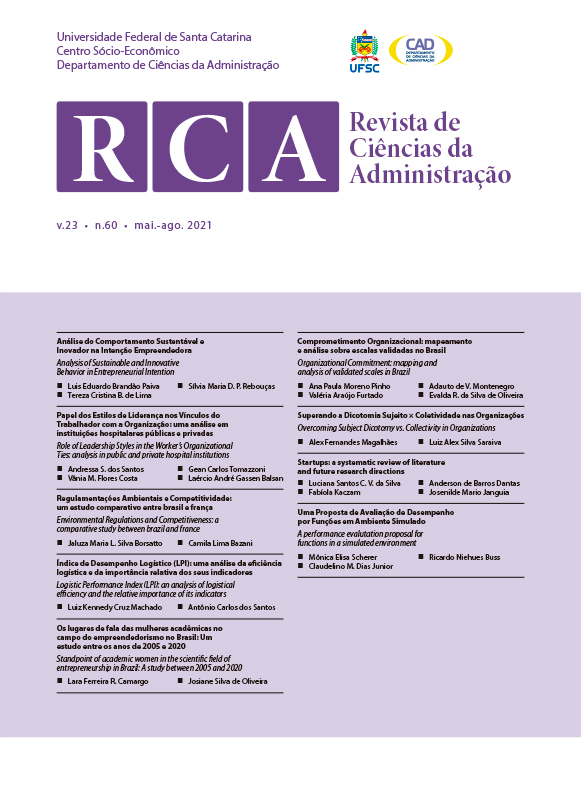
Overcoming subject dicotomy vs. collectivity in organizations
DOI:
https://doi.org/10.5007/2175-8077.2021.e66403Abstract
In this essay, the objective is to reflect on the complexity inherent to socio-organizational spaces, seeking to overcome the subject x collectivity dichotomy to encompass phenomena in a broader way to avoid reductionist organizational analysis. For this, classical authors in the Social Sciences are listed for a dialogue about socio-organizational dynamics articulating subjects and their practices organizations and effects to interrelationships between agents that, in turn, crystallize in an institutional dimension and serve contradictorily to the subjective productions in the midst of socialization spaces. We adopt a critical perspective for addressing socio-historical character to the object of analysis, as well as for considering elementary contradictions in its everyday expression and processuality. Main contributions are around complexity as a mark of the conditions of social and subjective production, guiding future works not to simplify them, considering the conceptual variability about what is taken by social organization and its interpretations.
References
BAREMBLITT, G. Compêndio de análise institucional e outras correntes. 5. ed. Belo Horizonte: Instituto Felix Guattari, 2002.
BASTOS, A. V. B.; LOIOLA, E.; QUEIROZ, N. ; SILVA. T. D. Conceito e perspectivas de estudos das organizações. In: ZANELLI, J. C.; BORGES-ANDRADE, J. E.; BASTOS, A. V. B. (Org.). Psicologia, Organizações e Trabalho no Brasil. Porto Alegre: Armed, 2004. p. 63-90.
BERGER, P. L.; LUCKMANN, T. A construção social da realidade. 33. ed. Petrópolis: Vozes, 2011.
BOURDIEU, P. O Poder simbólico. 14. ed. Rio de Janeiro: Bertrand Brasil, 2006.
BURREL, G.; MORGAN, G. Sociological paradigms and organisational analysis: elements of the sociology of corporate life. Burlington: Ashgate, 2005.
CHAUÍ, M. Convite à filosofia. 14. ed. São Paulo: Ática, 2010.
DURKHEIM, É. As regras do método sociológico. 3. ed. São Paulo: Martins Fontes, 2007.
GEERTZ, C. A interpretação das culturas. Rio de Janeiro: LTC, 2008.
GIDDENS, A. A constituição da sociedade. São Paulo: Martins Fontes, 2003.
GOFFMAN, E. Ritual de interação. Petrópolis: Vozes, 2011.
KUHN, T. S. A estrutura das revoluções científicas. 11. ed. São Paulo: Perspectiva, 2011.
MARX, K. O capital: crítica da economia política. Livro I. Vol. I. 27. ed. Rio de Janeiro: Civilização Brasileira, 2010.
MARX, K. Contribuição para a crítica da economia política. 2. ed. São Paulo: Expressão Popular, 2008.
MARX, K. O método da Economia Política. In: MARX, K. Para a crítica da economia política. São Paulo: Nova Cultural, 1999. p. 39-46.
MARX, K.; ENGELS, F. A ideologia alemã. 2. ed. São Paulo: Martins Fontes, 2001.
MORGAN, G. Imagens da organização. 2. ed. São Paulo: Atlas, 2006.
PAULA, A. P. P. Repensando os estudos organizacionais: o círculo das matrizes epistemológicas e a bordagem freudo-frankfurtiana. 2012. 233 f. Tese (Professor Titular) – Faculdade de Ciências Econômicas, Universidade Federal de Minas Gerais, 2012.
SIMON, H. A. Comportamento administrativo. 3. ed. Rio de Janeiro: FGV, 1979.
VERGARA, S. C.; CALDAS, M. P. Paradigma interpretacionista: a busca da superação do objetivismo funcionalista nos anos 1980 e 1990. Revista de Administração de Empresas, São Paulo, v. 45, n. 4, p. 66-72, out./dez. 2005.
WEBER, M. Economia e sociedade. V. 1. Brasília: UnB, 1994.
Downloads
Published
How to Cite
Issue
Section
License
The author must ensure:
- that there is complete consensus among all co-authors to approve the final version of the paper and its submission for publication.
- that their work is original, and if the work and/or words of others have been used, these have been duly acknowledged.
Plagiarism in all its forms constitutes unethical publishing behavior and is unacceptable. RCA reserves the right to use software or any other methods of plagiarism detection.
All submissions received for evaluation in the RCA journal are screened for plagiarism and self-plagiarism. Plagiarism identified in manuscripts during the evaluation process will result in the submission being archived. In the event of plagiarism being identified in a manuscript published in the journal, the Editor-in-Chief will conduct a preliminary investigation and, if necessary, retract it.
Authors grant RCA exclusive rights of first publication, with the work simultaneously licensed under the Creative Commons (CC BY) 4.0 International License.

Authors are authorized to enter into separate, additional contractual arrangements for the non-exclusive distribution of the version of the work published in this journal (e.g., publishing in an institutional repository, on a personal website, publishing a translation, or as a chapter in a book), with an acknowledgement of its authorship and initial publication in this journal.
This license grants any user the right to:
Share – copy, download, print, or redistribute the material in any medium or format.
Adapt – remix, transform, and build upon the material for any purpose, even commercially.
According to the following terms:
Attribution – You must give appropriate credit (cite and reference), provide a link to the license, and indicate if changes were made. You may do so in any reasonable manner, but not in any way that suggests the licensor endorses you or your use.
No additional restrictions – You may not apply legal terms or technological measures that legally restrict others from doing anything the license permits.
