
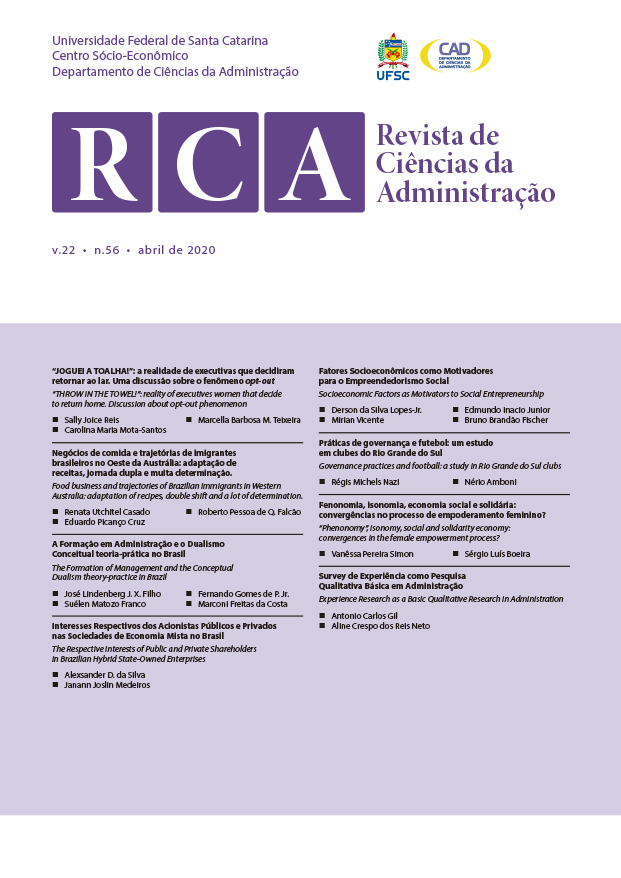
“Joguei a toalha!”: a realidade de executivas que decidiram retornar ao lar: uma discussão sobre o fenômeno opt-out
DOI:
https://doi.org/10.5007/2175-8077.2020.e77598Resumen
O presente artigo tem o objetivo de compreender os motivos que levam algumas executivas a desistirem da carreira e optarem pelo retorno ao lar. Trata-se de estudo com abordagem qualitativa, por meio do método história de vida. A coleta de dados ocorreu a partir de entrevista em profundidade, utilizando como sujeitos duas mulheres executivas. A pesquisa convoca a uma reflexão sobre esse posicionamento de desistência, uma vez que historicamente, há uma divisão entre os sexos, aspecto que permite compreender porque as mulheres encontram muitos desafios no que diz respeito à ascensão e à manutenção de sua carreira no mundo corporativo. A grande contribuição deste estudo foi a de avançar nos motivos que levam ao fenômeno opt-out, pouco explorado na literatura.Citas
ALMEIDA, T. S. As executivas entre a carreira e a vida pessoal. Dissertação (Mestrado em Administração) - Pontifícia Universidade Católica de Minas Gerais, Belo Horizonte, 2012.
ALMEIDA, V. C.; SANTOS, C. M. M. Trabalho, Carreira e Maternidade: Perspectivas e Dilemas de Mulheres Profissionais Contemporâneas. Administração: Ensino e Pesquisa, v. 19, n. 3, p. 583-605, 2018.
ALPERSTEDT, G. D.; FERREIRA, J. B.; SERAFIM, M. C. Empreendedorismo feminino: dificuldades relatadas em histórias de vida. Revista de Ciências da Administração, v. 16, n. 40, p. 221-234, 2014.
ANSARI, N. Respectable femininity: a significant panel of glass ceiling for career women. Gender in Management: An International Journal, v. 31, n. 8, p. 528-541, 2016.
BÄCHMANN, A. C.; GATERMANN, D. The duration of family-related employment interruptions–the role of occupational characteristics. Journal for Labour Market Research, v. 50, n. 1, p. 143-160, 2017.
BELKIN, L. The opt-out revolution, New York Times Magazine, October 26, 2006. Disponível em: https://www.nytimes.com/2003/10/26/magazine/the-opt-out-revolution.html. Acesso em: 08 de julho de 201p.
BIESE-STJERNBERG, I. Opting Out: A critical study of women leaving their careers to adopt new lifestyles. Thesis, Hawke Research Institute, University of South Australia, 2013.
BYKER, T. The Opt-Out Continuation: Education, Work, and Motherhood from 1984 to 2012. RSF: The Russell Sage Foundation Journal of the Social Sciences, v. 2, n. 4, p. 34-70, 2016.
CERIBELI, H. B.; SILVA, E. R. Interrupção voluntária da carreira em prol da maternidade. Revista Pensamento Contemporâneo em Administração, v. 11, n. 5, p. 116-139, 2017.
DAVIES-NETZLEY, S. A. Women above the glass ceiling: perceptions on corporate mobility and strategies for success. Gender & Society, v. 12, n. 3, p. 339-355, 1998.
EDDY, P. L.; WARD, K. Lean in or opt out: Career pathways of academic women. Change: The Magazine of Higher Learning, v. 47, n. 2, p. 6-13, 2015.
FREITAS, M. E. Mulheres no lar: machismo ou poder? GV-executivo, v. 12, n. 1, p. 54-57, 2013.
GONÇALVES, B. D. Transformações da identidade de gênero entre mulheres, no século XX, em Minas Gerais: um estudo em três gerações. Dissertação (Mestrado em Psicologia) - Belo Horizonte: UFMG, 2000.
GOULART, Í. B.; PAPA FILHO, S. O sentido do trabalho humano in Psicologia do Trabalho e gestão de recursos humanos: estudos contemporâneos. (2. ed.). São Paulo: Casa do Psicólogo, 2013.
GRANT-VALLONE, E. J.; ENSHER, E. A. Opting in between: Strategies used by professional women with children to balance work and family. Journal of Career Development, v. 38, n. 4, p. 331-348, 2011.
GROUT, P. A.; SONDEREGGER, S. An economic theory of the glass ceiling. Centre for Market and Public Organisation. Bristol Institute of Public Affairs. University of Bristol (Working Paper no. 07/183), 2007.
GRZYBOVSKI, D.; BOSCARIN, R.; MIGOTT, A. M. B. Estilo feminino de gestão em empresas familiares gaúchas. Rev. adm. contemp., v. 6, n. 2, p. 185-207, 2002.
HARMAN, C.; SEALY, R. Opt-in or opt-out: exploring how women construe their ambition at early career stages. Career Development International, v. 22, n. 4, p. 372-398, 2017.
HOFFMAM, R.; LEONE, E. T. Participação da mulher no mercado de trabalho e desigualdade da renda domiciliar per capita no Brasil: 1981-2002. Nova Economia, Belo Horizonte, v. 14, n. 2, p. 35-58, 2004.
JABLONSKI, B. A divisão de tarefas domésticas entre homens e mulheres no cotidiano do casamento. Psicol, Ciênc e Profissão, v. 30, n. 2, 2010.
LOSADA, B. L.; ROCHA-COUTINHO, M. L. Redefinindo o significado da atividade profissional para as mulheres: o caso das pequenas empresárias. Psicologia em Estudo, Maringá, v. 12, n. 3, p. 493-502, 2007.
LOUREIRO, C. M. P.; COSTA, I. S. A.; FREITAS, J. A. S. B. Trajetórias profissionais de mulheres executivas: qual o preço do sucesso?. Revista de Ciências da Administração, v. 14, n. 33, p. 130-144, 2012.
LOVEJOY, M.; STONE, P. Opting back in: the influence of time at home on professional women’s career redirection after opting out. Gender, Work and Organization, v. 19, n. 6, p. 631-653, 2012.
MAINIERO, L. A.; SULLIVAN, S. The opt-out revolt: Why people are leaving companies to create kaleidoscope careers. Mountain View, CA: Davies-Black Publishing, 2006.
MIRANDA, A. R. A.; CAPPELLE, M. C. A.; MAFRA, F. L. N. Contribuições do Método História de Vida para Estudos sobre Identidade: o exemplo do estudo sobre professoras gerentes. Ciências da Administração, v. 16, n. 40, p. 59-74, 2014.
MORRISON, A. M.; WHITE, R. P.; VELSOR, E. V. Breaking the glass ceiling: can women reach the top of America’s largest corporations? Massachusetts: Updated edition, 1994.
MOTA SANTOS, C. M.; CARVALHO NETO, A.; CAEIRO, M., VERSIANI, F.; MARTINS, M. G. As mulheres estão quebrando as três paredes de vidro?: um estudo com empreendedoras mineiras. Revista Economia & Gestão. Belo Horizonte, v. 16, n. 45, 2016.
NEVES, M. A. Anotações sobre o trabalho de gênero. Cad Pesq, v. 43, n. 149, p. 404-421, 2013.
OLIVEIRA, S. C.; FARIA, E. R.; SARRIERA, J. C.; PICCININI, C. A.; TRENTINI, C. M. Maternidade e trabalho: Uma revisão da literatura. Interamerican Journal of Psychology, v. 45, n. 2, p. 271-280, 2011.
PERROT, M. As mulheres ou os silêncios da história. As primeiras palestras de Perrot sobre as ausências das mulheres no campo da história foram nos anos 1970 (pp. 9-10). Trad. V. Ribeiro. Bauru-SP: Edusc, 1970.
POWELL, G. N.; BUTTERFIELD, D. A. Sex, gender, and aspirations to top management: Who's opting out? Who's opting in? Journal of Vocational Behavior, v. 82, n. 1, p. 30-36, 2013.
ROCHA-COUTINHO, M. L. Novas opções, antigos dilemas: mulher, família, carreira e relacionamento no Brasil. Temas em Psicologia da SBP, v. 12, n. 1, p. 2-17, 2004.
ROCHA-COUTINHO, M. L. Tecendo por trás dos panos: a mulher brasileira nas relações familiares. Rio De Janeiro: Rocco, 1994.
SALVAGNI, J.; CANABARRO, J. Mulheres líderes: as desigualdades de gênero, carreira e família nas organizações de trabalho. Revista de Gestão e Secretariado, v. 6, n. 2, p.88-110 2015.
SANTOS, C. M. M. As mulheres brasileiras: do espaço privado da casa para as posições executivas nas organizações brasileiras. Tese (Doutorado em Administração) - PUC Minas, Belo Horizonte, 2012.
SOCRATOUS, M.; GALLOWAY, L.; KAMENOU-AIGBEKAEN, N. Motherhood: an impediment to workplace progression? The case of Cyprus. Equality, Diversity and Inclusion: An International Journal, v. 35, n. 5/6, p. 364-382, 2016.
STILL, M. C. The Opt-Out Revolution in the United States: Implications for Modern Organizations, Managerial and Decision Economics, v. 27, p. 159-71, 2006.
TANURE, B.; CARVALHO NETO, A.; ANDRADE, J. Executivos: sucesso e infelicidade. Rio de Janeiro: Campus, 2007.
TAVARES, A. D. M.; BARBOSA, R. B. A mulher e a tripla jornada de trabalho: como esta mulher vivencia as atividades profissional, familiar e doméstica? Psicologia em Foco, v. 5, n. 1, 2015.
Descargas
Publicado
Cómo citar
Número
Sección
Licencia
El autor deberá garantizar:
- que exista pleno consenso entre todos los coautores para aprobar la versión final del documento y su envío para publicación.
que su trabajo es original, y si se utilizó trabajo y/o palabras de otras personas, estos fueron debidamente reconocidos.
El plagio en todas sus formas constituye un comportamiento editorial poco ético y es inaceptable. RCA se reserva el derecho de utilizar software o cualquier otro método de detección de plagio.
Todos los envíos recibidos para evaluación en la revista RCA pasan por la identificación de plagio y autoplagio. El plagio identificado en los manuscritos durante el proceso de evaluación dará lugar al archivo del envío. Si se identifica plagio en un manuscrito publicado en la revista, el Editor Jefe realizará una investigación preliminar y, de ser necesario, se retractará.
Los autores otorgan a RCA los derechos exclusivos de primera publicación, estando la obra licenciada simultáneamente bajo la Licencia Creative Commons (CC BY) 4.0 Internacional.

Los autores están autorizados a celebrar contratos adicionales por separado, para la distribución no exclusiva de la versión del trabajo publicado en esta revista (por ejemplo, publicación en un repositorio institucional, en un sitio web personal, publicación de una traducción o como capítulo de un libro), con reconocimiento de autoría y publicación inicial en esta revista.
Esta licencia permite a cualquier usuario tener derecho a:
Compartir: copiar, descargar, imprimir o redistribuir el material en cualquier medio o formato.
Adapte: remezcle, transforme y cree a partir del material para cualquier propósito, incluso comercial.
Bajo los siguientes términos:
Atribución: debe dar el crédito apropiado (citar y hacer referencia), proporcionar un enlace a la licencia e indicar si se realizaron cambios. Debe hacerlo bajo cualquier circunstancia razonable, pero de ninguna manera que sugiera que el licenciante lo respalda a usted o su uso.
Sin restricciones adicionales: no puede aplicar términos legales ni medidas tecnológicas que restrinjan legalmente a otros hacer algo que la licencia permite.
