
Alongamento estático versus conceito Mulligan – efeitos crônicos no treino de flexibilidade em ginastas
DOI:
https://doi.org/10.1590/1980-0037.2010v12n3p202Resumo
A flexibilidade é uma das valências físicas essenciais para a prática da Ginástica Rítmica (GR). Este estudo tem por objetivo comparar as adaptações crônicas do treino de flexibilidade em função de duas técnicas: o alongamento estático e a técnica Mulligan - Long Leg Traction, no movimento de extensão do quadril, em atletas de GR. Participaram do estudo oito atletas do sexo feminino, com média de idade de 13,25±0,89 anos, divididas em dois grupos. O Grupo 1 foi submetido à técnica Mulligan e o Grupo 2 ao alongamento estático. O treinamento de flexibilidade teve duração de seis semanas, foi realizado duas vezes por semana e constitui-se de duas repetições de 30 segundos para cada membro inferior. Utilizou-se a fotogrametria para avaliar a amplitude de movimento (ADM) de extensão do quadril. Realizou-se a avaliação da ADM antes do início e após seis semanas de treinamento. Utilizou-se estatística descritiva e inferencial para o tratamento dos dados. O aumento da ADM foi estatisticamente significativo em ambos os membros inferiores no Grupo 1, e no MID no Grupo 2. Após seis semanas de treinamento, o ganho de ADM do Grupo1 foi de 6,25º± 2,75º no MIE e, 525º ± 2,63º no MID; e do grupo2 foi 6,75º± 4,64º no MIE e 5,5º± 3,41º no MID. Ao comparar as técnicas executadas, em relação ao ganho de ADM, não houve diferença estatisticamente significativa. Conclui-se que, após as seis semanas de treinamento, as duas técnicas propostas promoveram aumento estatisticamente significativo na amplitude de movimento.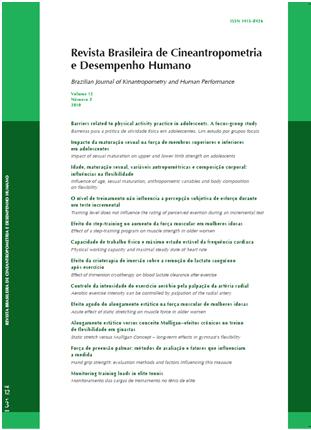
Publicado
2010-01-01
Edição
Seção
Artigos Originais
Licença
Copyright (c) 2010 Manuela Karloh, Raquel Petry, Maria Helena Kraeski, Thiago Sousa Matias, Anderson Simas Frutuoso

Este trabalho está licenciado sob uma licença Creative Commons Attribution 4.0 International License.
Os direitos Autorais para artigos publicados nesta revista são do autor. Os autores concedem os direitos de primeira publicação à RBCDH, sendo a obra simultaneamente licenciada sob a Licença Creative Commons (CC BY) 4.0 Internacional.
Os autores estão autorizados a celebrar contratos adicionais separadamente, para distribuição não exclusiva da versão do trabalho publicada nesta revista (por exemplo, publicação em repositório institucional, em site pessoal, publicação de tradução ou como capítulo de livro), com reconhecimento de autoria e publicação inicial nesta revista.

