
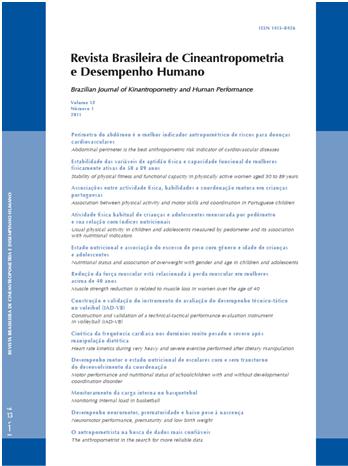
Abdominal perimeter is the best anthropometric risk indicator of cardiovascular diseases
DOI:
https://doi.org/10.1590/1980-0037.2011v13n1p1Abstract
The objectives of this study were: a) to determine the prevalence of inadequate body fat determined based on body mass index (BMI), abdominal perimeter (AP) and relative body fat (%F), and biochemical indicators of cardiovascular risk, and b) to examine which body fat indicators better reflect the biochemical factors. BMI, %F, AP, glucose, triglycerides, total cholesterol, high-density lipoprotein (HDL), and low-density lipoprotein (LDL) were measured in 125 men. More than half the sample (56.8%) had low HDL and high BMI (58.4%) and %F (53.6%). There was a lower percentage of subjects with elevated LDL (40.8%), AP (38.4%), triglycerides (34.8%), glucose (27.2%), and total cholesterol (15.2%). AP was associated with four biochemical markers, whereas %F was associated with three and BMI with only two. The prevalence of risk factors was high. An AP >92 cm proved to be the best fat indicator, demonstrating that men are exposed to high levels of LDL, total cholesterol, triglycerides, and glucose.
Downloads
Published
Issue
Section
License
Copyright (c) 2011 Maria Fátima Glaner, Andreia Pelegrini, Thales Boaventura Rachid Nascimento

This work is licensed under a Creative Commons Attribution 4.0 International License.

This work is licensed under a Creative Commons Attribution 4.0 International License.
