
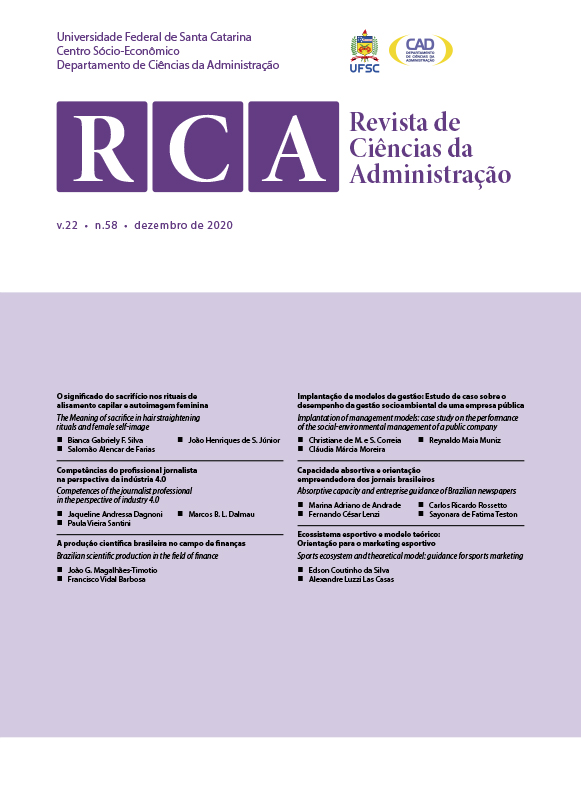
Capacidade absortiva e orientação empreendedora dos jornais brasileiros
DOI:
https://doi.org/10.5007/2175-8077.2020.e67496Resumo
Ambientes turbulentos exigem das firmas capacidade de aprender e aplicar o conhecimento de maneira rápida e efetiva para garantir processos empreendedores, inovações e resultado. Esta pesquisa busca avaliar a capacidade absortiva dos jornais brasileiros com a orientação empreendedora destas organizações. O objeto do estudo foi escolhido levando-se em consideração o momento de transformação deste tipo de negócio a partir das consequências que a internet trouxe para a forma como as pessoas consomem informação. Com uma abordagem quantitativa, o trabalho conclui que a capacidade absortiva das empresas estudadas influencia na orientação empreendedora das mesmas. O resultado foi obtido a partir de uma survey aplicadacom os principais gestores de empresas que possuem veículos de mídia impressa no Brasil. Além de comprovar a hipótese da pesquisa por meio de uma modelagem de equação estrutural, o estudo utiliza análises estatísticas para identificar e mensurar as dimensões de OE (Lumpkin & Dess, 1996) e ACAP (Zahra & George, 2002).
Referências
ALCADIPANI, R. O declínio dos jornais. GV Executivo, v. 6, n. 2. 2007.
ASSOCIAÇÃO NACIONAL DE JORNAIS (ANJ). A Indústria Jornalística Brasileira em 2017.Site insitucional da ANJ, 2018. Disponível em: https://www.anj.org.br/site/servicos/menindjornalistica/114-cenarios/742-a-industria-jornalistica-brasileira-em-2017.html. Acesso em: 28 de abril de 2018.
CAMOZZATO, E. S.; LIZOTE, S. A.; VERDINELLI, M. A.; SERAFIM, F. K. Orientação empreendedora, autoeficácia dos gestores e satisfação com o desempenho: um estudo em empresas incubadas. Revista de Ciências da Administração, Florianópolis, p. 68-83, ago. 2017.
CASSOL, A. Capital intelectual e capacidade absortiva como propulsores da inovação: estudo de caso no setor de papel e papelão ondulado. Dissertação (mestrado) – Programa de Pós-Graduação em Administração, Universidade do Vale do Itajaí, Biguaçu, 2014.
CESTINO, J.; MATTHEWS, R. A perspective on path dependence processes: the role of knowledge integration in business model persistence dynamics in the provincial press in England. Journal of Media Business Studies, v. 13, n. 1, p. 22-44, 2016.
CHURCHILL JR., G. A. A Paradigm for developing better measures of marketing constructs. Journal of Marketing Research, v. 16, n. 1, p. 64-74, 1979.
COHEN, W. M.; LEVINTHAL, D. A. Absorptive Capacity: a new perspective on learning and innovation. Administrative Science Quarterly, v. 35, n. 1, p. 128-152, mar. 1990.
COVIN, J. G.; LUMPKIN, G. T. Entrepreneurial orientation theory and research: Reflections on a needed construct. Entrepreneurship Theory and Practice, v. 35, n. 5, p. 855-872, 2011.
COVIN, J. G.; SLEVIN, D. P. Strategic management of small firms in hostile and benign environments. Strategic management journal, v. 10, n. 1, p. 75-87, 1989.
COVIN, J. G.; WALES, W. J. The measurement of entrepreneurial orientation. Entrepreneurship theory and practice, v. 36, n. 4, p. 677-702, 2012.
DE CLERCQ, D.; DIMOV, D.; THONGPAPANL, N. T. Organizational social capital, formalization, and internal knowledge sharing in entrepreneurial orientation formation. Entrepreneurship Theory and Practice, v. 37, n. 3, p. 505-537, 2013.
DESS, G. G.; LUMPKIN, G. T.. The role of entrepreneurial orientation in stimulating effective corporate entrepreneurship. The Academy of Management Executive, v. 19, n. 1, p. 147-156, 2005.
DÍAZ, Y.; GUERRERO, M.; PEÑA, I. Productividad de la innovación a través del emprendimiento corporativo: Innovation driven productivity through corporate entrepreneurship. Universia Business Review. v. 47, n. 32-47, Jul. 2015. ISSN: 16985117.
DÍAZ-NOCI, J. A History of Journalism on the Internet: A state of the art and some methodological trends. Revista internacional de Historia de la Comunicación, n. 1, p. 253-272, 2013.
ENGELEN, A.; KUBE, H.; SCHMIDT, S.; FLATTEN, T. C. Entrepreneurial orientation in turbulent environments: The moderating role of absorptive capacity. Research Policy, v. 43, n.8, p. 1353–1369, 2014.
FINNEY, S. J.; DISTEFANO, C. (2013). Nonnormal and categorical data in structural equation modeling. In: HANCOK, G. R.; MUELEER, R. O. Quantitative methods in education and the behavioral sciences: Issues, research, and teaching. Structural equation modeling: a second course (p. 439-492). Charlotte, NC, US: IAP Information Age Publishing.
FRANÇA, A. B.; SARAIVA, J.; HASHIMOTO, M. Orientação empreendedora como indicador do grau de empreendedorismo corporativo: fatores que caracterizam os intraempreendedores e influenciam sua percepção. Revista de Empreendedorismo e Gestão de Pequenas Empresas, v.1, n. 3, 2012.
FREITAS, H.; MARTENS, C. D. P.; BOISSIN, J.; BEHR, A. (2012). Elementos para guiar ações visando à orientação empreendedora em organizações de software. Revista de Administração, v. 47, n. 2, p. 163-179, 2012.
GARCIA, S. D. B.; MARTINEZ, T. L. Análisis de ecuaciones estructurales. In: GREIMEL-FUHRMANN, B.; GEYGER, A. Student´s evaluation of teachers and instructional quality analysis of relevant factors based on empirical evaluation research. Assessment Evaluation in Higher Education, London, v. 28, n. 3, p. 229-238, 2003.
GREER, J.; MENSING, D. The evolution of online newspapers: A longitudinal content analysis, 1997-2003. Internet newspapers: The making of a mainstream medium, p. 13-32, 2006.
GUTH, W. D.; GINSBERG, A.Guest editor’s introduction: corporate entrepreneurship. Strategic Management Journal. v. 11, p. 5-15, 1990.
HAIR Jr., J. F.; BLACK, W. C.; BABIN, B. J.; ANDERSON, R. E.; TATHAM R. L.; Análise multivariada de dados. 5. ed. Porto Alegre: Bookman, 2009.
HERNANDEZ-PERLINES, F. Moderating effect of absorptive capacity on the entrepreneurial orientation of international performance of family businesses. Journal of Family Business Management, v. 8, n. 1, p. 58-74, 2018.
HURLEY, R.; HULT, T. Innovation, Market Orientation, and Organizational Learning: an integration and empirical examination. Journal of Marketing, v. 62, n. 3, p. 42-55, 1998.
JAWORSKI, B. J.; KOHLI, A. Market Orientation: antecedents and consequences. Journal of Marketing, v. 57, n. 3, p. 53-70, 1993.
KARIMI, J.; WALTER, Z. Corporate entrepreneurship, disruptive business model innovation adoption, and its performance: The case of the newspaper industry. Long Range Planning, v. 49, n. 3, p. 342-360, 2016.
KIRZNER, I. M. Competition and entrepreneurship. Chicago, IL: Chicago University Press, 1973.
LANE, P. J.; KOKA, B. R.; PATHAK, S. The reification of absorptive capacity: A critical review and rejuvenation of the construct. Academy of management review, v. 31, n. 4, p. 833-863, 2006.
LUMPKIN, G. T.; DESS, G. G. Clarifying the entrepreneurial orientation construct and linking it to performance. Academy of management Review, v. 21, n. 1, p. 135-172, 1996.
LUMPKIN, G. T.; DESS, G. G. Linking two dimensions of entrepreneurial orientation to firm performance: The moderating role of environment and industry life cycle. Journal of Business Venturing, v. 16, p. 429–451, 2001.
MARTENS, Cristina Dai Prá et al. Relação entre Orientação Empreendedora e Maturidade na Gestão De Projetos Em Empresas Brasileiras De Software. 3. ed. [s. L.]: Revista Ibero-americana de Estratégia (RIAE), 2015. 91 p. 14 v.
MARTENS, C. D. P.; LACERDA, F. M.; BELFORT, A. C.; FREITAS, H. M. R. de. Research on entrepreneurial orientation: current status and future agenda. International Journal of Entrepreneurial Behavior & Research, v. 22, n. 4, p. 556-583, 2016.
MILLER, D. The correlates of entrepreneurship in tree types of firms. Management Science, v. 29, n.7, p. 770-791, 1983.
MILLER, D. Miller (1983) revisited: A reflection on EO research and some suggestions for the future. Entrepreneurship Theory and Practice, v. 35, n. 5, p. 873-894, 2011.
MILLER, D.; FRIESEN, P. Innovation in Conservative and Entrepreneurial Firms: Two Models of Strategic Momentum. Strategic Management Journal, v. 3, p. 1-25, 1982.
MINTZBERG, H. Strategy-Making in Three Modes.California Management Review, v. 16,n. 2,1973.
PADILHA, A. C. M.; CERVO, B.; AZEVEDO, J. B.; VASCONCELOS NETO, A. G.; FAGUNDES, P. M. Capacidade absortiva na produção artesanal de cervejas. Espacios, v. 37, n. 35, 2016.
SBISSA, A. P. Relacionamento Entre Capacidade Absortiva, Orientação Empreendedora E Desempenho Empresarial: Um Estudo Noshotéisde Florianópolis(SC). Dissertação (Mestrado)- Universidade do Vale do Itajaí,Programa de Pós-Graduação em Administração, Biguaçu, 2017.
SCHUMPETER, J. The theory of Economic Development:An Inquiry into Profits, Capital, Credit, Interest, and the Business Cycle. Cambride: Harvard University Press, 1934.
SCIASCIA, S.; D’ORIA, L.; BRUNI, M.; LARRAÑETA, B. Entrepreneurial Orientation in low-and medium-tech industries: The need for Absorptive Capacity to increase performance. European Management Journal, v. 32, n. 5, p. 761-769, 2014.
SHANE, S.; VENKATARAMAN, S. The Promise of Entrepreneurship as a Field of Research. The Academy of Management Review, v. 25, n. 1, p. 217-227, 2000.
SLATER, S.; NARVER, J. C. Market orientation and the learning organization. Journal of Marketing, v. 59, n. 3, p. 63-75, 1995.
SILVA FRANÇA, A; LIMA RUA, O. Influence of entrepreneurial orientation and absorptive capacities in export performance. : Influência da orientação empreendedora e das capacidades abortivas no desempenho das exportações. Tourism & Management Studies. v. 12, n. 1, p. 196-202, Jan. 2016. ISSN: 16462408.
TEECE, D. J. Explicating dynamic capabilities: Asset selection, coordination, and entrepreneurship in strategic management theory. UC Berkeley, 2003.
TEECE, D. J.; PISANO, G.; SHUEN, A. Dynamic capabilities and strategic management. Strategic management journal, p. 509-533, 1997.
TENCONI, C. D. Desenvolvimento de uma Escala para mensurar a capacidade de absorção em pequenas empresas. 2015. 251 f. Dissertação (Mestrado) -Curso de Administração, Universidade Estadual de Santa Catarina, Florianópolis, 2015.
TONDOLO, V. A. G.; BITENCOURT, C. C. Compreendendo as capacidades dinâmicas a partir de seus antecedentes, processos e resultados. Brazilian Business Review, v. 11, n. 5, p. 124-147, 2014.
VAN DOORN, S.; HEYDEN, M. L. M; VOLBERDA, H. W. Enhancing Entrepreneurial Orientation in Dynamic Environments: The Interplay between Top Management Team Advice-Seeking and Absorptive Capacity. Long Range Planning, v. 50, n. 2, p. 134-144, 2017.
WALES, W. J.; PARIDA, V.; PATEL, P. C. Too much of a good thing? Absorptive capacity, firm performance, and the moderating role of entrepreneurial orientation. Strategic Management Journal, v. 34, n. 5, p. 622-633, 2013.
WANG, C. L.; AHMED, P. K. Dynamic capabilities: A review and research agenda. International journal of management reviews, v. 9, n. 1, p. 31-51, 2007.
ZAHRA, S. A.; GEORGE, G. Absorptive capacity: A review, reconceptualization, and extension. Academy of management review, v. 27, n. 2, p. 185-203, 2002.
Downloads
Publicado
Como Citar
Edição
Seção
Licença
O autor deve garantir:
- que haja um consenso completo de todos os coautores em aprovar a versão final do documento e sua submissão para publicação.
- que seu trabalho é original, e se o trabalho e/ou palavras de outras pessoas foram utilizados, estas foram devidamente reconhecidas.
Plágio em todas as suas formas constituem um comportamento antiético de publicação e é inaceitável. RCA reserva-se o direito de usar software ou quaisquer outros métodos de detecção de plágio.
Todas as submissões recebidas para avaliação na revista RCA passam por identificação de plágio e autoplágio. Plágios identificados em manuscritos durante o processo de avaliação acarretarão no arquivamento da submissão. No caso de identificação de plágio em um manuscrito publicado na revista, o Editor Chefe conduzirá uma investigação preliminar e, caso necessário, fará a retratação.
Os autores cedem à RCA os direitos exclusivos de primeira publicação, com o trabalho simultaneamente licenciado sob a Licença Creative Commons (CC BY) 4.0 Internacional.

Os autores têm autorização para assumir contratos adicionais separadamente, para distribuição não exclusiva da versão do trabalho publicada neste periódico (ex.: publicar em repositório institucional, em site pessoal, publicar uma tradução, ou como capítulo de livro), com reconhecimento de autoria e publicação inicial neste periódico.
Esta licença permite que qualquer usuário tenha direito de:
Compartilhar – copiar, baixar, imprimir ou redistribuir o material em qualquer suporte ou formato.
Adaptar – remixar, transformar e criar a partir do material para qualquer fim, mesmo que comercial.
De acordo com os seguintes termos:
Atribuição – Você deve dar o crédito apropriado (citar e referenciar), prover um link para a licença e indicar se mudanças foram feitas. Você deve fazê-lo em qualquer circunstância razoável, mas de maneira alguma que sugira ao licenciante apoiar você ou o seu uso.
Sem restrições adicionais – Você não pode aplicar termos jurídicos ou medidas de caráter tecnológico que restrinjam legalmente outros de fazerem algo que a licença permita.
