
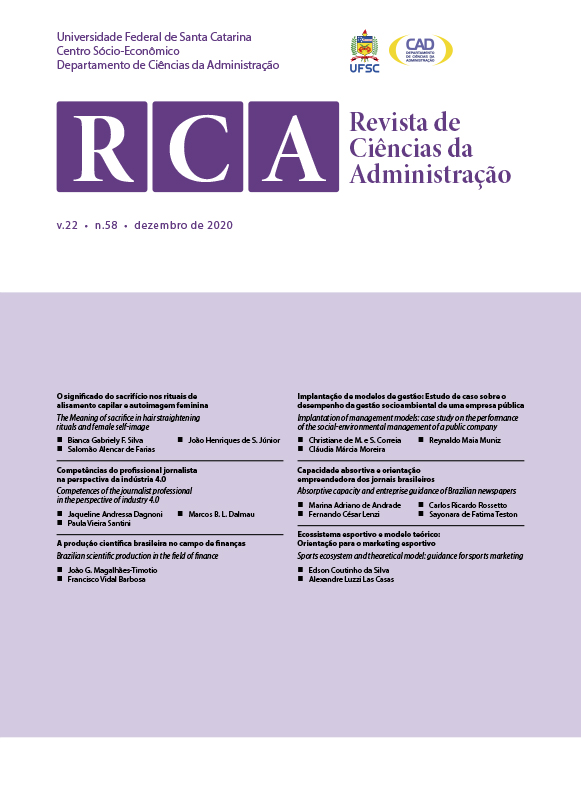
Capacidade absortiva e orientação empreendedora dos jornais brasileiros
DOI:
https://doi.org/10.5007/2175-8077.2020.e67496Resumen
Ambientes turbulentos exigem das firmas capacidade de aprender e aplicar o conhecimento de maneira rápida e efetiva para garantir processos empreendedores, inovações e resultado. Esta pesquisa busca avaliar a capacidade absortiva dos jornais brasileiros com a orientação empreendedora destas organizações. O objeto do estudo foi escolhido levando-se em consideração o momento de transformação deste tipo de negócio a partir das consequências que a internet trouxe para a forma como as pessoas consomem informação. Com uma abordagem quantitativa, o trabalho conclui que a capacidade absortiva das empresas estudadas influencia na orientação empreendedora das mesmas. O resultado foi obtido a partir de uma survey aplicadacom os principais gestores de empresas que possuem veículos de mídia impressa no Brasil. Além de comprovar a hipótese da pesquisa por meio de uma modelagem de equação estrutural, o estudo utiliza análises estatísticas para identificar e mensurar as dimensões de OE (Lumpkin & Dess, 1996) e ACAP (Zahra & George, 2002).
Citas
ALCADIPANI, R. O declínio dos jornais. GV Executivo, v. 6, n. 2. 2007.
ASSOCIAÇÃO NACIONAL DE JORNAIS (ANJ). A Indústria Jornalística Brasileira em 2017.Site insitucional da ANJ, 2018. Disponível em: https://www.anj.org.br/site/servicos/menindjornalistica/114-cenarios/742-a-industria-jornalistica-brasileira-em-2017.html. Acesso em: 28 de abril de 2018.
CAMOZZATO, E. S.; LIZOTE, S. A.; VERDINELLI, M. A.; SERAFIM, F. K. Orientação empreendedora, autoeficácia dos gestores e satisfação com o desempenho: um estudo em empresas incubadas. Revista de Ciências da Administração, Florianópolis, p. 68-83, ago. 2017.
CASSOL, A. Capital intelectual e capacidade absortiva como propulsores da inovação: estudo de caso no setor de papel e papelão ondulado. Dissertação (mestrado) – Programa de Pós-Graduação em Administração, Universidade do Vale do Itajaí, Biguaçu, 2014.
CESTINO, J.; MATTHEWS, R. A perspective on path dependence processes: the role of knowledge integration in business model persistence dynamics in the provincial press in England. Journal of Media Business Studies, v. 13, n. 1, p. 22-44, 2016.
CHURCHILL JR., G. A. A Paradigm for developing better measures of marketing constructs. Journal of Marketing Research, v. 16, n. 1, p. 64-74, 1979.
COHEN, W. M.; LEVINTHAL, D. A. Absorptive Capacity: a new perspective on learning and innovation. Administrative Science Quarterly, v. 35, n. 1, p. 128-152, mar. 1990.
COVIN, J. G.; LUMPKIN, G. T. Entrepreneurial orientation theory and research: Reflections on a needed construct. Entrepreneurship Theory and Practice, v. 35, n. 5, p. 855-872, 2011.
COVIN, J. G.; SLEVIN, D. P. Strategic management of small firms in hostile and benign environments. Strategic management journal, v. 10, n. 1, p. 75-87, 1989.
COVIN, J. G.; WALES, W. J. The measurement of entrepreneurial orientation. Entrepreneurship theory and practice, v. 36, n. 4, p. 677-702, 2012.
DE CLERCQ, D.; DIMOV, D.; THONGPAPANL, N. T. Organizational social capital, formalization, and internal knowledge sharing in entrepreneurial orientation formation. Entrepreneurship Theory and Practice, v. 37, n. 3, p. 505-537, 2013.
DESS, G. G.; LUMPKIN, G. T.. The role of entrepreneurial orientation in stimulating effective corporate entrepreneurship. The Academy of Management Executive, v. 19, n. 1, p. 147-156, 2005.
DÍAZ, Y.; GUERRERO, M.; PEÑA, I. Productividad de la innovación a través del emprendimiento corporativo: Innovation driven productivity through corporate entrepreneurship. Universia Business Review. v. 47, n. 32-47, Jul. 2015. ISSN: 16985117.
DÍAZ-NOCI, J. A History of Journalism on the Internet: A state of the art and some methodological trends. Revista internacional de Historia de la Comunicación, n. 1, p. 253-272, 2013.
ENGELEN, A.; KUBE, H.; SCHMIDT, S.; FLATTEN, T. C. Entrepreneurial orientation in turbulent environments: The moderating role of absorptive capacity. Research Policy, v. 43, n.8, p. 1353–1369, 2014.
FINNEY, S. J.; DISTEFANO, C. (2013). Nonnormal and categorical data in structural equation modeling. In: HANCOK, G. R.; MUELEER, R. O. Quantitative methods in education and the behavioral sciences: Issues, research, and teaching. Structural equation modeling: a second course (p. 439-492). Charlotte, NC, US: IAP Information Age Publishing.
FRANÇA, A. B.; SARAIVA, J.; HASHIMOTO, M. Orientação empreendedora como indicador do grau de empreendedorismo corporativo: fatores que caracterizam os intraempreendedores e influenciam sua percepção. Revista de Empreendedorismo e Gestão de Pequenas Empresas, v.1, n. 3, 2012.
FREITAS, H.; MARTENS, C. D. P.; BOISSIN, J.; BEHR, A. (2012). Elementos para guiar ações visando à orientação empreendedora em organizações de software. Revista de Administração, v. 47, n. 2, p. 163-179, 2012.
GARCIA, S. D. B.; MARTINEZ, T. L. Análisis de ecuaciones estructurales. In: GREIMEL-FUHRMANN, B.; GEYGER, A. Student´s evaluation of teachers and instructional quality analysis of relevant factors based on empirical evaluation research. Assessment Evaluation in Higher Education, London, v. 28, n. 3, p. 229-238, 2003.
GREER, J.; MENSING, D. The evolution of online newspapers: A longitudinal content analysis, 1997-2003. Internet newspapers: The making of a mainstream medium, p. 13-32, 2006.
GUTH, W. D.; GINSBERG, A.Guest editor’s introduction: corporate entrepreneurship. Strategic Management Journal. v. 11, p. 5-15, 1990.
HAIR Jr., J. F.; BLACK, W. C.; BABIN, B. J.; ANDERSON, R. E.; TATHAM R. L.; Análise multivariada de dados. 5. ed. Porto Alegre: Bookman, 2009.
HERNANDEZ-PERLINES, F. Moderating effect of absorptive capacity on the entrepreneurial orientation of international performance of family businesses. Journal of Family Business Management, v. 8, n. 1, p. 58-74, 2018.
HURLEY, R.; HULT, T. Innovation, Market Orientation, and Organizational Learning: an integration and empirical examination. Journal of Marketing, v. 62, n. 3, p. 42-55, 1998.
JAWORSKI, B. J.; KOHLI, A. Market Orientation: antecedents and consequences. Journal of Marketing, v. 57, n. 3, p. 53-70, 1993.
KARIMI, J.; WALTER, Z. Corporate entrepreneurship, disruptive business model innovation adoption, and its performance: The case of the newspaper industry. Long Range Planning, v. 49, n. 3, p. 342-360, 2016.
KIRZNER, I. M. Competition and entrepreneurship. Chicago, IL: Chicago University Press, 1973.
LANE, P. J.; KOKA, B. R.; PATHAK, S. The reification of absorptive capacity: A critical review and rejuvenation of the construct. Academy of management review, v. 31, n. 4, p. 833-863, 2006.
LUMPKIN, G. T.; DESS, G. G. Clarifying the entrepreneurial orientation construct and linking it to performance. Academy of management Review, v. 21, n. 1, p. 135-172, 1996.
LUMPKIN, G. T.; DESS, G. G. Linking two dimensions of entrepreneurial orientation to firm performance: The moderating role of environment and industry life cycle. Journal of Business Venturing, v. 16, p. 429–451, 2001.
MARTENS, Cristina Dai Prá et al. Relação entre Orientação Empreendedora e Maturidade na Gestão De Projetos Em Empresas Brasileiras De Software. 3. ed. [s. L.]: Revista Ibero-americana de Estratégia (RIAE), 2015. 91 p. 14 v.
MARTENS, C. D. P.; LACERDA, F. M.; BELFORT, A. C.; FREITAS, H. M. R. de. Research on entrepreneurial orientation: current status and future agenda. International Journal of Entrepreneurial Behavior & Research, v. 22, n. 4, p. 556-583, 2016.
MILLER, D. The correlates of entrepreneurship in tree types of firms. Management Science, v. 29, n.7, p. 770-791, 1983.
MILLER, D. Miller (1983) revisited: A reflection on EO research and some suggestions for the future. Entrepreneurship Theory and Practice, v. 35, n. 5, p. 873-894, 2011.
MILLER, D.; FRIESEN, P. Innovation in Conservative and Entrepreneurial Firms: Two Models of Strategic Momentum. Strategic Management Journal, v. 3, p. 1-25, 1982.
MINTZBERG, H. Strategy-Making in Three Modes.California Management Review, v. 16,n. 2,1973.
PADILHA, A. C. M.; CERVO, B.; AZEVEDO, J. B.; VASCONCELOS NETO, A. G.; FAGUNDES, P. M. Capacidade absortiva na produção artesanal de cervejas. Espacios, v. 37, n. 35, 2016.
SBISSA, A. P. Relacionamento Entre Capacidade Absortiva, Orientação Empreendedora E Desempenho Empresarial: Um Estudo Noshotéisde Florianópolis(SC). Dissertação (Mestrado)- Universidade do Vale do Itajaí,Programa de Pós-Graduação em Administração, Biguaçu, 2017.
SCHUMPETER, J. The theory of Economic Development:An Inquiry into Profits, Capital, Credit, Interest, and the Business Cycle. Cambride: Harvard University Press, 1934.
SCIASCIA, S.; D’ORIA, L.; BRUNI, M.; LARRAÑETA, B. Entrepreneurial Orientation in low-and medium-tech industries: The need for Absorptive Capacity to increase performance. European Management Journal, v. 32, n. 5, p. 761-769, 2014.
SHANE, S.; VENKATARAMAN, S. The Promise of Entrepreneurship as a Field of Research. The Academy of Management Review, v. 25, n. 1, p. 217-227, 2000.
SLATER, S.; NARVER, J. C. Market orientation and the learning organization. Journal of Marketing, v. 59, n. 3, p. 63-75, 1995.
SILVA FRANÇA, A; LIMA RUA, O. Influence of entrepreneurial orientation and absorptive capacities in export performance. : Influência da orientação empreendedora e das capacidades abortivas no desempenho das exportações. Tourism & Management Studies. v. 12, n. 1, p. 196-202, Jan. 2016. ISSN: 16462408.
TEECE, D. J. Explicating dynamic capabilities: Asset selection, coordination, and entrepreneurship in strategic management theory. UC Berkeley, 2003.
TEECE, D. J.; PISANO, G.; SHUEN, A. Dynamic capabilities and strategic management. Strategic management journal, p. 509-533, 1997.
TENCONI, C. D. Desenvolvimento de uma Escala para mensurar a capacidade de absorção em pequenas empresas. 2015. 251 f. Dissertação (Mestrado) -Curso de Administração, Universidade Estadual de Santa Catarina, Florianópolis, 2015.
TONDOLO, V. A. G.; BITENCOURT, C. C. Compreendendo as capacidades dinâmicas a partir de seus antecedentes, processos e resultados. Brazilian Business Review, v. 11, n. 5, p. 124-147, 2014.
VAN DOORN, S.; HEYDEN, M. L. M; VOLBERDA, H. W. Enhancing Entrepreneurial Orientation in Dynamic Environments: The Interplay between Top Management Team Advice-Seeking and Absorptive Capacity. Long Range Planning, v. 50, n. 2, p. 134-144, 2017.
WALES, W. J.; PARIDA, V.; PATEL, P. C. Too much of a good thing? Absorptive capacity, firm performance, and the moderating role of entrepreneurial orientation. Strategic Management Journal, v. 34, n. 5, p. 622-633, 2013.
WANG, C. L.; AHMED, P. K. Dynamic capabilities: A review and research agenda. International journal of management reviews, v. 9, n. 1, p. 31-51, 2007.
ZAHRA, S. A.; GEORGE, G. Absorptive capacity: A review, reconceptualization, and extension. Academy of management review, v. 27, n. 2, p. 185-203, 2002.
Descargas
Publicado
Cómo citar
Número
Sección
Licencia
El autor deberá garantizar:
- que exista pleno consenso entre todos los coautores para aprobar la versión final del documento y su envío para publicación.
que su trabajo es original, y si se utilizó trabajo y/o palabras de otras personas, estos fueron debidamente reconocidos.
El plagio en todas sus formas constituye un comportamiento editorial poco ético y es inaceptable. RCA se reserva el derecho de utilizar software o cualquier otro método de detección de plagio.
Todos los envíos recibidos para evaluación en la revista RCA pasan por la identificación de plagio y autoplagio. El plagio identificado en los manuscritos durante el proceso de evaluación dará lugar al archivo del envío. Si se identifica plagio en un manuscrito publicado en la revista, el Editor Jefe realizará una investigación preliminar y, de ser necesario, se retractará.
Los autores otorgan a RCA los derechos exclusivos de primera publicación, estando la obra licenciada simultáneamente bajo la Licencia Creative Commons (CC BY) 4.0 Internacional.

Los autores están autorizados a celebrar contratos adicionales por separado, para la distribución no exclusiva de la versión del trabajo publicado en esta revista (por ejemplo, publicación en un repositorio institucional, en un sitio web personal, publicación de una traducción o como capítulo de un libro), con reconocimiento de autoría y publicación inicial en esta revista.
Esta licencia permite a cualquier usuario tener derecho a:
Compartir: copiar, descargar, imprimir o redistribuir el material en cualquier medio o formato.
Adapte: remezcle, transforme y cree a partir del material para cualquier propósito, incluso comercial.
Bajo los siguientes términos:
Atribución: debe dar el crédito apropiado (citar y hacer referencia), proporcionar un enlace a la licencia e indicar si se realizaron cambios. Debe hacerlo bajo cualquier circunstancia razonable, pero de ninguna manera que sugiera que el licenciante lo respalda a usted o su uso.
Sin restricciones adicionales: no puede aplicar términos legales ni medidas tecnológicas que restrinjan legalmente a otros hacer algo que la licencia permite.
