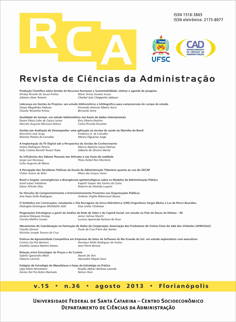
Qualidade de Serviço: um estudo bibliométrico nas bases de dados internacionais
DOI:
https://doi.org/10.5007/2175-8077.2013v15n36p49Resumen
O objetivo deste artigo é servir de fonte de referências sobre Qualidade de Serviços para futuras pesquisas. Após levantamento nas bases de dados internacionais, EBSCO e ProQuest, é apresentando os resultados sobre o estado da arte deste assunto. O método utilizado foi a bibliometria, sendo investigados 132 artigos de um universo de 13.427. Os trabalhos analisados compreendem o período de 1985 a 2011. Dentre as contribuições, resultados e conclusões para futuras pesquisas são apresentadas: i) autores mais citados; ii) metodologia, dimensões e questionário mais utilizada; iii) publicações mais referenciadas; iv) journals internacionais com mais publicações sobre o tema; v) distribuição da quantidade de publicações por ano; vi) redes de autores; vii) rede de instituições de ensino; viii) termos utilizados na busca nas bases internacionais; ix) as relações estudadas nos 132 artigos; x) critérios para escolha da metodologia na pesquisa em qualidade de serviços; xi) paradigma mais utilizado; e xii) 160 referências de alto impacto.
Descargas
Publicado
Cómo citar
Número
Sección
Licencia
El autor deberá garantizar:
- que exista pleno consenso entre todos los coautores para aprobar la versión final del documento y su envío para publicación.
que su trabajo es original, y si se utilizó trabajo y/o palabras de otras personas, estos fueron debidamente reconocidos.
El plagio en todas sus formas constituye un comportamiento editorial poco ético y es inaceptable. RCA se reserva el derecho de utilizar software o cualquier otro método de detección de plagio.
Todos los envíos recibidos para evaluación en la revista RCA pasan por la identificación de plagio y autoplagio. El plagio identificado en los manuscritos durante el proceso de evaluación dará lugar al archivo del envío. Si se identifica plagio en un manuscrito publicado en la revista, el Editor Jefe realizará una investigación preliminar y, de ser necesario, se retractará.
Los autores otorgan a RCA los derechos exclusivos de primera publicación, estando la obra licenciada simultáneamente bajo la Licencia Creative Commons (CC BY) 4.0 Internacional.

Los autores están autorizados a celebrar contratos adicionales por separado, para la distribución no exclusiva de la versión del trabajo publicado en esta revista (por ejemplo, publicación en un repositorio institucional, en un sitio web personal, publicación de una traducción o como capítulo de un libro), con reconocimiento de autoría y publicación inicial en esta revista.
Esta licencia permite a cualquier usuario tener derecho a:
Compartir: copiar, descargar, imprimir o redistribuir el material en cualquier medio o formato.
Adapte: remezcle, transforme y cree a partir del material para cualquier propósito, incluso comercial.
Bajo los siguientes términos:
Atribución: debe dar el crédito apropiado (citar y hacer referencia), proporcionar un enlace a la licencia e indicar si se realizaron cambios. Debe hacerlo bajo cualquier circunstancia razonable, pero de ninguna manera que sugiera que el licenciante lo respalda a usted o su uso.
Sin restricciones adicionales: no puede aplicar términos legales ni medidas tecnológicas que restrinjan legalmente a otros hacer algo que la licencia permite.