
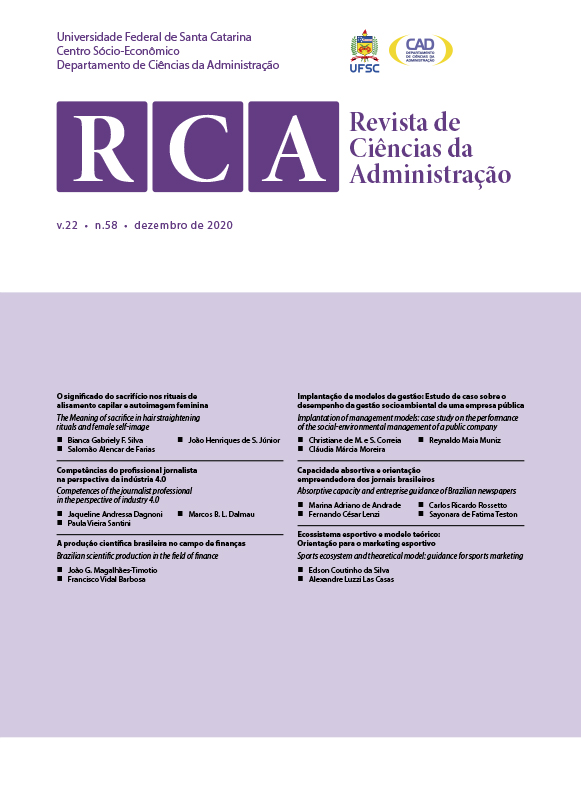
Sports ecosystem and theoretical model: guidance for sports marketing
DOI:
https://doi.org/10.5007/2175-8077.2020.e69999Abstract
Sports marketing is a reference for the generation of profits for sports entities incorporating sponsorships lined up to value chain marketing activities in a customer-oriented marketing plan. The marketing of sport focuses on sport as an event or entertainment. And, marketing through Sport focuses on products and services. This paper aims to introduce five frameworks of sports ecosystems and a theoretical model in order to promote business and marketing strategies focused on fans as a consumer in Brazilian sports clubs. This paper aims to introduce four sports ecosystem business models to marketing professionals as assumptions for implementing and applying market orientation to sports clubs. However, the authors want to establish sports ecosystems as inputs or assumptions for preparing a marketing plan for sports entities. Sports Marketing depends on sponsorship for designing, executing, and controlling the sports entities' value chain by offering benefits to fans passionate for their sporting teams.
References
Amorim, J. G. B. & Almeida, V. M. C. (2015). The Effect of Simultaneous Sponsorship of Rival Football Teams. Brazilian Administration Review. 12(1), 63-87.
Bernstein, G. (2015). The Principles of Sports Marketing. Illinois: Sagamore, Publishing.
Blumrodt, J; Desbordes, M. & Bodin, D. (2013). Professional Football Clubs and Corporate Social Responsibility. Sport Business and Management. 3(3), 205-225.
Bradbury, T. & O’Boyle, I. (2017) Understanding Sport Management: International Perspectives. New York, USA: Routledge.
Burden, W. & Li, M. (2009). Minor League Baseball: Exploring the Growing Interest in Outsourced Sport Marketing. Sport Marketing Quartely, 18, 139-149.
Chadwick, S. & Thwaites, D. (2005). Management Sport Sponsorship Programmes: Lessons from a Critical Assessment of English Soccer. Journal of Advertising Research 45(3), 328-338.
Clark, J. (2011). Changing the Game: Outlook for the Global Sport Market to 2015. PricewaterhouseCoopers (PwC). Disponível em: http://www.pwc.com/gx/en/hospitality-leisure/pdf/changing-the-game-outlook-for-the-global-sports-market-to-2015.pdf. Acesso em 10 outubro de 2016.
Collignon, H. & Sultan, N. (2014). Winning in Business Sports. ATKeaney Report. Disponível em: https://www.atkearney.com/documents/10192/5258876/Winning+in+the+Business+of+Sports.pdf/ed85b644-7633-469d-8f7a-99e4a50aadc8. Acesso em 8 de outubro de 2016.
Collignon, H.; Sultan, N. & Santander, C. (2011). The Sports Market: Major Trends and Challenges in an Industry Full of Passion. ATKeaney Report. Disponível em: http://www.smri.in/wp-content/uploads/2015/02/Sports_Market.pdf. Acesso em 8 de outubro de 2016.
Ferrand, A. & McCarthy, S. (2009). Marketing the Sports Organisation. Building Networks and Relationships. London: Routledge.
Fullerton, S. & Merz, G. R. (2008). The Four Domains of Sports Marketing: A Conceptual Framework. Sports Marketing Quarterly. 17(2), 90-108.
KPMG Report (2014). Business of Sports: Shaping a Successful Innings for the Indian Sports Industry. Disponível em: http://www.smri.in/wp-content/uploads/2015/02/Business-of-Sports-KPMG.pdf. Acesso em 8 de outubro de 2016.
Leopkey, B. & Parent, M. (2009). Risk Management Issues in Large-Scale Sporting Events: A Stakeholder Perspective. European Sport Management Quarterly, 9(2), 187-208.
Maltese, L. & Danglade, J. P. (2014). Marketing du Sport et Événementiel Sportif. Paris: Dunod.
McHugh, J., Bronson, P., & Watters, E. (2015). Disponível em: The Future of Sports (2015). Reports. futureof.com. http://www.gannett-cdn.com/usatoday/editorial/sports/The-Future-of-Sports-2015-Report.pdf. Acesso em 20 de outubro de 2016.
Moore, N. & Levermore, R. (2012). English Professional Football Clubs: Can Business Parameters of Small and Medium-Sized Enterprises be Applied? Sport Business and Management: An International Journal, 2(3), 196-209.
Norris, J. I.; Wann, D. L. & Zapalac, R. K. (2014). Sport Fan Maximizing: Following the Best Team or Being the Best Fan? Journal of Consumer Marketing, 32(3), 157-166.
Ratten, V. & Ratten H. (2011). International Sport Marketing: Practical and Future Research Implications. Journal of Business & Industrial Marketing. 26(8), 614-620,
Ratten, V. (2016). The Dynamics of Sport Marketing. Suggestions for Marketing Intelligence and planning. Marketing Intelligence & Planning, 14(2), 162-168.
Rundh, B. & Gottfridsson, P. (2015). Delivering Sports Events: The Arena Concept in Sports from Network Perspective. Journal of Business & Industrial Marketing, 30(7), 785-794.
Shilbury, D. & Rentschler, R. (2007). Assessing Sport Management Journals: A Multi-Dimensional Examination. Sport Management Review, 10(3), 3-14.
Shilbury, D. (2009). Sport Management Series, 3rd ed. Sydney: Allen & Unwin.
Smith, A. & Westerbeek, H. (2003). Sport Business in the Global Marketplace. New York: Palgrave, Macmillan.
Smolianov, P. & Shilbury, D. (2005). Examining Integrated Advertising and Sponsorship in Corporate Marketing Through Televised Sport. Sport Marketing Quarterly, 14, 239-250.
Storm, R. K.; Wagner, U. & Nielsen, K. (2017). When Sport Meets Business: A Brief Introduction. In: Nielsen, K.; Wagner, U. & Storm, R. K. When Sports Meets Business: Capabilities, Challenges, Critiques, London, UK: Sage.
Downloads
Published
How to Cite
Issue
Section
License
The author must ensure:
- that there is complete consensus among all co-authors to approve the final version of the paper and its submission for publication.
- that their work is original, and if the work and/or words of others have been used, these have been duly acknowledged.
Plagiarism in all its forms constitutes unethical publishing behavior and is unacceptable. RCA reserves the right to use software or any other methods of plagiarism detection.
All submissions received for evaluation in the RCA journal are screened for plagiarism and self-plagiarism. Plagiarism identified in manuscripts during the evaluation process will result in the submission being archived. In the event of plagiarism being identified in a manuscript published in the journal, the Editor-in-Chief will conduct a preliminary investigation and, if necessary, retract it.
Authors grant RCA exclusive rights of first publication, with the work simultaneously licensed under the Creative Commons (CC BY) 4.0 International License.

Authors are authorized to enter into separate, additional contractual arrangements for the non-exclusive distribution of the version of the work published in this journal (e.g., publishing in an institutional repository, on a personal website, publishing a translation, or as a chapter in a book), with an acknowledgement of its authorship and initial publication in this journal.
This license grants any user the right to:
Share – copy, download, print, or redistribute the material in any medium or format.
Adapt – remix, transform, and build upon the material for any purpose, even commercially.
According to the following terms:
Attribution – You must give appropriate credit (cite and reference), provide a link to the license, and indicate if changes were made. You may do so in any reasonable manner, but not in any way that suggests the licensor endorses you or your use.
No additional restrictions – You may not apply legal terms or technological measures that legally restrict others from doing anything the license permits.
