
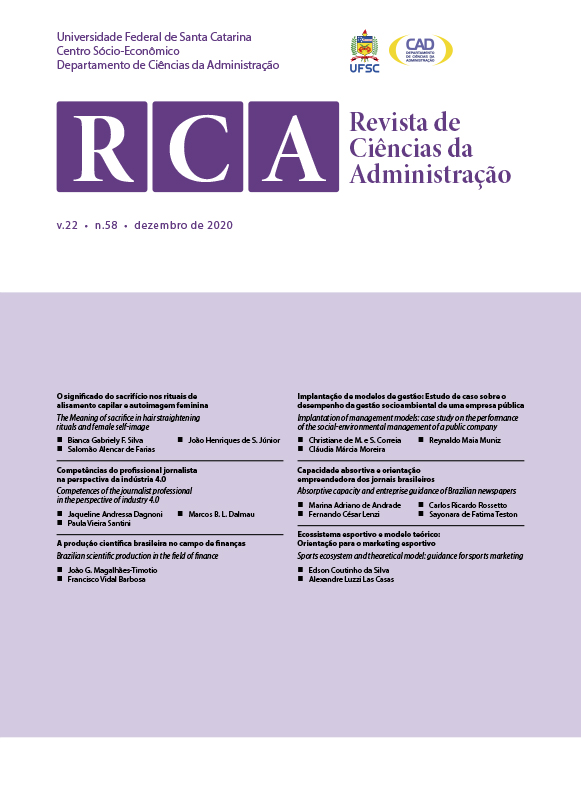
The Meaning of sacrifice in hair straightening rituals and female self-image
DOI:
https://doi.org/10.5007/2175-8077.2020.e70165Abstract
People consume based on the way they see themselves and want to be seen, especially with regard to aesthetic consumption, often presenting sacrificial conduct for the fulfillment of their desires. Associated with negative stereotypes, curly or curly hair usually undergoes structural changes from straightening to follow socially acceptable standards. In this context, this work aims to understand the meaning of the sacrifice involved in the straightening ritual and its relationship with self-image and idealized social patterns. The research, with a qualitative interpretative approach based on oral history and thematic content analysis, realized that the straightening ritual is seen as a sacrifice for women by factors such as time, money, health risk and the process itself; and most of them are influenced to perform the straightening by the influence of the compliments, judgments and prejudices of others.
References
AGNEW, C. R.; ETCHEVERRY, P. E. Cognitive interdependence: Considering self-in-relationship. In K. D. Vohs, E. J. Finkel (Eds.), Self and relationships: Connecting intrapersonal and interpersonal processes, p. 274-293. New York: Guilford Press, 2006
AGNEW, C. R.; VAN LANGE, P. A.; RUSBULT, C. E.; LANGSTON, C. A. Cognitive interdependence: Commitment and the mental representation of close relationships. Journal of personality and social psychology, v. 74, n. 4, 1998.
BADJE, D. To possess and to be possessed: the sacred facet of gift giving. European Advances in Consumer Research. v. 7, 2007.
BANKHEAD, T.; JOHNSON, T. Self-Esteem, Hair-Esteem and Black Women with Natural Hair. International Journal of Education and Social Science. v. 1, n. 4, p; 92-102, 2014.
BARDIN, L. Análise de conteúdo. Lisboa: Edições 70, 1977.
BAUER, M.; GASKELL, G. Pesquisa qualitativa com texto, imagem e som. Petrópolis: Vozes, 7 ed, 2008.
BELK, R. W. Digital consumption and the extended self. Journal of Marketing Management, v. 30, n. 1/2, p. 1101-1118, 2014.
BELK, R. W. Extended Self in a Digital World. Journal of Consumer Research, 2013.
BELK, R. W. Possessions and the Extended Self. Journal of Consumer Research, v. 15, p. 139-168, 1988.
BELK, R. W.; COON, G. S. Gift giving as agapic love: An alternative to the exchange paradigm based on dating experiences. Journal of Consumer Research, v. 2, n.3, p. 393-417, 1993.
BELK, R. W.; COSTA, J. A. The Mountain Man Myth: A Contemporary Consuming Fantasy. Journal of Consumer Research, v. 25, n. 3, p. 218-240, December, 1998.
BELK, R. W.; GER, G.; ASKEGAARD, S. The Fire of Desire: A Multisited Inquiry into Consumer Passion. Journal of Consumer Research. Vol. 30, N. 3, p. 326-351, 2003.
BELK, R. W.; WALLENDORF, M.; SHERRY, J. F. JR. The Sacred and the Profane in Consumer Behavior: Theodicy on the Odyssey. Journal of Consumer Research. v. 16, p. 1-38, 1989.
BENSON, E. P.; COOK, A. G. Ritual sacrifice in ancient Peru. Austin, TX: University of Texas Press, 2001.
BIRDWELL, A. E. A study of influence of image congruence on consumer choice. Journal of Business, v. 41, n. 1, p. 76-88, 1968.
CAMPOS, R. D.; CASOTTI, L. M. Bela na tela da TV: padrões de beleza e imaginário nos textos culturais televisivos. Revista Interdisciplinar de Marketing, v.6, n.1, p. 26-39, 2016.
CASOTTI, L. M.; SUAREZ, M. C.; CAMPOS, R. D. O tempo da beleza: consumo e comportamento feminino, novos olhares. Rio de Janeiro: Senac Nacional, 2008.
CHAPMAN, Y. "I am Not my Hair! Or am I?": Black Women's Transformative Experience in their Self Perceptions of Abroad and at Home (Master’s thesis), 2007.
CHERRIER, H.; RAHMAN K. Galloping Through the Global Brandscape: Consumers in a Branded Reality. Advances in Consumer Research, v. 37, eds., 2010.
DIAS, T. C.; BABY, A.; KANEKO, T. M.; VELASCO, M. V. Relaxing/ straightening of Afro-ethnic hair: historical overview. Journal of Cosmetic Dermatology, v. 6. p. 2–5, 2007.
DOLICH, I. J. Congruence Relationship Between Self-Image and Product Brands. Journal of Marketing Research, v. 6, n. 1, p. 80-84, 1969.
DOMZAL, T. J.; KERNAN, J. B. Variations on the Pursuit of Beauty: Toward A Corporal Theory of the Body. Psychology & Marketing, v. 10, n.6, p. 495-511, 1993.
ERASMUS, Z. 'Oe! My Hare Gaan Huistoe': Hair-Styling as Black Cultural Practice. Race, Identity and Change, v. 32, p. 11-16, 1997.
FEIN, S.; SPENCER, S. J. Prejudice as Self-image Maintenance: Affirming the Self Through Derogating Others. Journal of Personality and Social Psychology, v. 73, n. 1, p. 31-44, 1997.
FOUCAULT, M. Vigiar e punir: nascimento da prisão. Tradução de Raquel Ramalhete. 36. ed. Petrópolis: Vozes, 2009.
FRANQUILINO, E. Cabelos através dos tempos. Revista de Negócios da Indústria da Beleza, Edição Temática, v. 4, n. 11, p. 6-16, 2009.
GASKELL, G.; BAUER, M. Para uma prestação de contas pública: além da amostra, da fidedignidade e da validade. In: Bauer, M. W. & Gaskell, G. Pesquisa Qualitativa com texto, imagem e som. Um manual prático. 8. ed. Petrópolis: Vozes, p. 39-63, 2010.
GRUBB, E. L.; GRATHWOHL, L. H. Consumer Self Concept, Symbolism and Market Behavior: A Theoretical Approach. Journal of Marketing Research, v. 31, p. 22-27, 1967.
HIRSCHMAN, E. C. Commonality and idiosyncracy in popular culture: An empirical examination of the “layers of meaning” concept. Paper read at Consumer Esthetics and Symbolic Consumption, at New York, 1980.
HIRSCHMAN, E.; HOLBROOK, M. B. Hedonic consumption: emerging concepts, methods and propositions. Journal of Marketing. v. 46, 1982.
HOLT, D. B. How Consumers Consume: A Typology of Consumption Practices. Journal of Consumer Research, v. 22, n. 1, p. 1-16, June, 1995.
HUBERT, H.; MAUSS, M. Sobre o sacrifício. São Paulo: Cosac Naify, 1899.
KEARNS, C. M. Theory and description in recent work on sacrifice. Journal of the Royal Anthropological Institute. v. 22, n. 2, p. 412-414, 2016.
KELLER, M.; KALMUS V. Between Consumerism And Protectionism Attitudes towards children, consumption and the media in Estonia, Childhood, v. 16 n. 3 p.355–375, 2009.
LEACH, E. R. Two Essays Concerning the Symbolic Representation of Time. Reader in Comparative Religion, eds. William Lessa and Evon Vogt, New York: Harper; Row, 1958.
LEONARDI, G. R. Cosmetologia aplicada. 2 ed. São Paulo: Ed. Santa Isabel, 2008.
LEVY, S. J. Symbols for Sale. Harvard Business Review, v. 37, n. 4, p. 117-124, 1959.
LIAO, K. H.; CHEN, S. H.; JHOU, Y. S. The Effect of Price, Quality, Sacrifice, Risks and Value on General Consumers’ Perceptions with Aesthetic Medicine. International Academic Conference on Social Sciences, p. 163–171, 2014.
LIPOVETSKY, G. O império do efêmero: a moda e seu destino nas sociedades modernas. São Paulo: Companhia das Letras, 1989.
LIPOVETSKY, G. A terceira mulher: permanência e evolução do feminino. São Paulo, Companhia das Letras, 2000.
LIVRAMENTO, M. N.; HOR-MEYLL, L. F.; PESSOA, L. A. Valores que motivam mulheres de baixa renda a comprar produtos de beleza. RAM - Rev. Adm. Mackenzie. São Paulo, v. 14, n. 1, p. 44-74, 2013.
MANNING, J. The Sociology of Hair: Hair Symbolism Among College Students, Social Sciences Journal, v. 10, p. 35-48, 2011.
MATEAR, M. A. The Role and Nature of Willingness to Sacrifice in Marketing Relationships. Kingston: Queen’s University, 2014.
MCCRACKEN, G. Culture and consumption: a theoretical account of the structure and movement of the cultural meaning of consumer goods. Journal of Consumer Research, v. 13, n. 1, p. 71-84, 1986.
OLASODE, O. A. Chemical hair relaxation and adverse outcomes among Negroid women in South West Nigeria, Journal of Pakistan Association of Dermatologists, v. 19, n. 4 p. 203-207, 2009.
PIRES, K. T.; MOCELLIN, M. C. Manipulando cabelos e identidades: um estudo com mulheres negras em Santa Maria-RS. Revista África e africanidades, v. 9, n. 21, p. 1-20, 2016.
PONCHIO, M. C.; STREHLAU, V. I. Eu estendido no interesse por automóveis clássicos: estudo comparativo entre consumidores paulistanos. FACEP PESQUISA, v. 14, n. 3, p. 299- 308, 2011.
ROGERS, C. R. Cl&nt-Centered Therapy. Houghton-Mifflin, Boston, 1951.
ROOK, D. W. The Ritual Dimension of Consumer Behavior. Journal of Consumer Research, v.12, p. 251-264, Dez, 1985.
RUDIO, F. V. Introdução ao projeto de pesquisa científica. 34a ed. Petrópolis: Vozes, 2007.
RUSBULT, C. E.; AGNEW, C. R. Prosocial motivation and behaviour in close relationships. Herzliya Symposium, v. 2, March, 4, 2008.
RUVIO, A.; BELK, R. The Routledge companion to identity and consumption. London and New York: Routledge, 2013.
SCHEWE, C. D.; DILLON, W. R. Marketing Information system utilization: An application of self-concept theory. Journal of Business Research, v. 6, n.1, p. 67-79, 1978.
SCHUELLER, R. Iniciação a química cosmética. v. 2. São Paulo. Tecnopress, 2002.
SIRGY, M. J. Self-Concept in Consumer Behavior: A Critical Review. Journal of Consumer Research, v. 9, n. 3, p. 287-300, 1982.
SIRGY, M. J. The Self-Concept in Relation to Product Preference and Purchase Intention. In: BELLUR, V. Marketing Horizons: A 1980's Perspective: Proceedings of the 1980 Academy of Marketing Science (AMS) Annual Conference (E-book). Springer, p. 350-354, 2015.
THOMPSON, C. Black women, beauty, and hair as a matter of being. Women’s Studies, v. 38, p. 831–856, 2009.
TRIVIÑOS, A. N. S. Introdução à pesquisa em ciências sociais: a pesquisa qualitativa em educação. São Paulo, Atlas, 1987.
TSEELON, E. The Masque of Femininity. London: Sage, 1995.
VAN LANGE, P. A. M.; AGNEW, C. R.; HARINCK, F.; STEEMERS, G. E. M. From game theory to real life: How social value orientation affects willingness to sacrifice in ongoing close relationships. Journal of Personality and Social Psychology, v. 73 n. 6, p.1330-1344, 1997.
ZEITHAML, V. A. Consumer perceptions of price, quality, and value: a means-end model and synthesis of evidence. The Journal of Marketing, v. 52, n. 3, p. 2-22, 1988.
WOLF, N. O mito da beleza: como as imagens da beleza são usadas contra as mulheres. Rio de Janeiro: Rocco, 1992.
Downloads
Published
How to Cite
Issue
Section
License
The author must ensure:
- that there is complete consensus among all co-authors to approve the final version of the paper and its submission for publication.
- that their work is original, and if the work and/or words of others have been used, these have been duly acknowledged.
Plagiarism in all its forms constitutes unethical publishing behavior and is unacceptable. RCA reserves the right to use software or any other methods of plagiarism detection.
All submissions received for evaluation in the RCA journal are screened for plagiarism and self-plagiarism. Plagiarism identified in manuscripts during the evaluation process will result in the submission being archived. In the event of plagiarism being identified in a manuscript published in the journal, the Editor-in-Chief will conduct a preliminary investigation and, if necessary, retract it.
Authors grant RCA exclusive rights of first publication, with the work simultaneously licensed under the Creative Commons (CC BY) 4.0 International License.

Authors are authorized to enter into separate, additional contractual arrangements for the non-exclusive distribution of the version of the work published in this journal (e.g., publishing in an institutional repository, on a personal website, publishing a translation, or as a chapter in a book), with an acknowledgement of its authorship and initial publication in this journal.
This license grants any user the right to:
Share – copy, download, print, or redistribute the material in any medium or format.
Adapt – remix, transform, and build upon the material for any purpose, even commercially.
According to the following terms:
Attribution – You must give appropriate credit (cite and reference), provide a link to the license, and indicate if changes were made. You may do so in any reasonable manner, but not in any way that suggests the licensor endorses you or your use.
No additional restrictions – You may not apply legal terms or technological measures that legally restrict others from doing anything the license permits.
