
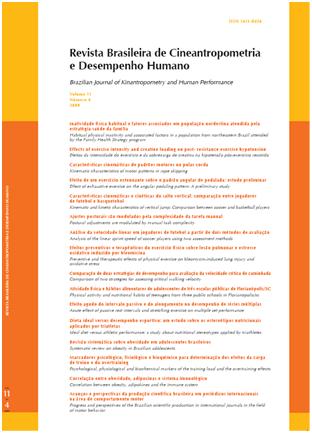
Habitual physical inactivity and associated factors in a population from northeastern Brazil attended by the Family Health Strategy program
DOI:
https://doi.org/10.1590/1980-0037.2009v11n4p365Abstract
The objective of this study was to determine the prevalence of low habitual physical activity (LHPA) in adults and to identify associated demographic, socioeconomic and health indicators. A household/population-based cross-sectional study was conducted on male and female adults aged 20 to 69 years, living in eight areas covered by the Family Health Strategy (FHS) program of the town of Guanambi, Bahia, Brazil. A total of 565 domestic households were included, for a final sample of 711 (93.15%) adults, including 544 (76.5%) females. The questionnaire of Baecke et al. was used to assess LHPA, establishing the first and second quartiles as recommended by the instrument itself (? 7.25). Associations were analyzed using descriptive analysis and Poisson regression at a level of significance of p ? .05. The prevalence of LHPA was 51.1%. After adjusted analysis, LHPA was only associated with gender, with women presenting a higher chance of LHPA (RR = 1.72, CI = 1.27-2.33). The prevalence of LHPA was similar to that reported in the literature. Studies evaluating the association between physical activity such as domestic activities, leisure, sports or occupation/work and other variables are necessary to demonstrate the limitations and possibilities of physical activity intervention programs in populations attended by the FHS.
Published
Issue
Section
License
Copyright (c) 2009 Marcius de almeida Gomes, Maria de Fátima da Silva Duarte, Jacemile da Silva Pereira, Ysnaya Rocha Fernandes, Lisiane Schilling Poeta, Adriano Ferreti Borgatto

This work is licensed under a Creative Commons Attribution 4.0 International License.

This work is licensed under a Creative Commons Attribution 4.0 International License.
