“Por el amor del estudiante”: hacia una lexicografía integradora.
DOI:
https://doi.org/10.5007/%25xResumen
Este artículo parte de una paradoja aparente: el ordenador puede ayudar a evitar problemas con los que él mismo tropieza al traducir, provocados por las dimensiones sintagmática y paradigmática de la lengua, como las palabras polisémicas y casi-sinónimas, las colocaciones, las valencias, etc. Para reducir el riesgo de que también los estudiantes de ELE tropiecen con ellos, la lexicografía debe, a nuestro parecer, aprovechar las posibilidades ofrecidas por la era digital para almacenar y ofrecer el léxico de tal manera que el aprendiz encuentre ahí un máximo de componentes que le ayuden a evitar precisamente estos escollos. “Por el amor del estudiante” recomendamos que se tomen en cuenta unas 10 pautas “pedagógicas”, alrededor de las palabras clave siguientes: tomar en cuenta los marcos y estilos de aprendizaje; apelar a ambos hemisferios del cerebro humano; disposición temática; distinguir entre vocabulario activo y pasivo; presentar un conjunto de dimensiones del lexema, inclusive la comparación con otras lenguas; producir asociaciones significativas; repetición controlada; incluir retroalimentación; proceder a una selección léxica y trabajar por fases y niveles. En otros términos, abogamos por una lexicografía integradora, es decir: que integre un máximo de dimensiones sintagmáticas y paradigmáticas del léxico, para que el usuario se sienta invitado a descubrir, a través del léxico, todo el mundo hispánico.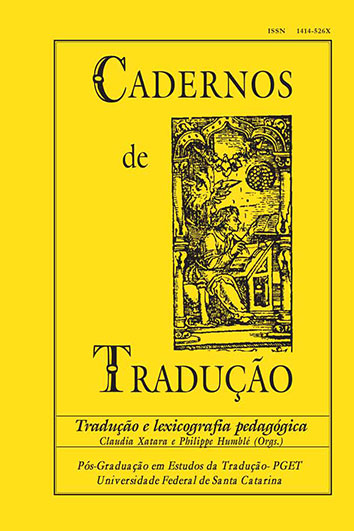
Descargas
Publicado
2006-04-30
Cómo citar
Buyse, K. (2006). “Por el amor del estudiante”: hacia una lexicografía integradora. Cadernos De Tradução, 2(18), 195–213. https://doi.org/10.5007/%x
Número
Sección
Artículos
Licencia
Derechos de autor 2006 Cadernos de Tradução

Esta obra está bajo una licencia internacional Creative Commons Atribución 4.0.
Declaración de Derecho de Autor
Los autores conservan sus derechos de autor y conceden a la revista el derecho a la primera publicación bajo la Licencia Creative Commons Attribution, que permite que se comparta el trabajo reconociéndose la autoría y publicación inicial en esta revista.
Los autores están autorizados a asumir contratos adicionales por separado para la distribución no exclusiva de la versión del trabajo publicada en esta revista (por ej.: publicar en un repositorio institucional o como capítulo de libro, reconociéndose la autoría y publicación inicial en esta revista).