Satyricon e tradução poética: traduções brasileiras perante sutilezas cruciais da poesia de Petrônio.
DOI:
https://doi.org/10.5007/2175-7968.2008v2n22p107Abstract
Smart appropriations of Antiquity’s popular genres aggregated to a contesting exploration of the Greek-Roman canon from the time when Satyricon was written strengthen the thesis that the Petronius’ workmanship is before an ambitious literary project than a moralizing reaction to the age of Nero. According to some recent studies of theorists like Connors, Conte and Panayotakis, the combination of prose and verse in Satyricon is, for example, unusual and sophisticated. The exploration of some levels of language-manipulation and the complex punning web evidenced for such authors, instead of being only details that enrich the text, constitute in some cases the main existing literary work in it and imply a redoubled care to the translator. For inspiration of such studies and of the translation theories of Mounin, Berman and Britto, in this work four translations of the first one of the poems that appear amid the narrative of Satyricon are taken to the analysis and submitted to critique.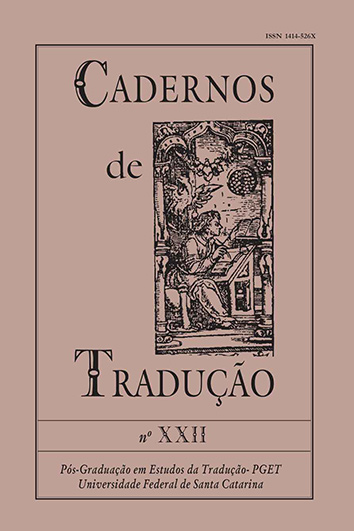
Downloads
Published
2009-02-06
How to Cite
Queriquelli, L. H. (2009). Satyricon e tradução poética: traduções brasileiras perante sutilezas cruciais da poesia de Petrônio. Cadernos De Tradução, 2(22), 107–127. https://doi.org/10.5007/2175-7968.2008v2n22p107
Issue
Section
Articles
License
Copyright Notice
Authors hold the copyright and grant the journal the right for their articles' first publication, being their works simultaneously licensed under the Creative Commons Attribution License (CC BY), which allows the sharing of such works with its authorship acknowledged and its initial publication in this journal.
Authors are allowed to enter into separate additional contractual arrangements for the non-exclusive distribution of the journal's published version of the work (e.g., post it to an institutional repository or as a book chapter, with an acknowledgment of its initial publication in this journal).