
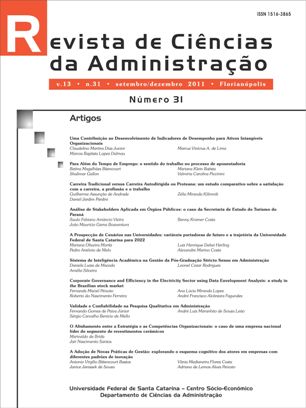
Carreira tradicional versus carreira autodirigida ou proteana: um estudo comparativo sobre a satisfação com a carreira, a profissão e o trabalho
DOI:
https://doi.org/10.5007/2175-8077.2011v13n31p58Resumo
Este estudo objetivou verificar se as atitudes e os valores dos profissionais que atualmente se inserem ou se encontram no mercado de trabalho são mais aderentes à ideia da carreira tradicional ou à da carreira autodirigida/proteana. Buscou identificar, ainda, as âncoras de carreira dos entrevistados, o grau de satisfação com a carreira, com a profissão e com o trabalho, assim como a relação entre estas variáveis. O instrumento de coleta de dados utilizado foi o questionário, e a amostra foi composta por 113 estudantes de Graduação e de Pós-Graduação Lato e Stricto Sensu em Administração. Como resultado, encontrou-se a âncora de carreira “Estilo de Vida” com a média mais elevada, indicando a tendência de se buscar uma carreira que permita integrar as necessidades pessoais, familiares e de trabalho. Detectou-se aqui uma maior inclinação dos pesquisados para trilhar a carreira autodirigida ou proteana, e não foram encontradas correlações entre âncoras de carreira e satisfação com a carreira, indicando que não h determinada âncora que possa proporcionar maior satisfação profissional do que outra. O estudo contribui com a proposição de questões acerca do perfil de carreira que vem sendo adotado e com a identificação do nível de satisfação do profissional, além de recomendar uma revisão da escala de Âncoras de Carreira, de maneira a aumentar sua confiabilidade.
Downloads
Publicado
Como Citar
Edição
Seção
Licença
O autor deve garantir:
- que haja um consenso completo de todos os coautores em aprovar a versão final do documento e sua submissão para publicação.
- que seu trabalho é original, e se o trabalho e/ou palavras de outras pessoas foram utilizados, estas foram devidamente reconhecidas.
Plágio em todas as suas formas constituem um comportamento antiético de publicação e é inaceitável. RCA reserva-se o direito de usar software ou quaisquer outros métodos de detecção de plágio.
Todas as submissões recebidas para avaliação na revista RCA passam por identificação de plágio e autoplágio. Plágios identificados em manuscritos durante o processo de avaliação acarretarão no arquivamento da submissão. No caso de identificação de plágio em um manuscrito publicado na revista, o Editor Chefe conduzirá uma investigação preliminar e, caso necessário, fará a retratação.
Os autores cedem à RCA os direitos exclusivos de primeira publicação, com o trabalho simultaneamente licenciado sob a Licença Creative Commons (CC BY) 4.0 Internacional.

Os autores têm autorização para assumir contratos adicionais separadamente, para distribuição não exclusiva da versão do trabalho publicada neste periódico (ex.: publicar em repositório institucional, em site pessoal, publicar uma tradução, ou como capítulo de livro), com reconhecimento de autoria e publicação inicial neste periódico.
Esta licença permite que qualquer usuário tenha direito de:
Compartilhar – copiar, baixar, imprimir ou redistribuir o material em qualquer suporte ou formato.
Adaptar – remixar, transformar e criar a partir do material para qualquer fim, mesmo que comercial.
De acordo com os seguintes termos:
Atribuição – Você deve dar o crédito apropriado (citar e referenciar), prover um link para a licença e indicar se mudanças foram feitas. Você deve fazê-lo em qualquer circunstância razoável, mas de maneira alguma que sugira ao licenciante apoiar você ou o seu uso.
Sem restrições adicionais – Você não pode aplicar termos jurídicos ou medidas de caráter tecnológico que restrinjam legalmente outros de fazerem algo que a licença permita.
