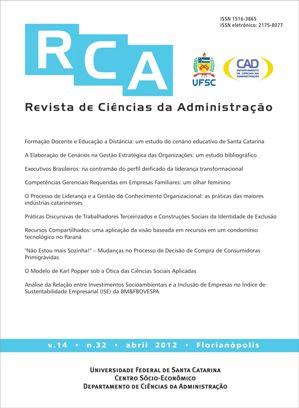
Karl Popper’s model under the perspective of the applied social sciences
DOI:
https://doi.org/10.5007/2175-8077.2012v14n32p124Abstract
DOI: http://dx.doi.org/10.5007/2175-8077.2012v14n32p124
Karl Popper is the leading philosopher of science in modern times, competing with Thomas Kuhn’s interpretation to the primacy of how to utilize de scientific method. Clearly, there are different versions for a reading of this important author who coined the method called deductive with test. This text recognizes the relevance of Karl Popper’s view of science as a practice in hard and biological fields, where it is widely accepted. However, this popularity is not shared in the applied social sciences area. This is an essay to rescue his contribution in an attempt to translate the concepts he developed in a didactic way. To this end, there will be an introduction to the fundamentals of science as specific form o knowledge, seeking to contrast the deductive and inductive approaches and procedures of what is known as formal science, basic and applied. An attempt to classify the formulation of theoretical propositions is undertaken with the use of different criteria, taking examples in the field of management and economics as an illustration.
Downloads
Published
How to Cite
Issue
Section
License
The author must ensure:
- that there is complete consensus among all co-authors to approve the final version of the paper and its submission for publication.
- that their work is original, and if the work and/or words of others have been used, these have been duly acknowledged.
Plagiarism in all its forms constitutes unethical publishing behavior and is unacceptable. RCA reserves the right to use software or any other methods of plagiarism detection.
All submissions received for evaluation in the RCA journal are screened for plagiarism and self-plagiarism. Plagiarism identified in manuscripts during the evaluation process will result in the submission being archived. In the event of plagiarism being identified in a manuscript published in the journal, the Editor-in-Chief will conduct a preliminary investigation and, if necessary, retract it.
Authors grant RCA exclusive rights of first publication, with the work simultaneously licensed under the Creative Commons (CC BY) 4.0 International License.

Authors are authorized to enter into separate, additional contractual arrangements for the non-exclusive distribution of the version of the work published in this journal (e.g., publishing in an institutional repository, on a personal website, publishing a translation, or as a chapter in a book), with an acknowledgement of its authorship and initial publication in this journal.
This license grants any user the right to:
Share – copy, download, print, or redistribute the material in any medium or format.
Adapt – remix, transform, and build upon the material for any purpose, even commercially.
According to the following terms:
Attribution – You must give appropriate credit (cite and reference), provide a link to the license, and indicate if changes were made. You may do so in any reasonable manner, but not in any way that suggests the licensor endorses you or your use.
No additional restrictions – You may not apply legal terms or technological measures that legally restrict others from doing anything the license permits.