
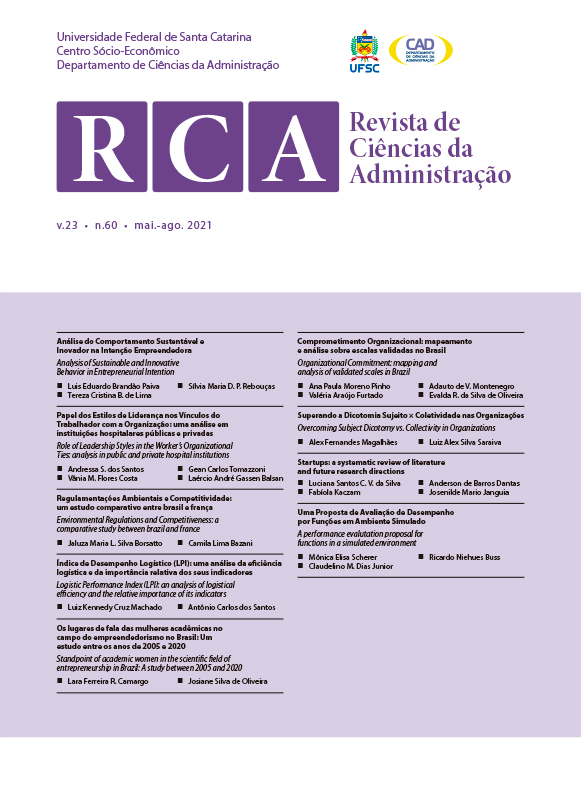
Regulamentações ambientais e competitividade: um estudo comparativo entre Brasil e França
DOI:
https://doi.org/10.5007/2175-8077.2021.e61944Resumen
Este estudo objetivou verificar se existe algum tipo de associação entre o rigor das regulamentações ambientais e a competitividade dos países Brasil e França, entre 2005 e 2015, com base nos resultados dos indicadores de rigor das regulamentações ambientais (Environmental Policy Stringency Index, OECD) e competitividade (Global Competitiveness Index, WEF). Ademais, buscou-se analisar a evolução do rigor das regulamentações ambientais e da competitividade, e um comparativo quanto à associação entre o rigor das regulamentações ambientais e a competitividade desses países. Trata-se de uma pesquisa quali-quantitativa, analisando descritivamente as variáveis em estudo e utilizando-se do teste estatístico correlação linear de Pearson. Os resultados demonstraram que a França é um país mais competitivo e com maior rigor em suas políticas ambientais que o Brasil. Verificou-se a existência de uma associação negativa entre o rigor das regulamentações ambientais e a competitividade no Brasil, e na França verificou-se uma relação negativa e positiva com os pilares da competitividade.
Citas
AIGINGER, K. T. Competitiveness: From a Dangerous Obsession to a Welfare Creating Ability with Positive Externalities. Journal of Industry, Competition and Trade, v. 6, n. 2, p. 161-177, jun. 2006.
ANSOFF, H. I. Corporate strategy. Harmondsworth: Penguin. 1965.
APAK, Sudi; ATAY, Erhan. Global competitiveness in the EU through green innovation technologies and knowledge production. Procedia-Social and Behavioral Sciences, v. 181, p. 207-217, 2015.
BALKYTE, A.; TVARONAVICIENE, M. Perception of competitiveness in the context of sustainable development: Facets of sustainable competitiveness. Journal of Business Economics and Management, v. 11, n. 2, p. 341-365, jun. 2011.
BRASIL. Ministério das Relações Exteriores. O Brasil no G-20. 2018. Disponível em: <http://www.itamaraty.gov.br/pt-BR/politica-externa/diplomacia-economica-comercial-e-financeira/15586-brasil-g20>. Acesso em: 25 out. 2018.
BORSATTO, Jaluza Maria Lima Silva; AMUI, Lara Bartocci Liboni. Green innovation: Unfolding the relation with environmental regulations and competitiveness. Resources, Conservation and Recycling, v. 149, p. 445-454, 2019.
CLEFF, T.; RENNINGS, K. Determinants of environmental product and process innovation. European environment, v. 9, n. 5, p. 191-201, 1999.
CONSTANTINI, V.; MAZZANTI, M. On the green and innovative side of trade competitiveness? The impact of environmental policies and innovation on EU exports. Research Policy, v. 41, n.1, p. 132-153, fev. 2012.
COSTA, R. S.; MARION, J. C. A Uniformidade na Evidenciação das Informações Ambientais. Revista Contabilidade & Finanças, n. 43, p. 20-33, jan./abr. 2007.
DONAIRE, D. Gestão Ambiental na empresa. São Paulo: Atlas, 1995.
DRAPER, N. R.; SMITH, H. Applied regression analysis. 3. ed. New York: John Wiley e Sons, 1998.
FÁVERO, Luiz Paulo; BELFIORE, Patrícia. Manual de análise de dados: estatística e modelagem multivariada com Excel®, SPSS® e Stata®. Elsevier Brasil, 2017.
FÓRUM ECONÔMICO MUNDIAL – FEM. The Global Competitiveness Report. 2018. Disponível em: <http://www3.weforum.org/docs/GCR2017-2018/05FullReport/TheGlobalCompetitivenessReport2017%E2%80%932018.pdf>. Acesso em: 03 nov. 2018.
FRONDEL, M.; HORBACH, J.; RENNINGS, K. End‐of‐pipe or cleaner production? An empirical comparison of environmental innovation decisions across OECD countries. Business strategy and the environment, v. 16, n. 8, p. 571-584, 2007.
HERCIU, M.; OGREAN, C. An Overview on European Union Sustainable Competitiveness. Procedia Economics and Finance, v. 16, p. 651–656, 2014.
IAMAGUCHI, T. E.; MARTINS DE SOUZA, M. C. França: A construção do direito ambiental em um país desenvolvido. Revista Tópos. v. 5, n. 2, p. 47-66, 2011.
JAFFE, A. B.; NEWELL, R. G.; STAVINS, R. N. A tale of two market failures: technology and environmental policy. Ecological Economics, v. 54, n. 2-3, p. 164-174, ago. 2005.
KEMP, R.; PONTOGLIO, S. The innovation effects of environmental policy instruments - A typical case of the blind men and the elephant? Ecological Economics, v. 72, p. 28-36, dez. 2011.
LIMA, M. L. B.; FROTA, J. A.; ARAÚJO, F. S. M.; FONTENELE, R. E. S. Desenvolvimento sustentável e competitividade nas nações: uma análise multivariada. Reuna, v. 22, n. 1, p. 41-62, 2017.
LIU, Lijun et al. Are Environmental Regulations Holding Back Industrial Growth? Evidence from China. Journal of Cleaner Production, p. 127007, 2021.
LUSTOSA, MARIA CECÍLIA JUNQUEIRA. Inovação e tecnologia para uma economia verde: questões fundamentais. Política Ambiental, v. 8, p. 111-122, 2011.
MARGULIS, S. A regulamentação ambiental: instrumentos e implementação (Texto para discussão, N° 437). Brasília, DF: IPEA, 1998.
NAÇÕES UNIDAS. Adoção do Acordo de Paris. 2015. Disponível em: <https://nacoesunidas.org/wp-content/uploads/2016/04/Acordo-de-Paris.pdf>. Acesso em: nov. 2018.
PORTER, M. E. A vantagem competitiva das nações. Rio de Janeiro: Campus, 1989.
PORTER, M. E. America’s Green strategy. Scientific American, v. 264, n. 4, p. 168, abr. 1991.
PORTER, M. E. Competitive advantage: creating and sustaining superior performance. New York: The Free Press, 1985.
PORTER, M. E.; VAN DER LINDE, C. Toward a New Conception of the Environment-Competitiveness Relationship. Journal of Economic Perspectives, v. 9, n. 4, p. 97-118, 1995.
REN, S., LI, X., YUAN, B., LI, D. & CHEN, X. The effects of three types of environmental regulation on ecoefficiency: A cross-region analysis in China. Journal of Cleaner Production, v. 173, p. 245-255, fev. 2018.
REILLY, John M. Green growth and the efficient use of natural resources. Energy Economics, v. 34, p. S85-S93, 2012.
RUBASHKINA, Y.; GALEOTTI, M.; VERDOLINI, E. Environmental regulation and competitiveness: Empirical evidence on the Porter Hypothesis from European manufacturing sectors. Energy Policy, v. 83, p. 288-300, ago. 2015.
SCOONES, Ian; LEACH, Melissa; NEWELL, Peter (Ed.). The politics of green transformations. Routledge, 2015.
SILVEIRA, Juliane Dias Coelho de Araújo; OLIVEIRA, Murilo Alvarenga. Inovação e desempenho organizacional: um estudo com empresas brasileiras inovadoras. Sociedade, Contabilidade e Gestão, v. 8, n. 2, 2013.
STAVINS, R. N. Correlated uncertainty and policy instrument choice. Journal of Environmental Economics and Management, v. 30, n. 2, p. 218-232, mar. 1996.
SUCHEK, Nathalia; FERNANDES, Paula; NASCIMENTO, Thiago Cavalcante. Empreendedorismo e competitividade: Aplicação de uma análise de cluster. In: XXX Jornadas Luso-Espanholas de Gestão Científica: cooperação transfronteiriça: desenvolvimento e coesão territorial: livro de resumos. Instituto Politécnico de Bragança, 2020. p. 125.
YU, Binbin; SHEN, Chen. Environmental regulation and industrial capacity utilization: An empirical study of China. Journal of Cleaner Production, v. 246, p. 118986, 2020.
ZHANG, Yixiang et al. Environmental regulation, capital output and energy efficiency in China: An empirical research based on integrated energy prices. Energy Policy, v. 146, p. 111826, 2020.
ZHANG, Ming; SUN, Xinran; WANG, Wenwen. Study on the effect of environmental regulations and industrial structure on haze pollution in China from the dual perspective of independence and linkage. Journal of Cleaner Production, v. 256, p. 120748, 2020.
ZHAO, X.; YIN, H.; ZHAO, Y. Impact of environmental regulations on the efficiency and CO2 emissions of power plants in China. Applied Energy, v. 149, p. 238-247, jul. 2015.
Descargas
Publicado
Cómo citar
Número
Sección
Licencia
El autor deberá garantizar:
- que exista pleno consenso entre todos los coautores para aprobar la versión final del documento y su envío para publicación.
que su trabajo es original, y si se utilizó trabajo y/o palabras de otras personas, estos fueron debidamente reconocidos.
El plagio en todas sus formas constituye un comportamiento editorial poco ético y es inaceptable. RCA se reserva el derecho de utilizar software o cualquier otro método de detección de plagio.
Todos los envíos recibidos para evaluación en la revista RCA pasan por la identificación de plagio y autoplagio. El plagio identificado en los manuscritos durante el proceso de evaluación dará lugar al archivo del envío. Si se identifica plagio en un manuscrito publicado en la revista, el Editor Jefe realizará una investigación preliminar y, de ser necesario, se retractará.
Los autores otorgan a RCA los derechos exclusivos de primera publicación, estando la obra licenciada simultáneamente bajo la Licencia Creative Commons (CC BY) 4.0 Internacional.

Los autores están autorizados a celebrar contratos adicionales por separado, para la distribución no exclusiva de la versión del trabajo publicado en esta revista (por ejemplo, publicación en un repositorio institucional, en un sitio web personal, publicación de una traducción o como capítulo de un libro), con reconocimiento de autoría y publicación inicial en esta revista.
Esta licencia permite a cualquier usuario tener derecho a:
Compartir: copiar, descargar, imprimir o redistribuir el material en cualquier medio o formato.
Adapte: remezcle, transforme y cree a partir del material para cualquier propósito, incluso comercial.
Bajo los siguientes términos:
Atribución: debe dar el crédito apropiado (citar y hacer referencia), proporcionar un enlace a la licencia e indicar si se realizaron cambios. Debe hacerlo bajo cualquier circunstancia razonable, pero de ninguna manera que sugiera que el licenciante lo respalda a usted o su uso.
Sin restricciones adicionales: no puede aplicar términos legales ni medidas tecnológicas que restrinjan legalmente a otros hacer algo que la licencia permite.
