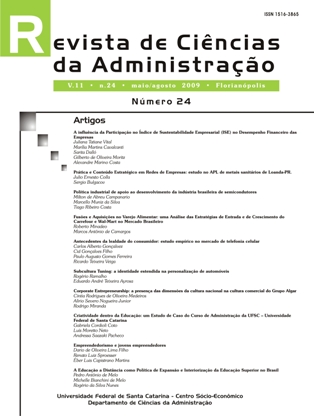
Criatividade dentro da Educação: um estudo de caso do Curso de Administração da UFSC – Universidade Federal de Santa Catarina
DOI:
https://doi.org/10.5007/2175-8077.2009v11n24p221Resumen
É incontestável a importância da criatividade na sociedade do conhecimento. Nesse processo de desenvolvimento criativo, já foi comprovado que tanto a família quanto a escola exercem papéis de suma importância. Diante disso, o presente artigo tem como objetivo identificar a contribuição do Curso de Administração da Universidade Federal de Santa Catarina para o estímulo da criatividade em seus alunos. O estudo foi delineado a partir da avaliação dos planos de ensino das disciplinas oferecidas pelo CAD – Departamento de Ciências da Administração e da análise da percepção dos alunos. Quanto à metodologia aplicada, o estudo caracterizou-se como: qualitativo, exploratório, descritivo, teórico aplicado, estudo de campo, documental, ex-post facto, participante e teórico aplicado. Dentre os resultados atingidos, identificou-se uma discrepância entre a avaliação dos planos de ensino (teoria) e a percepção dos alunos (prática), assim como uma real contribuição do curso para o estímulo da criatividade entre razoável e boa.
Descargas
Publicado
Cómo citar
Número
Sección
Licencia
El autor deberá garantizar:
- que exista pleno consenso entre todos los coautores para aprobar la versión final del documento y su envío para publicación.
que su trabajo es original, y si se utilizó trabajo y/o palabras de otras personas, estos fueron debidamente reconocidos.
El plagio en todas sus formas constituye un comportamiento editorial poco ético y es inaceptable. RCA se reserva el derecho de utilizar software o cualquier otro método de detección de plagio.
Todos los envíos recibidos para evaluación en la revista RCA pasan por la identificación de plagio y autoplagio. El plagio identificado en los manuscritos durante el proceso de evaluación dará lugar al archivo del envío. Si se identifica plagio en un manuscrito publicado en la revista, el Editor Jefe realizará una investigación preliminar y, de ser necesario, se retractará.
Los autores otorgan a RCA los derechos exclusivos de primera publicación, estando la obra licenciada simultáneamente bajo la Licencia Creative Commons (CC BY) 4.0 Internacional.

Los autores están autorizados a celebrar contratos adicionales por separado, para la distribución no exclusiva de la versión del trabajo publicado en esta revista (por ejemplo, publicación en un repositorio institucional, en un sitio web personal, publicación de una traducción o como capítulo de un libro), con reconocimiento de autoría y publicación inicial en esta revista.
Esta licencia permite a cualquier usuario tener derecho a:
Compartir: copiar, descargar, imprimir o redistribuir el material en cualquier medio o formato.
Adapte: remezcle, transforme y cree a partir del material para cualquier propósito, incluso comercial.
Bajo los siguientes términos:
Atribución: debe dar el crédito apropiado (citar y hacer referencia), proporcionar un enlace a la licencia e indicar si se realizaron cambios. Debe hacerlo bajo cualquier circunstancia razonable, pero de ninguna manera que sugiera que el licenciante lo respalda a usted o su uso.
Sin restricciones adicionales: no puede aplicar términos legales ni medidas tecnológicas que restrinjan legalmente a otros hacer algo que la licencia permite.