
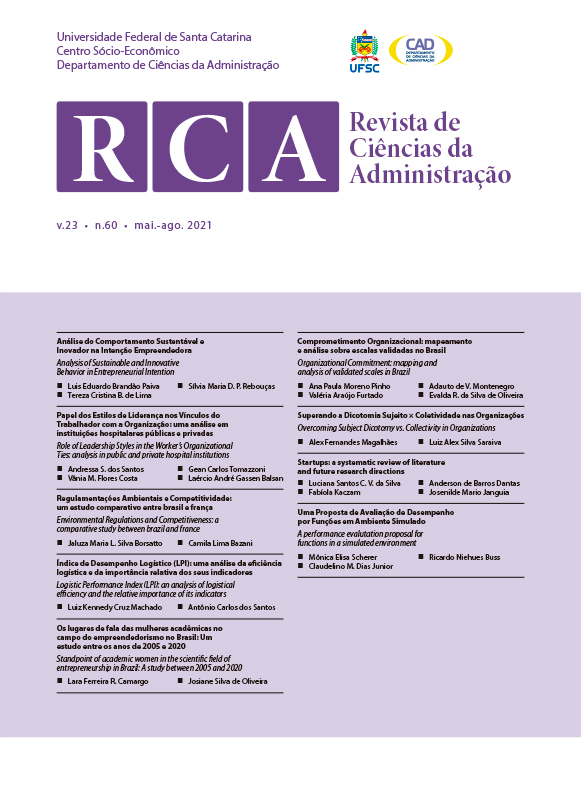
Logistic performance index (LPI): an analysis of logistical efficiency and the relative importance of its indicators
DOI:
https://doi.org/10.5007/2175-8077.2021.e78182Abstract
This research evaluated the logistical efficiency of the countries, as well as creating scores that represent the weight of each indicator of the Logistic Performance Index (LPI) in this efficiency. The Data Envelopment Analysis (DEA) was used to measure logistical efficiency and made it possible to compare the six LPI indicators (inputs) from 99 countries and show the relationship of these indicators with the Gross Domestic Product per capita (output). For the creation of the scores, multivariate statistics were used with the discriminant analysis to elucidate which indicators better discriminate the groups of the countries that are more and less efficient in terms of logistics. The results grouped the levels of logistical efficiency of the countries in the lower, median and upper efficiency ranges, while the discriminant analysis showed the LPI indicators that most impact logistics performance, with Customs, Infrastructure and International Shipments being the most significant indicators in search for maximum logistical efficiency in the countries.
References
BALLOU, R. H. Gerenciamento da cadeia de suprimentos: Logística Empresarial. 5. ed. Porto Alegre: Bookman, 2006.
BANCO MUNDIAL. 2020. Disponível em: <https://www.bancomundial.org/es/country/panama>. Acesso em: 03 mar. 2020.
BANCO MUNDIAL. Connecting to compete 2016: trade logistics in the global economy. Disponível em: < https://lpi.worldbank.org/>. Acesso em: 21 jan. 2019.
BANCO MUNDIAL. Connecting to compete 2018: trade logistics in the global economy. Disponível em: < https://lpi.worldbank.org/>. Acesso em: 21 jan. 2019.
BAZANI, C. L. Desempenho logístico do Brasil no mercado internacional: análise do índice LPI. 2017. 116 p. Dissertação (Mestrado em Ciências Contábeis) – Universidade Federal de Uberlândia, Uberlândia. 2017.
BIZOTTO, B. L. S.; COSTA, C. A.; RUI, C.; LAZZAROTTO, E.; RECHE, R. A.; CAMARGO, M. E. Estudo de Caso dos Impactos da Crise Global nos Critérios Competitivos Estratégicos de Empresas. Revista Gestão Industrial. v. 07, n. 1, p. 23-42, 2011.
CIA.GOV. 2020. Disponível em: <https://www.cia.gov/library/publications/the-world-factbook/geos/lu.html >. Acesso em: 02 abr. 2020
CABRAL, S.; SILVA JÚNIOR, A. F. Escolhas estratégicas para expansão de uma malha ferroviária: uma análise baseada em opções reais. Revista Base (Administração e Contabilidade) da UNISINOS, [S.l.], v. 8, n. 1, p. 78-90, 2011.
CARLSSON, R.; OTTO, A.; HALL, J. W. The role of infrastructure in macroeconomic growth theories. Civil Engineering and Environmental Systems. v. 30, n. 3-4, p. 263-273, 2013.
CAVANHA FILHO, A. O. Userchain: end user logistics. 2. ed. Houston: Petrobras, 2008.
CHARNES, A.; COOPER, W. W.; RHODES, E. Measuring the efficiency of decision making units. European Journal of Operational Research, v.2, n. 6, p.429-444, 1978.
CORRAR, L. J.; PAULO, E.; DIAS FILHO, J. M. (Coord). Análise multivariada: para os cursos de administração, ciências contábeis e economia. São Paulo: Atlas, 2017.
CSCMP - COUNCIL OF SUPPLY CHAIN MANAGEMENT PROFESSIONALS. Supply chain and logistics terms and glossary. 2009. Disponível em: <https://cscmp.org/supply-chain-management-definitions> Acesso em: 08 dez. 2018.
DYSON, R. G.; ALLEN, R.; CAMANHO, A. S.; PODINOVSKI, V. V.; SARRICO, C. S.; SHALE, E. A. Pitfalls and protocols in DEA. European Journal of Operational Research, v. 132, n. 2, p. 245-259, 2001.
ENG-LARSSON, F.; LUNDQUIST, K. J.; OLANDA, L. O., WANDEL, S. Explaining the cyclic behavior of freight transport CO2 emissions in Sweden over time. Transport Policy, The Hague, v. 23, p. 79-87, 2012.
FARRELL, M. J. The measurement of productive efficiency. Journal of the Royal Statistical Society: Series A (General), v. 120, n. 3, p. 253-281, 1957.
FÁVERO, L. P.; BELFIORE, P. Manual de análise de dados. 1. ed. Rio de Janeiro: Elsevier, 2017.
FIELD, A. Descobrindo a estatística usando o SPSS. Porto Alegre: Artmed, 2013.
GESSNER, E.; RODRIGUEZ, C. M. T.; LEZANA, Á. G. R. Desempenho Logístico do Brasil entre 2007 E 2018: Análise com base no Índice de Desempenho Logístico do Banco Mundial. Brazilian Journal of Production Engineering-BJPE, v. 4, n. 3, p. 150-168, 2018.
GOMES, C. F. S.; RIBEIRO, P. C. C. Gestão da cadeia de suprimentos integrada à tecnologia da informação. São Paulo: Pioneira Thomson Learning, 2004.
GUJARATI, D. N.; PORTER, D. C. Econometria Básica. 5. ed. McGraw Hill Brasil, 2011.
HAIR, J. F.; BLACK, W. C.; BABIN, B. J.; ANDERSON, R. E.; TATHAM, R. L. Análise multivariada de dados. 6. ed. Porto Alegre: Bookman, 2009.
KABAK, Ö.; ÜLENGIN, F.; EKICI, Ş. Ö. Connecting logistics performance to export: A scenario-based approach. Research in Transportation Economics, v. 70, p. 69-82, 2018.
LAU, K. H. Benchmarking green logistics performance with a composite index. Benchmarking: An International Journal, v. 18, n. 6, p. 873-896, 2011.
MARIANO, E. B.; GOBBO JR, J. A.; DE CASTRO CAMIOTO, F.; DO NASCIMENTO REBELATTO, D. A. CO2 emissions and logistics performance: a composite index proposal. Journal of Cleaner Production, v. 163, p. 166-178, 2017.
MARIN, T.; VIEIRA, G. B. B.; VERRUCK, F.; DA SILVA, R. M. A Relação entre a Implementação do Programa Operador Econômico Autorizado e o Índice de Performance Logística dos Países. Gestão & Regionalidade, v. 35, n. 104, 2019.
MARKOVITS-SOMOGYI, R.; BOKOR, Z. Assessing the logistics efficiency of European countries by using the DEA-PC methodology. Transport, v. 29, n. 2, p. 137-145, 2014.
MARÔCO, J. Análise Estatística: com utilização do SPSS. 2. ed. Lisboa: Edições Sílabo, 2003.
MARÔCO, J. Análise de equações estruturais: Fundamentos teóricos, software & aplicações. 2. ed. Pêro Pinheiro: Report Number, 2014.
MARTÍ, L.; MARTÍN, J. C.; PUERTAS, R. A DEA-logistics performance index. Journal of Applied Economics, v. 20, n. 1, p. 169-192, 2017.
MARTÍ, L.; PUERTAS, R.; GARCÍA, L. The importance of the Logistics Performance Index in international trade. Applied Economics, v. 46, n. 24, p. 2982-2992, 2014.
MATEUS, R. S. Análise de insolvência empresarial: uma abordagem financeira fundamentalista com aplicação do método estatístico multivariado e da técnica discriminante. 2010. 79 p. Dissertação (Mestrado Profissional em Desenvolvimento Regional e Gestão de Empreendimentos Locais) - Universidade Federal de Sergipe, São Cristóvão, 2010.
OCDE – Organização para a Cooperação e Desenvolvimento Econômico. 2020. Disponível em: <http://www.oecd.org/>. Acesso em: 03 mar. 2020.
OLIVEIRA, J. de S. A relação entre inovação e produtividade nas empresas hoteleiras-uma perspectiva de análise utilizando a análise envoltória de dados (DEA) e a modelagem de equações estruturais (SEM). 2018. 352 p. Tese (Doutorado em Administração) - Escola de Administração de Empresas de São Paulo, São Paulo, 2018.
REY, M. F. Indicadores de desempenho logístico. Revista Logmam, v. 30, n. 10, p. 18-23. 1999.
REZAEI, J.; VAN ROEKEL, W. S.; TAVASSZY, L. Measuring the relative importance of the logistics performance index indicators using Best Worst Method. Transport Policy, v. 68, p. 158-169, 2018.
SARKIS, J. Preparing Your Data for DEA: Modeling Data Irregularities and Structural Complexities in Data Envelopment Analysis. Nova York: Springer, 2007.
SOLIANI, R. D. Evaluation of the Brazilian Logistic Performance in the LPI Index. European International Journal of Science and Technology, v.7, n. 8, p. 35-48, 2018.
WACZIARG, R.; WELCH, K. H. Trade liberalization and growth: new evidence. World Bank Economic Review, v. 22, n. 2, p. 187-231, 2008.
Downloads
Published
How to Cite
Issue
Section
License
The author must ensure:
- that there is complete consensus among all co-authors to approve the final version of the paper and its submission for publication.
- that their work is original, and if the work and/or words of others have been used, these have been duly acknowledged.
Plagiarism in all its forms constitutes unethical publishing behavior and is unacceptable. RCA reserves the right to use software or any other methods of plagiarism detection.
All submissions received for evaluation in the RCA journal are screened for plagiarism and self-plagiarism. Plagiarism identified in manuscripts during the evaluation process will result in the submission being archived. In the event of plagiarism being identified in a manuscript published in the journal, the Editor-in-Chief will conduct a preliminary investigation and, if necessary, retract it.
Authors grant RCA exclusive rights of first publication, with the work simultaneously licensed under the Creative Commons (CC BY) 4.0 International License.

Authors are authorized to enter into separate, additional contractual arrangements for the non-exclusive distribution of the version of the work published in this journal (e.g., publishing in an institutional repository, on a personal website, publishing a translation, or as a chapter in a book), with an acknowledgement of its authorship and initial publication in this journal.
This license grants any user the right to:
Share – copy, download, print, or redistribute the material in any medium or format.
Adapt – remix, transform, and build upon the material for any purpose, even commercially.
According to the following terms:
Attribution – You must give appropriate credit (cite and reference), provide a link to the license, and indicate if changes were made. You may do so in any reasonable manner, but not in any way that suggests the licensor endorses you or your use.
No additional restrictions – You may not apply legal terms or technological measures that legally restrict others from doing anything the license permits.
