Entrevista com Pablo Romero-Fresco
DOI:
https://doi.org/10.5007/2175-7968.2019v39n2p316Abstract
Pablo Romero-Fresco é pesquisador financiado pelo Instituto Ramón y Cajal da Universidade de Vigo (Spain) e Professor Honorário de Tradução e de Cinema na University of Roehampton (Londres). Ele é autor dos livros Subtitling through Speech Recognition: Respeaking (Routledge), Accessible Filmmaking (Routledge) e editor do livro The Reception of Subtitles for the Deaf and Hard of Hearing in Europe (Peter Lang).Atualmente Pablo trabalha atualmente para diversos órgãos governamentais, universidades, companhias e associações que atendem usuários com deficiência ao redor do mundo com objetivo de introduzir e aprimorar o acesso a eventos ao vivo para pessoas com deficiência auditiva. Seu “Guia de Cinema Acessível”(Accessible Filmmaking Guide) está sendo usado por muitas emissoras públicas internacionais, universidades e produtoras para introduzir uma abordagem mais inclusiva e integrada à tradução e à acessibilidade na indústria cinematográfica. Pablo é líder dos projetos “Media Accessibility Platform” e “ILSA: Interlingual Live Subtitling for Access”, fundados pela Comissão da União Europeia e também lidera o Centro Internacional de Pesquisa GALMA (Galician Observatory for Media Access), no qual atualmente coordena nove projetos de pesquisas em legendagem ao vivo e accessible filmmaking (produção cinematográfica acessível). Seu primeiro documentário, Joining the Dots (2012), foi projetado durante o 69º Festival de Cinema de Veneza, assim como em outros festivais de Londres, Polônia, França, Suíça e Áustria, o filme foi usado pela Netflix e também em várias escolas ao redor da Europa para conscientizar as pessoas sobre audiodescrição.References
Romero-Fresco, Pablo. Subtitling through speech recognition: Respeaking. St. Jerome Pub., 2011.
Downloads
Published
2019-05-28
How to Cite
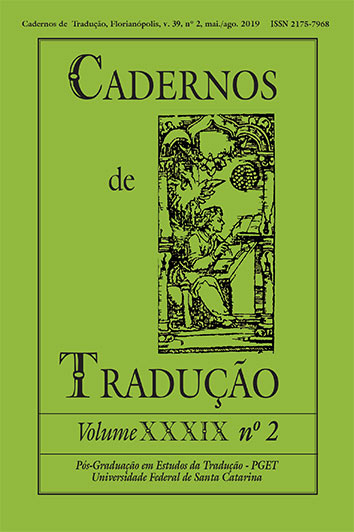
Villela, L. M. (2019). Entrevista com Pablo Romero-Fresco. Cadernos De Tradução, 39(2), 316–325. https://doi.org/10.5007/2175-7968.2019v39n2p316
Issue
Section
Interviews
License
Copyright Notice
Authors hold the copyright and grant the journal the right for their articles' first publication, being their works simultaneously licensed under the Creative Commons Attribution License (CC BY), which allows the sharing of such works with its authorship acknowledged and its initial publication in this journal.
Authors are allowed to enter into separate additional contractual arrangements for the non-exclusive distribution of the journal's published version of the work (e.g., post it to an institutional repository or as a book chapter, with an acknowledgment of its initial publication in this journal).