
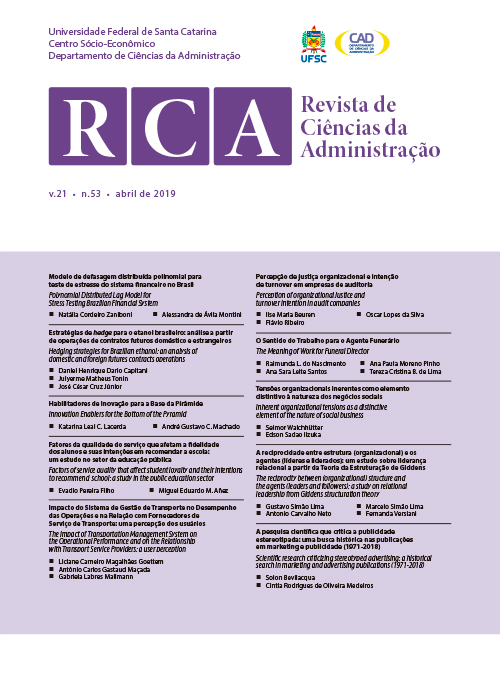
The Meaning of Work for Funeral Director
DOI:
https://doi.org/10.5007/2175-8077.2019V21n53p112Abstract
The aim of this article is to investigate the meaning of work for funeral director. This is a descriptive and qualitative study. The data were collected through interviews with semi-structured script and analyzed through lexical analysis and content. It is observed that, despite the difficulties and limitations of his professional performance, the funeral director finds meaning in their work, mainly through the valuation and recognition of his service by customers. This research contributes to studies on the meaning of work, especially with socially devalued professionals who are considered "dirty", in addition to expanding the discussion about the importance of work for individuals that, despite having no pleasure in performing their activities, seek to perform well due to other elements. New categories are proposed for complementing the theme, such as satisfaction and preconception.References
ANDRADE, S. P. C.; TOLFO, S. R.; DELLAGNELO, E. H. L. Sentidos do trabalho e racionalidades instrumental e substantiva: interfaces entre a administração e a psicologia. Revista de Administração Contemporânea, v. 16, n. 2, p. 200-216, 2012.
ANTUNES, R. L. C. Os sentidos do trabalho: ensaio sobre a afirmação e a negação do trabalho. 3. ed. São Paulo: Boitempo Editorial, 1999.
ASHFORTH, B. E.; KREINER, G. E.; CLARK, M. A.; FUGATE, M. Congruence work in stigmatized occupations: A managerial lens on employee fit with dirty work. Journal Organizational Behavior, v. 38, n. 8, p. 1260-1279, 2017.
BASTOS, A. V. B.; PINHO, A. P. M.; COSTA, C. A. Significado do trabalho: um estudo entre trabalhadores inseridos em organizações formais. RAE, v. 35, n. 6, p. 20-29, 1995.
BATISTA, A. S.; CODO, W. Dirty work and stigma: caretakers of death in cemeteries. Revista de Estudios Sociales, n. 63, p. 72-83, 2018.
BEUKES, I.; BOTHA, E. Organisational commitment, work engagement and meaning of work of nursing staff in hospitals. SA Journal of Industrial Psychology, v. 39, n. 2, p. 1-10, 2013.
BITENCOURT, B. M.; GALLON, S.; BATISTA, M. K.; PICCININI, V. C. Para além do tempo de emprego: o sentido do trabalho no processo de aposentadoria. Revista de Ciências de Administração, v. 13, n. 31, p. 30-57, 2011.
BORGES, L. O. Os atributos e a medida do significado do trabalho. Psicologia: teoria e pesquisa, v. 13, n. 2, p. 211-220, 1997.
BORGES, L. O.; TAMAYO, A. A estrutura cognitiva do significado do trabalho. Revista Psicologia, v. 1, n. 2, p. 11-44, 2001.
CÂMARA, C. M. C. Os agentes funerários e a morte: o cuidado presente diante da vida ausente. 2011. 166 f. Dissertação (Mestrado em Psicologia) – Programa de Pós-Graduação em Psicologia, Universidade Federal do Rio Grande do Norte, Natal, 2011.
CAMARGO, B. V.; JUSTO, A. M. IRAMUTEQ: um software gratuito para análise de dados textuais. Temas em Psicologia, v. 21, n. 2, p. 513-518, 2013.
CANHOLI JÚNIOR, C.; LIMA, T. C. B.; LIMA, M. A. M.; VIANA, L. M. M. V. Sentidos do trabalho para trabalhadores do saneamento básico. In: ENCONTRO DA ASSOCIAÇÃO NACIONAL DE PÓS-GRADUAÇÃO E PESQUISA EM ADMINISTRAÇÃO, 40., 2016, Costa do Sauípe. Anais [...]. Costa do Sauípe: UFBA, 2016. p. 1-19.
CASTRO, E. T. Aqui jaz uma morte: atitudes fúnebres na trajetória da empresa funerária da família Haas de Blumenau. 2013. 399 f. Tese (Doutorado em História) – Programa de Pós-Graduação em História, Universidade Federal de Santa Catarina, Florianópolis, 2013.
COLLIS, J.; HUSSEY, R. Pesquisa em Administração: um guia prático para alunos de graduação e pós-graduação. 2. ed. Porto Alegre: Bookman, 2005.
COUTINHO, M. C. Sentidos do trabalho contemporâneo: as trajetórias identitárias como estratégia de investigação. Cadernos de Psicologia Social do Trabalho, v. 12, n. 2, p. 189-202, 2009.
CRESWELL, J. W. Projeto de pesquisa: métodos qualitativo e quantitativo. 3. ed. Porto Alegre: Artmed, 2010.
DENZIN, N. K.; LINCOLN, Y. S. O planejamento da pesquisa qualitativa: teoria e abordagens. Tradução de Sílvia Regina Netz. 2. ed. Porto Alegre: Artmed, 2006.
FARINA, A. S.; ANTUNES, A. D. A.; YOKOMIZO, J. E.; ARIENTE, L. A. A morte como trabalho, um estudo com agentes funerários da Grande São Paulo. In: CARVALHO, A. M.; FARINA, A. S.; FRANCO, E. M.: STELLA, C.; GARÇÃO, J.; RUSCHE, R. S; SIQUEIRA, V. (org.). Temas contemporâneos em Psicologia do Cotidiano. São Paulo: Editora Expressão e Arte, 2009. p. 35-58.
FORSYTH, C. J.; PALMER, C. E.; SIMPSON, J. Funeral director: maintaining business, reputation and performance. Free Inquiry in Creative Sociology, v. 34, n. 2, p. 123-132, 2006.
FREITAS, H. M. R. de; CUNHA JÚNIOR, M.V.M. da; MOSCAROLA, J. Aplicação de sistema de software para auxílio na análise de conteúdo. RAUSP, São Paulo, v. 32, n. 3, p. 97-109, 1997.
GASKELL, G. Entrevistas individuais e grupais. In: BAUER, M. W.; GASKELL, G. (org.). Pesquisa qualitativa com texto, imagem e som: um manual prático. Petrópolis: Vozes, 2002. p. 64-89.
GELDENHUYS, M., ŁABA, K.; VENTER, C. M. Meaningful work, work engagement and organisational commitment. SA Journal of Industrial Psychology, v. 40, n. 1, p. 1-10, 2014.
GRAY, D. E. Pesquisa no mundo real. 2. ed. Porto Alegre: Penso, 2012.
HACKMAN, J. R.; OLDHAM, G. R. Development of the job diagnostic survey. Journal of Applied Psychology, v. 60, n. 2, p. 159-170, 1975.
HACKMAN, J. R.; OLDHAM, G. R. The job diagnostic survey: an instrument for the diagnosis of jobs and the evaluation of job redesign projects. New Haven: Department of Administrative Sciences of Yale University, 1974. 87p.
KOVÁCS, M. J.; VAICIUNAS, N.; ALVES, E. G. R. Profissionais do serviço funerário e a questão da morte. Psicologia Ciência e Profissão, v. 34, n. 4, p. 940-954, 2014.
MAKKAWY, A.; SCOTT, C. Dirty work. In: SCOTT, C. R.; BARKER, J. R.; KUHN, T.; KEYTON, J.; TURNER, P. K.; LEWIS, L. K. (ed.). The international encyclopedia of organizational communication, 2017. p. 1-8.
MARTINS, G. de A. Estudo de caso: uma estratégia de pesquisa. 2. ed. São Paulo: Editora Atlas, 2008.
MORIN, E. M. Os sentidos do trabalho. RAE, São Paulo, v. 41, n. 3, p. 8-19, 2001.
MORIN, E. M. Fator humano: os sentidos do trabalho. RAE Executivo, v. 1, n. 1, p. 71-75, 2002.
MORIN, E. M.; TONELLI, M. J.; PLIOPAS, A. L. V. O trabalho e seus sentidos. In: ENCONTRO DA ASSOCIAÇÃO NACIONAL DE PÓS-GRADUAÇÃO E PESQUISA EM ADMINISTRAÇÃO, 27., 2003, Atibaia. Anais [...]. Atibaia, 2003. p. 1-16.
MORIN, E. M.; TONELLI, M. J.; PLIOPAS, A. L. V. O trabalho e seus sentidos. Psicologia e Sociedade, v. 19, n. spe, p. 47-56, 2007.
MORSE, N. C.; WEISS, R. S. The function and meaning of work and the job. American Sociological Review, v. 20, n. 2, p. 191-198, 1955.
MOW INTERNATIONAL RESEARCH TEAM. The meaning of working. London: Academic Press, 1987.
NASCIMENTO, A. R. A. do; MENANDRO, P. R. M. Análise lexical e análise de conteúdo: uma proposta de utilização conjugada. Estudos e Pesquisas em Psicologia, ano 6, n. 2, p. 72-88, 2006.
OLIVEIRA, S. R.; PICCININI, V. C.; FONTOURA, D. S.; SCHWEIG, C. Buscando o sentido do trabalho. In: ENCONTRO DA ASSOCIAÇÃO NACIONAL DE PÓS-GRADUAÇÃO E PESQUISA EM ADMINISTRAÇÃO, 28., 2004, Curitiba. Anais [...]. Curitiba, 2004. p. 1-16.
PRATT, M. G.; ASHFORTH, B. E. Fostering meaningfulness in working and at work. In: CAMERON, K. S.; DUTTON, J. E.; QUINN, R. E. (ed.). Positive Organizational Scholarship. San Francisco: Berrett-Koehler Publishers, Inc, 2003. p. 309-327.
RIBAS, V.; GOMES, F. A. Trabalhadores da morte – dilemas éticos. O Mundo da Saúde, v. 36, n. 1, p. 86-89, 2012.
RODRIGUES, A. L.; BARRICHELLO, A.; IRIGARAY, H. A. R.; SOARES, D. R.; MORIN, E. M. O trabalho e seus sentidos: um estudo com peritos criminais da Polícia Federal. RAP, v. 51, n. 6, p. 1058-1084, 2017.
RODRIGUES, A. L.; BARRICHELLO, A.; MORIN, E. M. Os sentidos do trabalho para profissionais de enfermagem: um estudo multimétodos. RAE, v. 56, n. 2, p. 192-208, 2016.
RODRIGUES, C. M. L.; SANTANA, G. B. M.; SILVA, J. C. F. da; DUARTE, J. M. M.; NOGUEIRA, L. F. da S.; ARAÚJO, P. H. R.; SILVA, Y. S. G. da. Trabalhando com a morte: bem-estar no trabalho de agentes funerários. Revista Laborativa, v. 5, n. 1, p. 4-17, 2016.
RODRIGUES, J. C. Tabu da morte. Rio de Janeiro: Editora FIOCRUZ, 2006.
ROSSO, B. D.; DEKAS, K. H.; WRZESNIEWSKI, A. On the meaning of work: A theoretical integration and review. Research in Organizational Behavior, v. 30, p. 91-127, 2010.
RUIZ, E. M.; CAVALCANTE, S. C. De “papa-defunto” a trabalhador: morte e trabalho no cotidiano dos agentes funerários. In: BORSOI, I. C. F.; SCOPINHO, R. A. (org.). Velhos trabalhos, novos dias: modos atuais de inserção de antigas atividades laborais. Fortaleza: Edições UFC, 2007. p. 219-251.
SILVA, A.; BASTOS, G. M. F.; LIMA, T. C. B. de; FERRAZ, S. F. de S.; CABRAL, A. C. de A. Sentido do trabalho e diversidade: um estudo com homossexuais masculinos. Revista ADM. MADE, v. 17, n. 2, p. 85-105, 2013.
SIQUEIRA, K. C. de L.; SILVA, J. M. da; ANGNES, J. S. “Cuidar de preso?!”: Os sentidos do trabalho para agentes penitenciários. Revista de Ciências de Administração, v. 19, n. 48, p. 84-95, 2017.
SOARES, D. C.; VIEIRA, A. O sentido do trabalho e a (re)construção de identidades: um estudo de caso em uma empresa de telefonia celular. In: ENCONTRO DA ASSOCIAÇÃO NACIONAL DE PÓS-GRADUAÇÃO E PESQUISA EM ADMINISTRAÇÃO, 33., 2009, São Paulo. Anais [...]. São Paulo, 2009. p. 1-15.
SOUZA, K. C. C.; BOEMER, M. R. O significado do trabalho em funerárias sob a perspectiva do trabalhador. Saúde e Sociedade, v. 7, n. 1, p. 27-52, 1998.
SPINELLI-DE-SÁ, J. G.; LEMOS, A. H. C. Sentido do trabalho: análise da produção científica brasileira. Revista ADM.MADE, ano 17, v. 21, n. 3, p.21-39, 2017.
TOLFO, S. da R.; COUTINHO, M. C.; ALMEIDA, A. R. de; BAASCH, D.; CUGNIER, J. S. Revisitando abordagens sobre sentidos e significados do trabalho. In: FÓRUM CRITEOS, 1., 2005, Porto Alegre. Anais... Porto Alegre, 2005. p. 1-11.
TOLFO, S. da R.; PICCININI, V. Sentidos e significados do trabalho: explorando conceitos, variáveis e estudos empíricos brasileiros. Psicologia & Sociedade, v. 19, n. spe, p. 38-46, 2007.
Downloads
Published
How to Cite
Issue
Section
License
Copyright (c) 2019 Revista de Ciências da Administração

This work is licensed under a Creative Commons Attribution 4.0 International License.
The author must ensure:
- that there is complete consensus among all co-authors to approve the final version of the paper and its submission for publication.
- that their work is original, and if the work and/or words of others have been used, these have been duly acknowledged.
Plagiarism in all its forms constitutes unethical publishing behavior and is unacceptable. RCA reserves the right to use software or any other methods of plagiarism detection.
All submissions received for evaluation in the RCA journal are screened for plagiarism and self-plagiarism. Plagiarism identified in manuscripts during the evaluation process will result in the submission being archived. In the event of plagiarism being identified in a manuscript published in the journal, the Editor-in-Chief will conduct a preliminary investigation and, if necessary, retract it.
Authors grant RCA exclusive rights of first publication, with the work simultaneously licensed under the Creative Commons (CC BY) 4.0 International License.

Authors are authorized to enter into separate, additional contractual arrangements for the non-exclusive distribution of the version of the work published in this journal (e.g., publishing in an institutional repository, on a personal website, publishing a translation, or as a chapter in a book), with an acknowledgement of its authorship and initial publication in this journal.
This license grants any user the right to:
Share – copy, download, print, or redistribute the material in any medium or format.
Adapt – remix, transform, and build upon the material for any purpose, even commercially.
According to the following terms:
Attribution – You must give appropriate credit (cite and reference), provide a link to the license, and indicate if changes were made. You may do so in any reasonable manner, but not in any way that suggests the licensor endorses you or your use.
No additional restrictions – You may not apply legal terms or technological measures that legally restrict others from doing anything the license permits.
