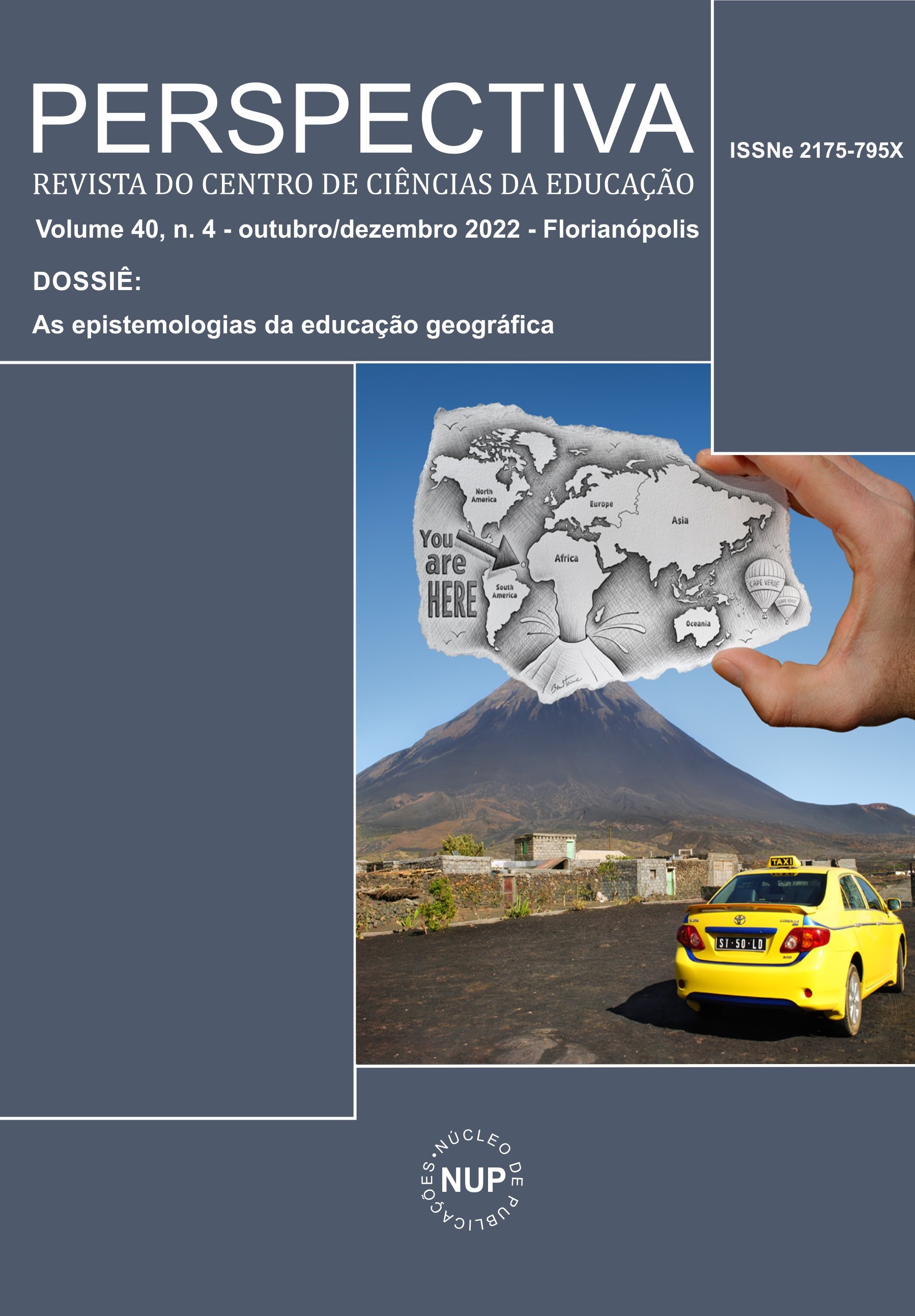
Ensaios sobre a pluralidade epistemológica da Geografia na escola
DOI:
https://doi.org/10.5007/2175-795X.2022.e91853Keywords:
Dossiê Perspectiva, 2022, Volume40 n 4Abstract
Em seu âmago, a Educação Geográfica constitui-se como conhecimento que estrutura a leitura do mundo, cumprindo uma função social importante, ao possibilitar múltiplas formas de compreender a realidade dos lugares onde se vive e das relações entre a sociedade e a natureza (CASTELLAR, 2017). E, se a Geografia é uma forma de pensar (GOMES, 2017) a reflexão epistemológica sobre o conhecimento geográfico e sobre a educação geográfica, questiona-se os paradigmas estruturais vigentes, métodos e teorias, trajetórias e também as relações que se estabelecem entre os sujeitos envolvidos e os objetos de análise que as sustentam. (continua)
References
CASTELLAR, Sonia M. V.; JULIASZ, Paula Cristiane S. Educação geográfica e pensamento espacial: conceitos e representações. Acta Geográfica, v. 1, 2017.
GOMES, Paulo César da Costa. Quadros Geográficos. uma forma de ver, uma forma de pensar. Rio de Janeiro: Bertrand Brasil, 2017.
BORNHEIM, Gerd. Crise da ideia de crise. In: NOVAES, Adauto (org.). A crise da razão. São Paulo: Companhia das Letras, 1996.
FOUCAULT, M. Verdade, poder e si mesmo. In: . Ditos e escritos: ética, sexualidade, política. v. V. Rio de Janeiro: Forense Universitária, 2004.
HOOKS, Bell. Ensinando a transgredir: a educação como prática da liberdade. 2 ed. São Paulo: editora WMF Martins Fontes, 2017.
Downloads
Published
How to Cite
Issue
Section
License
Copyright (c) 2022 Kalina Salaib Springer, Rosemy da Silva Nascimento, Francisco de Assis Gonçalves Junior

This work is licensed under a Creative Commons Attribution 4.0 International License.
This journal provides open access to all of it content on the principle that making research freely available to the public supports a greater global exchange of knowledge. Such access is associated with increased readership and increased citation of an author's work. For more information on this approach, see the Public Knowledge Project, which has designed this system to improve the scholarly and public quality of research, and which freely distributes the journal system as well as other software to support the open access publishing of scholarly resources. The names and email addresses entered in this journal site will be used exclusively for the stated purposes of this journal and will not be made available for any other purpose or to any other party.
The Perspectiva allow the author(s) yo hold the copyright without restrictions as well as publishing rights. If the paper will be republished later in another format, the author(s) should inform that it has originally been published as article in Perspectiva Journal and quote the complete references.

