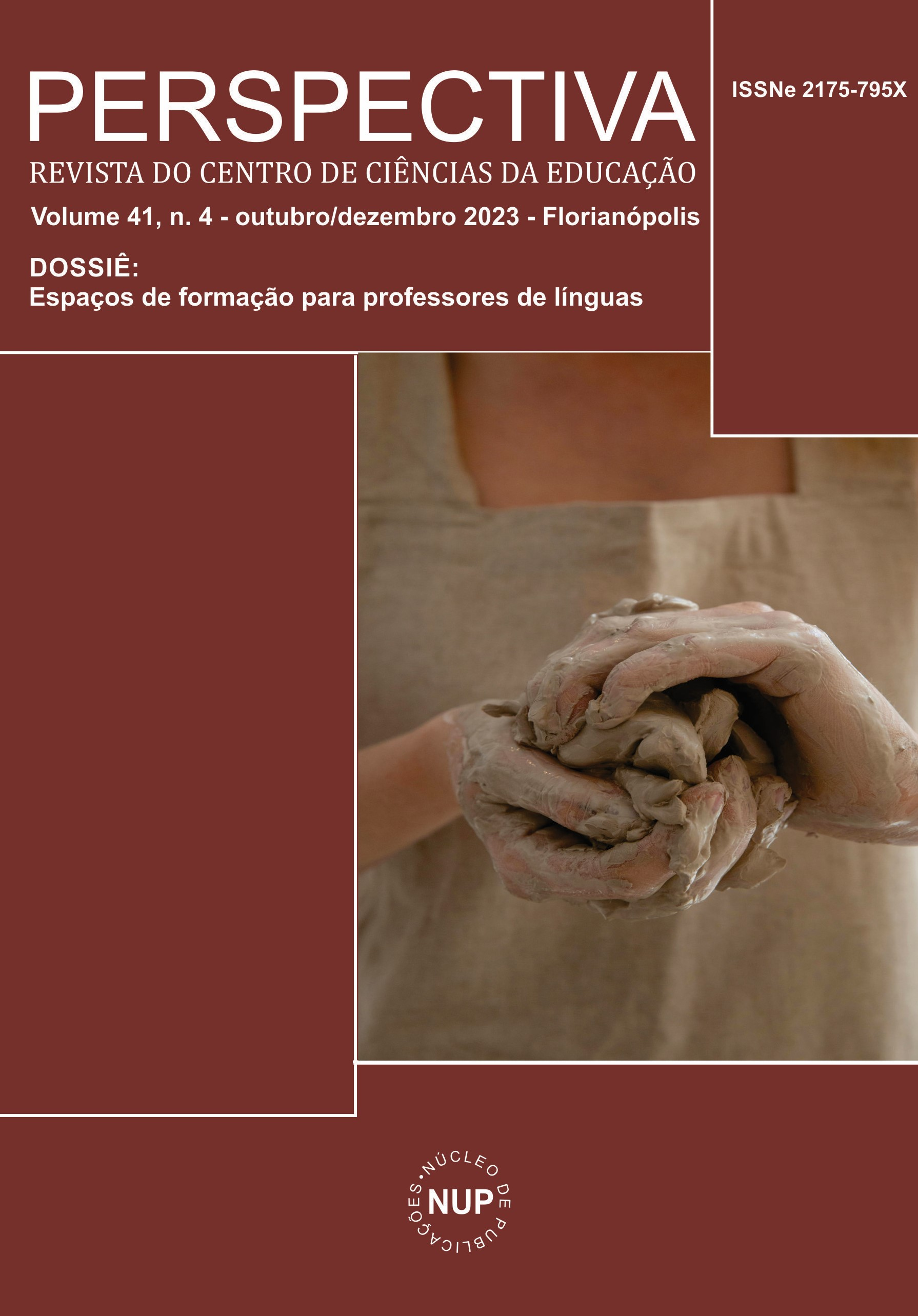
Training spaces for language teachers
DOI:
https://doi.org/10.5007/2175-795X.2023.e90644Keywords:
formação de professores, professores de idiomasAbstract
Considering the different contexts of language teaching, both in public and private spaces, in national and international contexts, this dossier brings together differentiated experiences and proposals that present multiple spaces of training for language teachers. Training spaces that operate on the basis of divergent thinking, as Rodari (1982) states, that use creativity allied to theoretical and practical knowledge, in favor of experiences that make a difference in teacher training. Curricular teaching, extension courses, study centers, institutional projects, webinars, lives are spaces that contribute to discussions about the teaching, spaces in which different conceptions of teaching, approaches, methodologies, and concepts such as interculture and decoloniality are discussed. By placing itself in different spaces of face-to-face and online training, of short or long duration, which address multiple contexts of teaching, the dossier aims to gather experiences from Brazil and abroad, in the field of languages, including indigenous languages and Libras, as well as the training experience in other countries that share the same questions and concerns about teacher training. From our experiences as students, we accumulate good and bad experiences that shape the professional we are. However, knowledge is not only formed in concrete experience, but is also nurtured by educational theories, "enabling the teacher to create 'schemes' that he/she mobilizes in his/her concrete situations, configuring his/her 'theoretical-practical' collection of experiences in a constant process of re-elaboration." (ALMEIDA & PIMENTA, 2014, p. 20). Leading the graduate to, from an early age, critically reflect on these experiences contributes to the conscious formation of this professional - teacher and educator, who does not focus only on teaching the target language, but facilitate access to the language-culture (MENDES, 2015), promote literacy and contribute to the formation of a critical student.
In undergraduate courses, the teaching practices are a privileged moment for future teachers, because in these training processes, many are the actors who share responsibilities and successes. The relationships and reflections that are established in the formative spaces and in the obligatory teaching practices can broaden the understanding about the knowledge of the teaching profession. The articles that make up this dossier are the fruit of these relationships and reflections. As Almeida and Pimenta (2014, p. 20) state, "teaching is a complex social praxis. Performed by human beings among human beings, it is modified by the action and relationship of subjects (teachers and students) situated in contexts (institutional, cultural, spatial, temporal, social), and, at the same time that it is modified in this contextualized relational process, it modifies the subjects involved in it."
This proposal brings together eight articles, each addressing the topic in different contexts of education. The first article seeks to understand the importance of the discipline Applied Linguistics in the initial training and practice of teachers of Libras who will work in the context of Basic Education, both with deaf students and listeners. In the second article, the authors present spaces and formative experiences involving indigenous language teachers in higher education. They analyze the formative journey of indigenous teachers at the Federal University of Santa Catarina, focusing on the relationship of these teachers with three indigenous languages - Guarani, Kaingang and Laklãnõ-Xokleng - in the context of the Intercultural Indigenous Graduation course. Our guests from other Brazilian institutions present the contexts of initial teacher training in three foreign languages considered minority, namely Italian, Japanese and French. In the third article, the Núcleo de Estudos em Língua Italiana (NELIB/CNPq) proposes a reflection about the necessary knowledge for Italian teachers to develop an intercultural/decolonial and emancipatory pedagogical practice in a world in constant transformation. The fourth article aims to identify the trajectory of Japanese language teaching and the development of teaching materials, considering the transformation over time, until today, in order to identify the current situation of Japanese language teaching in Brazil in a macro sense. The fifth article analyzes the process of professional development of a student of English as a Second Language during the implementation of a university extension project developed at a college of application of a Brazilian federal university, guided by a transdisciplinary perspective in order to sensitize young high school students to the importance of knowing the Brazilian biodiversity. In turn, the sixth article addresses questions about the relevance of continuing teacher education in the area of English, from a critical-discursive perspective in which it analyzes the teachers' discourse on continuing education in order to discuss issues related to the need for such training. Renowned colleagues from Italian and Argentine institutions also shared with us their reflections and activities on initial teacher training. The seventh article, written in Italian, discusses the nature of the teacher and his/her formation, questioning the knowledge and competencies this professional should have. Finally, the eighth article, written in Spanish, presents an innovative experience at the University of Rosario about Spanish language teaching ateliers for migrants and refugees from Haiti and Sierra León, a language teacher training space where topics such as immigration culture and critical interculturalism were worked on. By sharing the experiences and reflections of our colleagues, we believe that the thematic dossier proposed here will contribute with theoretical, pedagogical and practical knowledge in the area of language education and teacher training, serving professionals from the scientific, academic and school community.
References
ALMEIDA, Maria Isabel de., PIMENTA, Selma Garrido. Centralidade do estágio em cursos de Didática nas Licenciaturas: rupturas e ressignificações. In: ALMEIDA, Maria Isabel de., PIMENTA, Selma Garrido. (orgs). Estágios supervisionados na formação docente. São Paulo, Cortez, 2014.
RODARI, Gianni. Gramática da Fantasia. São Paulo: Summus, 1982.
MENDES, E. A ideia de cultura e sua atualidade para o ensino-aprendizagem de LE/L2. Revista EntreLinguas, Araraquara, v. 1, n. 2, p. 203–222, 2015. DOI: 10.29051/el.v1i2.8060. Disponível em: https://periodicos.fclar.unesp.br/entrelinguas/article/view/8060. Acesso em: 18 ago. 2022.
Downloads
Published
How to Cite
Issue
Section
License
Copyright (c) 2023 Clarissa Laus Pereira Oliveira, Daniela Bunn, Raquel Carolina Souza Ferraz D'Ely

This work is licensed under a Creative Commons Attribution 4.0 International License.
This journal provides open access to all of it content on the principle that making research freely available to the public supports a greater global exchange of knowledge. Such access is associated with increased readership and increased citation of an author's work. For more information on this approach, see the Public Knowledge Project, which has designed this system to improve the scholarly and public quality of research, and which freely distributes the journal system as well as other software to support the open access publishing of scholarly resources. The names and email addresses entered in this journal site will be used exclusively for the stated purposes of this journal and will not be made available for any other purpose or to any other party.
The Perspectiva allow the author(s) yo hold the copyright without restrictions as well as publishing rights. If the paper will be republished later in another format, the author(s) should inform that it has originally been published as article in Perspectiva Journal and quote the complete references.

