
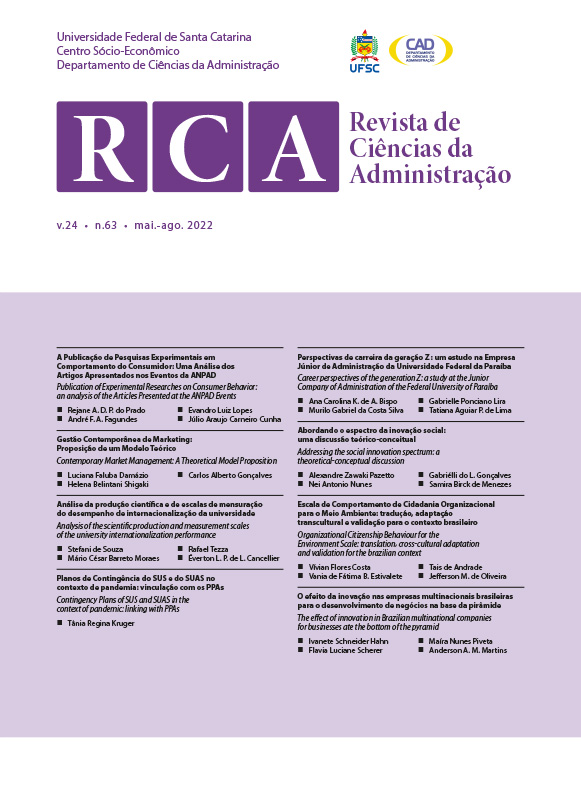
Perspectivas de carreira da geração Z
um estudo na Empresa Júnior de Administração da Universidade Federal da Paraíba
DOI:
https://doi.org/10.5007/2175-8077.2022.e82847Palavras-chave:
Carreira, Geração Z, Empresa Júnior, AdministraçãoResumo
A geração Z é composta por indivíduos antenados e inquietos, que estão constantemente buscando o novo. Objetivando compreender as perspectivas de carreira destes indivíduos, este estudo se concentrou na investigação de membros e ex-membros da Empresa Júnior de Administração, graduandos e egressos do curso de graduação em Administração da Universidade Federal da Paraíba. Por meio de uma abordagem qualitativa, a pesquisa teve duas fases: questionário de âncoras de carreira para traçar o perfil dos entrevistados e entrevistas com roteiro semiestruturado. Os resultados apontam que as âncoras mais presentes são (i) dedicação a uma causa, (ii) desafio puro e (iii) autonomia/independência, reforçando o perfil da geração Z, caracterizado pela inquietação, flexibilidade, inovação e busca por desafios. A carreira acaba sendo caracterizada por dúvidas, incertezas, falta de experiência e de planejamento de carreira eficaz. A Empresa Júnior apresenta-se também como um ambiente de desenvolvimento de competências e aprendizagem, aliando teoria e prática.
Referências
ARAÚJO, E. T.; MOREIRA, M. A.; GOMES, S. C.; AQUIME, M. L. P. Fatores de decisão de carreira durante a graduação. Revista de Carreiras e Pessoas, v. 8, n. 2, p. 151-171, 2018. DOI: https://doi.org/10.20503/recape.v8i2.35577
AVENI, A.; FIACO, R. M. D.; GOIS, T. C. Empresas Júnior: suas características com base nas pesquisas nacionais da Brasil Júnior e em Brasília no Distrito Federal. Universitas Gestão e TI, Brasília, v. 6, n. 1, p. 21-31, jan./jun. 2016. DOI: https://doi.org/10.5102/un.gti.v6i1.3902
BARANCHENKO, Y.; XIE, Y.; LIN, Z.; LAU, M. C. K.; MA, J. Relationship between employability and turnover intention: the moderating effects of organizational support and career orientation. Journal of management organization, v. 26, n. 2, pp. 241-262, 2020. DOI: https://doi.org/10.1017/jmo.2019.77
BARDIN, L. Análise de Conteúdo. São Paulo: Edições 70, 2016.
BRASIL JÚNIOR. Parecer Final Selo EJ 2014. Brasília: Confederação Brasileira de Empresas Juniores, 2014. Recuperado em 25 jul. 2020, de: https://issuu.com/brasiljunior/docs/selo_ej_-_edital_2014.
BRAVO, J.; SEIBERT, S. E.; KRAIMER, M. L.; WAYNE, S. Measuring career orientations in the era of the boundaryless career. Journal of Career Assessment, v. 6, p. 1-11, nov. 2015.
CHAPMAN, J. R. An empirically derived framework for conceptualizing Schein’s career orientation theory. Journal of Career Assessment, v.24, n. 4, p. 669-684, 2015. DOI: https://doi.org/10.1177/1069072715616107
CHUANG, N. K.; LEE, P. C.; KWOK, L. Assisting students with career decision-making difficulties: Can career decision-making self-efficacy and career decision-making profile help? Journal of Hospitality, Leisure, Sport & Tourism Education, v. 26, n.100235, jan. 2020. DOI: https://doi.org/10.1016/j.jhlste.2019.100235
CLOSS, L. S.; ROCHA-DE-OLIVEIRA, S. História de Vida e Trajetórias Profissionais: Estudo com Executivos Brasileiros. Revista da Adm. Contemporânea, v. 19, n. 4, p. 525-543, jul./ago. 2015. DOI: http://dx.doi.org/10.1590/1982-7849rac20151951
COLET, D. S.; MOZZATO, A. R. Nativos digitais: características atribuídas por gestores à geração Z. Desenvolve - Revista de Gestão do Unilasalle, v. 8, n. 25, 2019. DOI: http://dx.doi.org/10.18316/desenv.v8i2.5020
CORDEIRO, H. T. D.; FREITAG, B. B.; FISCHER, A. L. ALBUQUERQUE, L. G. A questão das gerações no campo da gestão de pessoas: tema emergente? Revista de Carreiras e Pessoas. São Paulo. v. 3, n. 2,p.2-18, mai./ago. 2013. DOI: https://doi.org/10.20503/recape.v3i2.16531
CORTELAZZO, L. BONESSO, S.; GERLIA, F.; BATISTA-FOGUET, J. M. Protean career orientation: Behavioral antecedents and employability outcomes. Journal of Vocational Behavior, v. 116, n. 103343, out. 2019. DOI: https://doi.org/10.1016/j.jvb.2019.103343
CSOBANKA, Z. E. The Z Generation. Acta Technologica Dubnicae, v. 6, n. 2, 2016. DOI: https://doi.org/10.1515/atd-2016-0012
DANTE, F. S.; ARROYO, R, F. Âncoras de carreira: por onde caminham as gerações? Revista de Carreiras e Pessoas, v. 7, n. 2, p. 512-528, mai./ago. 2017. DOI: https://doi.org/10.20503/recape.v7i2.32748
DAVIS, J.; WOLFF, H. G.; FORRET, M. L.; SULLIVAN, S. E. Networking via LinkedIn: An examination of usage and career benefits. Journal of Vocational Behavior, v. 118, n. 103396, jan. 2020. DOI: https://doi.org/10.1016/j.jvb.2020.103396
DELUCA, G.; ROCHA-DE-OLIVEIRA, S. Inked careers: Tattooing professional paths. Brazilian Administration Review, v. 13, n. 4, 2016. DOI: http://dx.doi.org/10.1590/180 7-7692bar2016160081
DUTRA, J. S. Administração de carreiras. 1. ed. São Paulo: Atlas, 2012. EJA CONSULTORIA. A empresa. Disponível em http://www.ejaconsultoria.com.br. Acesso em 05 jan. 2020.
ÉPOCA. As 10 habilidades profissionais que toda empresa vai exigir em 2020. Época Negócios Online, 2019. Disponível em: https://epocanegocios.globo.com/Carreira/noticia/2019/10/10-habilidadesprofissionais-que-toda-empresa-vai-exigir-em2020.html
ERASMUS, B. Perceptions of administrative staff on career advancement realities at a South African university. Journal of Contemporary Management Issues, v. 25, n. 1, p. 69-88, abr. 2020. DOI: https://doi.org/10.30924/mjcmi.25.1.4
GRANGEIRO, R. R.; NADAE, J.; BARRETO, A. J. T. P. Produção científica sobre carreira em periódicos de Administração: uma análise bibliométrica. Caderno Profissional de Administração UNIMEP, v. 9, n. 1,jan./jun. 2020.
GIL, A. C. Como elaborar projetos de pesquisa (4. ed.). São Paulo: Atlas, 2002.
GUBLER, M.; BIEMANN, T.; TSCHOPP, C.; GROTE, G. How career anchors differentiate managerial career trajectories. Journal of Career Development, v. 42. n.5, p. 412-430, mar. 2015. DOI: https://doi.org/10.1177/0894845315572891
IORGULESCU, M. Generation Z and its Perception of Work. Cross-Cultural Management Journal, v. 18, n. 1, p. 47-54, 2016.
KIANI, A.; LIU, J.; GHANI, U.; POPELNUKHA, A. Impact of future time perspective on Entrepreneurial Career Intention for Individual Sustainable Career Development: the Roles of Learning Orientation and Entrepreneurial Passion. Sustainability, v. 12, n. 3864, p. 1-18, mai. 2020. DOI: https://doi.org/10.3390/su12093864
LEAL, M. S. F.; MELO, F. J. C. d.; SOBRAL, E. F. M.; CARNEIRO, J. S. Planejamento e âncora de carreira: um estudo com discentes do Curso de Administração da Universidade de Pernambuco - Campus Salgueiro. Research, Society and Development, v. 10, n. 2, p. 1-15, fev. 2021. DOI: http://dx.doi.org/10.33448/rsd-v10i2.12350
MAGALHÃES, M.; de O.; BENDASSOLLI, P., F. Desenvolvimento de carreira nas organizações. In: BORGES, L., de O., MOURÃO, L. O trabalho e as organizações: atuações a partir da Psicologia. Porto Alegre: Artmed, 2013. DOI: https://doi. org/10.1590/1413-73722407316
MATTHEWMAN, J. Os novos nômades globais. São Paulo: Clio Editora, 2012.
MEDEIROS, M. C.; MIRANDA, R. C. R. Pesquisa sobre empresas juniores em instituições de ensino superior do Distrito Federal: estudo de caso com foco no Centro Universitário IESB. Revista Gestão e Secretariado, v. 9, n. 3, p. 151-177, set./dez. 2018. DOI: https://doi.org/10.7769/gesec.v9i3.790
MELO, A. O.; TAVARES, M. V. B.; FÉLIX, B. S.; SANTOS, A. C. B. Identidade da geração Z na gestão de startups. Revista Alcance – Eletrônica, vol. 26, n. 3, set./dez. 2019. DOI: https://doi.org/10.14210/alcance.v26n3(Set/Dez).p320-333
MENDES, T.; FRAGA, P.; OLIVEIRA, I. Empresa júnior na atuação do profissional consultor de Biblioteconomia: um estudo de caso a partir da Universidade Federal de Goiás. Encontros Bibli: Revista Eletrônica de Biblioteconomia e Ciência da Informação, v. 23, n. esp., p. 25-40, 2018. DOI: https://doi.org/10.5007/1518-2924.2018v23nespp25
MERRIAM, S. B. Qualitative research: a guide to design and interpretation. San Francisco: JosseyBass, 2009.
MIANO, V. Y.; VIEIRA, F. O. Perspectivas de carreira dos formandos de Administração de uma IFES. Revista Pensamento Contemporâneo em Administração, v. 6, n. 1, p. 72-90, jan./mar. 2012. DOI: https://doi.org/10.12712/rpca.v6i1.114
MINAYO, M. C. Análise qualitativa: teoria, passos e fidedignidade. Ciência & Saúde Coletiva, v. 17, n. 3, p. 621-626, 2012. DOI: https://doi.org/10.1590/S1413-81232012000300007
MONTEIRO, M. S. H.; LEITE, D. B. Perspectivas de carreira dos estudantes de Administração da Universidade Federal de Mato Grosso: comparativo entre os estudantes das gerações X e Y. Navus – Revista de Gestão e Tecnologia, v. 9, n. 1, p. 87-104, jan./mar. 2019. DOI: http://dx.doi.org/10.22279/navus.2019.v9n1.p87-104.780
MOREIRA, S. A. S.; ARAÚJO, B. F. V. B. Homens e mulheres da geração Y e suas âncoras de carreira. Desenvolvimento em Questão, Editora Unijuí, v. 16, n. 42, p. 621-650, jan./mar. 2018. DOI: https://doi.org/10.21527/2237-6453.2018.42.621-650
OLIVEIRA, S. Jovens para sempre: como entender os conflitos de gerações. São Paulo: Integrare Editora. 128 p. 2012.
REIS, T. A.; GRAZIANO, G. O.; OSVALDO, Y. C. Como as âncoras de carreira de Edgar Schein influenciaram na escolha da carreira feita por alunos de universidade do interior de São Paulo. Revista de Carreiras e Pessoas, v. 7, n. 1, p. 374-386, jan./ abr. 2017. DOI: https://doi.org/10.20503/recape.v7i1.32651
RIBEIRO, J.; SOUZA, F. N.; LOBÃO, C. Saturação da análise na investigação qualitativa: Quando parar de recolher dados? Revista Pesquisa Qualitativa, São Paulo, v. 6, n. 10, p. 3-5, abr. 2018a.
RIBEIRO, R. P. D.; NUNES, S. C.; LOPES, H. E. G. As carreiras proteana e sem fronteiras e as âncoras de carreira: um estudo com profissionais da área de Saúde em Minas Gerais. Gestão & Regionalidade, v. 34, n. 102, set./dez. 2018b. DOI: https://doi.org/10.13037/gr.vol34n102.4249
ROSA, M. V. F. P. C; ARNOLDI, M. A. G. C. A entrevista na pesquisa qualitativa: mecanismo para validação dos resultados. Belo Horizonte, 2 ed, Autêntica, 2014.
RYERSON, L. 10 jobs that on’t exist 20 years from now. Insider, mai. 2019. Disponível em: https://www.insider.com/jobs-going-extinct-2018-5#retailjewelers-3. Acesso em: 22 jul. 2020
SAVELA, A. E.; O’BRIEN, K. M. Predicting College Women’s Career Plans: instrumentality, work, and family. Journal of Career Development, v. 43, n. 4, p. 335–348, out./dez. 2016. https://doi.org/10.1177/0894845315602118
SCHAWBEL, D. Meet the Next Wave of Workers Who Are Taking over Your Office. CNBC, 2016. Disponível em: https://www.cnbc.com/2016/08/31/after-millennials-comes-gen-z-meet-the-nextwave-of-workers-that-are-taking-overyour-officecomment ary.html. Acesso em: 19 mai. 2020.
SCHEIN, E. H. Career anchors: discovering your real values. San Diego: University Associates, 1990.
SCHEIN, E. H. Career anchors and job/role planning: the links between career planning and career development. In: MONTROSS, D. H.; SHINKMAN, C. J. (Ed.). Career development: theory and practice. Springfield: Charles C. Thomas, 1993. p. 207-218.
SCHEIN, E. H. Career anchors revisited: implications for career development in the 21st century. Academy of Management Perspectives, v. 10, p. 80-88, 1996.
SCHEIN, E. H.; VAN MAANEN, J. Career anchors and job/role planning. Organizational Dynamics, v. 45, n. 3, p. 165-173, 2016. DOI: http://dx.doi.org/10.1016/j.orgdyn.2016.07.002
SILVA, A. B.; COSTA, V. P.; DIAS, S. O. M. Determinantes do processo de aprendizagem no Programa Trainee da Empresa Júnior de Administração (EJA) da Universidade Federal da Paraíba (UFPB). RACE - Revista de Administração, Contabilidade e Economia (Online), v. 15, p. 275- 298, 2016a. DOI: https://doi.org/10.18593/race.v15i1.7573
SILVA, R. C.; TREVISAN, L. N.; VELOSO, E. F. R.; DUTRA, J. S. Âncoras e valores sob diferentes perspectivas da gestão de carreira. Revista Brasileira de Gestão de Negócios, v. 18, n. 59, p. 145-162, 2016b. DOI: https://doi.org/10.7819/rbgn.v18i59.2260
SILVA, A. P. M.; LOPES, L. F. D.; ROTILI, L. B.; FABRÍCIO, A.; CARNEIRO, L. Escolha e comprometimento de carreira: percepção de profissionais das gerações X e Y. Revista de Carreiras e Pessoas, v. 8, n. 1, p. 19-40, 2018. DOI: https://doi.org/10.20503/recape.v8i1.33002
SUBRAMANIAN, K. R. The Generation Gap and Employee Relationship. International Journal of Engineering and Management Research, v. 7, n. 6, p. 59-67, dez. 2017.
SULTANA, R.; MALIK, O. F. Is Protean Career Attitude Beneficial for Both Employees and Organizations? Investigating the Mediating Effects of Knowing Career Competencies. Front. Psychol, v. 10, n. 1284, jun. 2019. DOI: https://doi.org/10.3389/fpsyg.2019.01284
TAPSCOTT, D. A hora da geração digital: como os jovens que cresceram usando a internet estão mudando tudo das empresas aos governos. 1ª Ed. Rio de Janeiro: Agir Negócios, 2010.
VELOSO, E. F. R.; SILVA, R. C.; TREVISAN, L. N. T.; GOMES, D. F. N.; DUTRA, J. S. Momento social, valores e expectativa: como as mudanças econômicas influenciam a visão dos jovens sobre o trabalho? Revista Organizações em Contexto, v. 10, n. 19, p.279-305, 2014. DOI: https://doi.org/10.15603/1982-8756/roc.v10n19p279-305
VIEIRA, A.; MONTEIRO, P. R. M.; CARREIRI, A. P.; GUERRA, V. A.; BRANT, L. C. Um estudo das relações entre gênero e âncoras de carreira. Cadernos EBAPE.BR, v. 17, n. 3, p. 577-589, jul./set. 2019.
ZHITOMIRSKY-GEFFET, M.; BLAU, M. Crossgenerational analysis of predictive factors of addictive behavior in smartphone usage. Computers in Human Behavior, v. 64, p. 682-693, 2016. DOI: https://doi.org/10.1016/j.chb.2016.07.061
Downloads
Publicado
Como Citar
Edição
Seção
Licença
O autor deve garantir:
- que haja um consenso completo de todos os coautores em aprovar a versão final do documento e sua submissão para publicação.
- que seu trabalho é original, e se o trabalho e/ou palavras de outras pessoas foram utilizados, estas foram devidamente reconhecidas.
Plágio em todas as suas formas constituem um comportamento antiético de publicação e é inaceitável. RCA reserva-se o direito de usar software ou quaisquer outros métodos de detecção de plágio.
Todas as submissões recebidas para avaliação na revista RCA passam por identificação de plágio e autoplágio. Plágios identificados em manuscritos durante o processo de avaliação acarretarão no arquivamento da submissão. No caso de identificação de plágio em um manuscrito publicado na revista, o Editor Chefe conduzirá uma investigação preliminar e, caso necessário, fará a retratação.
Os autores cedem à RCA os direitos exclusivos de primeira publicação, com o trabalho simultaneamente licenciado sob a Licença Creative Commons (CC BY) 4.0 Internacional.

Os autores têm autorização para assumir contratos adicionais separadamente, para distribuição não exclusiva da versão do trabalho publicada neste periódico (ex.: publicar em repositório institucional, em site pessoal, publicar uma tradução, ou como capítulo de livro), com reconhecimento de autoria e publicação inicial neste periódico.
Esta licença permite que qualquer usuário tenha direito de:
Compartilhar – copiar, baixar, imprimir ou redistribuir o material em qualquer suporte ou formato.
Adaptar – remixar, transformar e criar a partir do material para qualquer fim, mesmo que comercial.
De acordo com os seguintes termos:
Atribuição – Você deve dar o crédito apropriado (citar e referenciar), prover um link para a licença e indicar se mudanças foram feitas. Você deve fazê-lo em qualquer circunstância razoável, mas de maneira alguma que sugira ao licenciante apoiar você ou o seu uso.
Sem restrições adicionais – Você não pode aplicar termos jurídicos ou medidas de caráter tecnológico que restrinjam legalmente outros de fazerem algo que a licença permita.
