Investigando o papel do monitoramento cognitivo-discursivo e da meta-reflexão na formação de tradutores.
DOI:
https://doi.org/10.5007/%25xResumo
Partindo de abordagens cognitivas e discursivas dos estudos da tradução, este artigo visa a um refinamento de proposta didática, feita em estudos anteriores (Alves, Magalhães e Pagano, 2002; Alves e Magalhães, 2004), para o desenvolvimento de competências em tradução por meio do incremento de uma interface cognitivo-discursiva. Seu objetivo é analisar retextualizações e relatos retrospectivos produzidos por tradutores novatos cuja formação inicial se fundamentou na aquisição de conhecimentos declarativos sobre a linguagem e na reflexão sobre seus próprios processos de tradução. No desenvolvimento das competências destes tradutores novatos no contexto da sala de aula, foram usados conceitos das abordagens sistêmica e cognitiva dos estudos da tradução. Posteriormente, analisaram-se seus relatos retrospectivos com o suporte da análise crítica do discurso. Os métodos usados foram a prática de leitura crítica com base nos conceitos de coesão, registro e gênero; e de escrita crítica, com base em reflexão sobre o processo cognitivo auxiliado pelo uso do software Translog. Posteriormente, procedeuse à análise crítica do hibridismo de tipos textuais, gêneros e discursos nos relatos retrospectivos dos tradutores. Os resultados mostram que há efeitos positivos de desenvolvimento do conhecimento declarativo e da meta reflexão dos tradutores novatos, interpretados através da configuração genérica dos relatos e dos discursos neles construídos.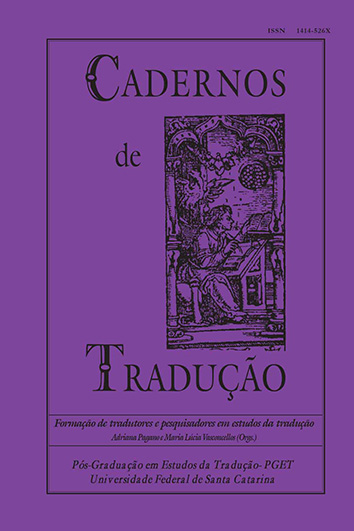
Downloads
Publicado
30-04-2006
Como Citar
Magalhães, C., & Alves, F. (2006). Investigando o papel do monitoramento cognitivo-discursivo e da meta-reflexão na formação de tradutores. Cadernos De Tradução, 1(17), 71–127. https://doi.org/10.5007/%x
Edição
Seção
Artigos
Licença
Copyright (c) 2006 Cadernos de Tradução

Este trabalho está licenciado sob uma licença Creative Commons Attribution 4.0 International License.
Autores mantêm os direitos autorais e concedem à revista o direito de primeira publicação, com o trabalho simultaneamente licenciado sob a Licença Creative Commons Atribuição 4.0 Internacional (CC BY) que permite o compartilhamento do trabalho com reconhecimento da autoria e publicação inicial nesta revista.
Autores têm autorização para assumir contratos adicionais separadamente, para distribuição não exclusiva da versão do trabalho publicada nesta revista (ex.: publicar em repositório institucional ou como capítulo de livro, com reconhecimento de autoria e publicação inicial nesta revista).